


August 28, 2025 in Edelman Award Winner
From Underdogs to Gold Medalists: How USA Cycling Pedaled Predictive Analytics to the Podium
SHARE: PRINT ARTICLE: https://doi.org/10.1287/orms.2025.03.14

In the summer of 2024, under the glaring lights of the Paris Olympic velodrome, the U.S. Women’s Team Pursuit Cycling squad pulled off something extraordinary: a stunning gold medal win that shocked the cycling world and delighted a nation. But this wasn’t just a sports triumph – it was a victory for math, modeling and a small analytics team that revolutionized the way USA Cycling makes decisions.
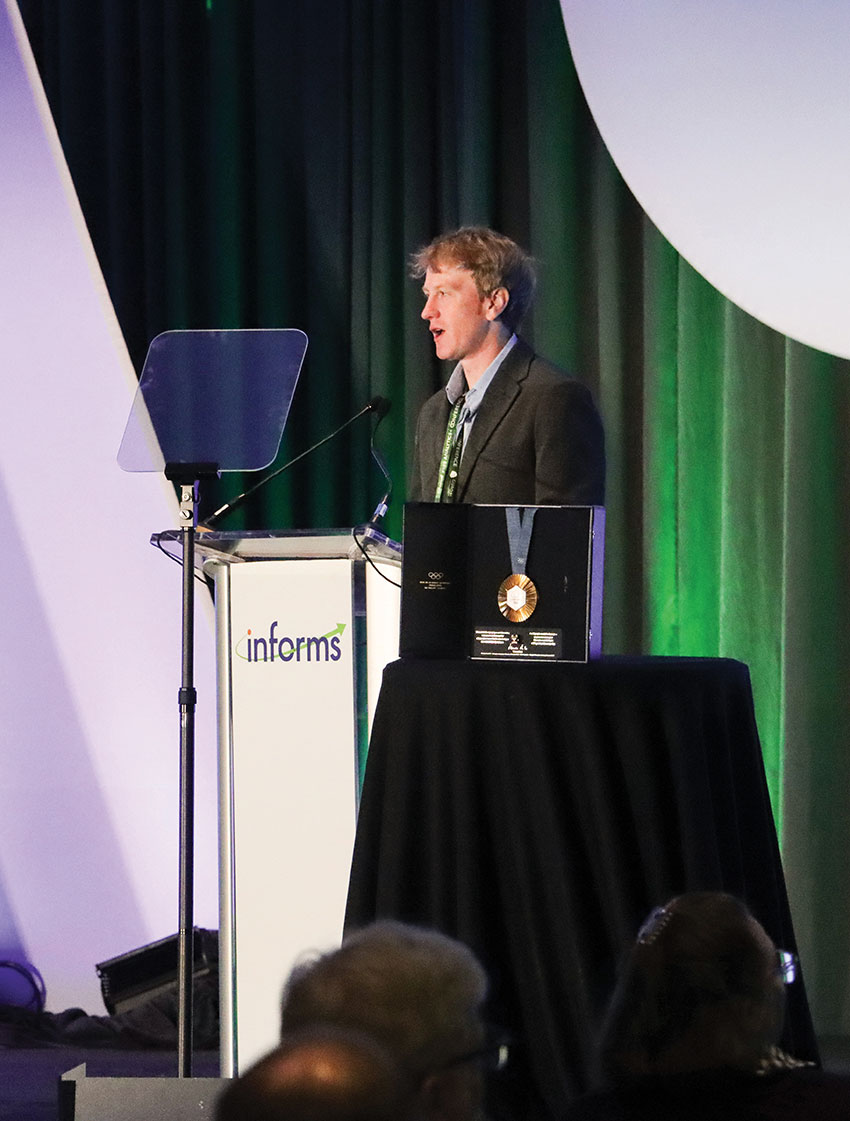 In April 2025, that same analytics dream team found themselves on an entirely different stage: the INFORMS Edelman Gala. There, their project was crowned the winner of the world’s most prestigious award in operations research and analytics – the Franz Edelman Award.
“It was shocking,” recalled Ryan Cooper, the lead data scientist behind the project. “Jim [Miller] kicked me under the table before they announced it and gave me a wink. I decided I’d better start writing an acceptance speech right then.”
Cooper, USA Cycling’s Senior Data Analyst, wasn’t exaggerating when he said they were surprised. In a room filled with inventory models and logistics optimization, USA Cycling’s Olympic-sized story of resilience and innovation stood out.
Edelman teammate and USA Cycling veteran Jim Miller called it a “double win.”
“Jim and I have been around awhile,” Cooper said, “and when you work with elite athletes and you work around sport, you get to see a lot of the highs and the lows. You see big wins, and what that feels like even being adjacent to that. Winning the Edelman, we got to feel that same feeling.”
A Different Kind of Race
At first glance, the pairing of elite cycling and analytics might seem odd. But Cooper’s and Miller’s stories – and that of USA Cycling – reveals just how deep the connection runs.
“Cycling’s actually been at the forefront of data science in sport for decades,” Cooper explained. “We’re talking heart rate monitors, power meters, lactate testing – it’s all physics, physiology, and numbers. The challenge wasn’t data. It was budget. We didn’t have the internal firepower to turn that data into decisions.”
That changed in 2023 when Cooper joined the organization, just months before the World Championships in Glasgow. The team had high hopes – and the early results to back them – but walked away with half the medals they’d projected. It was a turning point.
“We ran the numbers. We knew what the data said we were capable of. But on the day, the outcomes didn’t match,” Cooper said. “That forced us to ask, where did we go wrong – and what can we do better?”
Engineering Gold
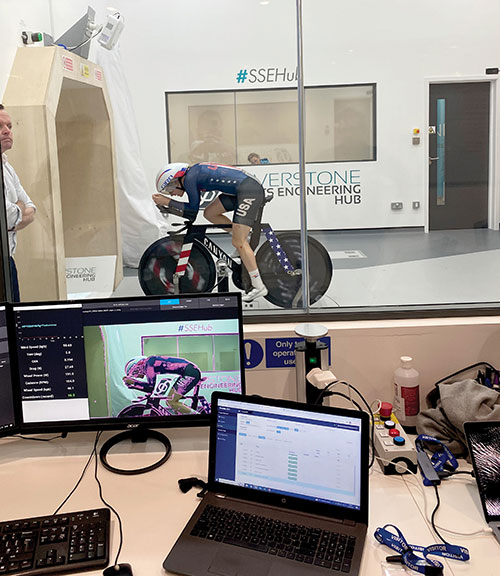 With only eight months until Paris, USA Cycling doubled down on its data-driven approach. The Women’s Team Pursuit squad became the focal point: a tight team of four riders racing in precise synchronization around a track.
The stakes were high, and the timeline tight. “We had the athletes, we had the talent, but we needed the model to show us the blueprint,” Cooper explained.
So that’s exactly what they built: a highly granular optimization model that simulated thousands of racing scenarios based on aerodynamics, power output, air density, rotation strategies and fatigue. Every data point mattered – from the riders’ physiology to the shape of the velodrome.
“We broke the race down into KPIs,” Cooper said. “Are you increasing power? Are you more aerodynamic? How fast are your lap transitions? And then we modeled exactly what it would take to hit our goal time. If you could check off all those KPIs, you could get the gold.”
This wasn’t a one-way equation. It was a real-time feedback loop. The model made predictions. The athletes tested them on the track. Data came back. The model evolved.
“It was very clear where the gaps were,” Cooper added. “For example, in Glasgow, one of our strongest riders, Chloe Dygert, ended up pulling the team for six or seven laps – which is pretty much unheard of. We knew we had to rethink the rotation strategy entirely.”
By the time the team hit the boards in Paris, every decision had been simulated, stress-tested and optimized. And the result? A first-place finish with Project 4:05 – and validation of a modeling framework that changed everything.
The Edelman Effect
Winning Olympic gold was just the beginning. The ripple effects of that medal and the analytics engine behind it have transformed USA Cycling from a lean, underfunded outfit into a leader in sports innovation.
The Edelman Award only accelerated that trajectory.
“It’s opened doors that we could only dream about before,” said Cooper. “Now we’ve got venture capital attention, a Tech & Innovation Committee with folks from OpenAI and Strava, and a strategic partnership with the U.S. Olympic & Paralympic Committee.”
USA Cycling has already secured $1.6 million in new annual funding, hired new analysts, and launched a data warehouse project with the USOPC. They’re even building tools that bring AI to the fingertips of coaches – natural language interfaces that can simulate different athlete scenarios at the click of a button.
“We call it the ‘death of dashboards,’” Cooper joked. “It’s the idea that coaches and directors shouldn’t need a data analyst sitting next to them to make sense of complex results. They should be able to say, ‘Run this model with these athletes under these conditions’ and get a meaningful, predictive output.”
Blending Science with Soul
What made the project Edelman-worthy wasn’t just the complexity of the model or the high-stakes outcome. It was the blending of technical rigor with human nuance.
“You’re dealing with real people – athletes who’ve dedicated their lives to this,” Cooper explained. “The model has to be crisp, but it also has to account for physiological variance, mental fatigue, even travel logistics. That’s where O.R. shines – it helps you manage all that complexity and uncertainty.”
Cooper’s journey into sports analytics began more than a decade ago. A former competitive triathlete, he first built a time trial simulation model as a side project while working at a consulting firm. In 2014, he launched the Best Bike Split platform. By 2015, USA Cycling came calling.
Miller has been involved with USA Cycling for every Olympics since 2004. When he caught wind of a mixed-integer programming model for time trial optimization that Cooper was working on, Miller knew he needed both Cooper and that model on his team.
“We ran all the time trial analysis for Kristen Armstrong for the Rio Olympics in 2016,” Cooper said. “She won her third gold. That was when I saw the blending of math and cycling come to life.”
Miller, now USA Cycling chief of sport performance, spent many years developing the next generation of American cyclists, earning the International Olympic Committee’s highest honor for coaches – the Order of Ikkos – three times, all for coaching three-time Olympic champion Armstrong to victory.
The Next Revolution: Talent ID
Looking ahead to the 2028 Summer Olympics in Los Angeles, USA Cycling has set an ambitious target: 10 medals, nearly doubling their Paris haul. To get there, they’re focusing not just on race-day strategy – but on revolutionizing how they discover talent.
“Our challenge is geographic,” said Cooper. “We’ve got the athletes, but very few facilities. We might have someone in Iowa who could dominate sprint track, but no track within 1,000 miles.”
The solution? Data.
USA Cycling is developing machine learning models to identify physiological profiles suited to different disciplines, exploring cross-training strategies, and using large language models (LLMs) to mine social and performance data for hidden gems.
One such gem? Kristen Faulkner. Originally an alternate for the road race, Faulkner was redirected to train on the track, despite having never raced the discipline. The model flagged her as a strong fit and she joined the pursuit team. Not only did she help win gold on the track, but her anaerobic improvements helped her break away and win gold in the road race as well.
“We have all the talent, we just don’t have the ability to get the athletes to the place where they can hone it,” said Cooper. “This is where we’re starting to look at how we can leverage data, machine learning and AI to identify talent for different funding levels.”
Changing the Game – And the Conversation
For Cooper, one of the most rewarding parts of the Edelman journey wasn’t just the recognition. It was the reaction from the analytics community – especially the next generation.
“Students came up to us at the conference and told us how excited they were about our project,” he said. “They saw a new way to apply what they’re learning – not just to business problems, but to human problems. They seemed excited that they could use O.R. to think outside the box.”
And while Cooper is bullish about AI’s potential, he’s clear-eyed about the challenges ahead.
“Giving these models access to solvers and tools? Huge multiplier. But you still need expertise. You need someone who knows the sport, the science, the math.”
At the end of the day, USA Cycling’s win wasn’t just a story of gold medals and predictive models. It was about what happens when data meets heart. When operations research steps out of the warehouse and into the arena. And when the underdogs dare to race like champions – backed by algorithms and driven by belief.
As Cooper put it: “We saw what was possible. Then we built the math to get there.”
