
October 26, 2025 in 2025 INFORMS Annual Meeting
Operations Research and Social Policy: Models that Can Make a Difference
SHARE: PRINT ARTICLE: https://doi.org/10.1287/orms.2025.04.03n
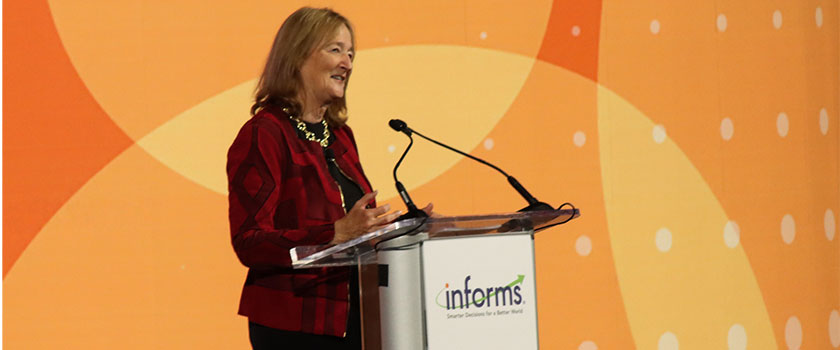
Margaret L. Brandeau, Coleman F. Fung Professor of Engineering and Professor of Health Policy at Stanford University, gave the opening plenary at the 2025 INFORMS Annual Meeting in Atlanta. Brandeau addressed one of the most pressing challenges in American society: how operations research can inform policy decisions tackling intertwined social crises – from the opioid epidemic and homelessness to criminal justice reform and healthcare inequity. The plenary set a reflective, purpose-driven tone for the conference, reminding attendees that OR/MS is not just about optimization algorithms, but about optimizing lives and communities.
Brandeau is a leader in applying mathematical and economic modeling to health policy decision-making. Over her distinguished career, she has worked on HIV prevention programs, opioid crisis response strategies, housing interventions for people experiencing homelessness and criminal justice diversion programs for drug offenders. Her research exemplifies how rigorous analytical frameworks can support policymakers who face incomplete data, limited resources and politically charged objectives.
She is an INFORMS Fellow and has received the Philip McCord Morse Lectureship Award, INFORMS President’s Award (recognizing contributions to societal welfare), as well as two Pierskalla Awards for research excellence in healthcare management science. Her work has also been recognized by the International Society for Pharmacoeconomics and Outcomes Research, and the Center for the Evaluation of Value and Risk in Health.
“Complex Dynamics Systems? Use O.R., my friend!”
Brandeau framed her talk around a central question: How can operations research guide effective policies for social problems marked by complexity, uncertainty and inequality? She emphasized that O.R.-based models provide a structured framework that leverages the best available evidence to evaluate alternative public programs. These models capture uncertainties, complexities and interactions that decision-makers must navigate, offering clarity where intuition and political rhetoric often fall short.
Brandeau was candid about the limitations: O.R. models are not silver bullets. They cannot replace political will or substitute community engagement. But they can illuminate trade-offs, quantify potential impacts and identify which interventions deliver the most benefit per dollar spent-critical insights when resources are scarce and stakes are high.
Key Insights
The Opioid Crisis: Dynamic Modeling for Resource Allocation
Brandeau described her work modeling the U.S. opioid epidemic, which has claimed over 80,000 lives annually in recent years. She outlined how compartmental models (spreadsheet simulation) can simulate the flow of individuals through different stages: non-use, prescription use, opioid use disorder (OUD), treatment and overdose death. These models help answer critical questions: Should policymakers prioritize prevention (limiting opioid prescriptions) or treatment expansion (medication-assisted therapy, naloxone distribution)? How do we balance harm reduction with enforcement? Brandeau’s research shows that prevention is most effective when opioid access rates are high, but even when overdose rates spike, investing in preventive interventions remains optimal if access rates exceed fatal overdose rates. Her work also highlights the importance of connecting individuals to community-based treatment programs, because the effectiveness of interventions heavily depends on follow-through and continuity of care.
Criminal Justice Reform: Diversion Programs for Drug Offenders
Brandeau shared findings from her analysis of criminal justice diversion programs, which redirect low-level drug offenders from incarceration into community-based treatment and support services. Programs like Law Enforcement Assisted Diversion (LEAD) in Seattle have shown promising results. Her cost-effectiveness analysis revealed that diversion programs substantially reduce criminal justice spending while only moderately increasing healthcare costs. More importantly, they reduce fatal overdoses, lower HIV and hepatitis C transmission, improve quality of life and decrease recidivism. Brandeau emphasized that the success of diversion programs hinges on effective linkage to community services, such as substance use disorder treatment, needle exchange programs and housing assistance. Without this connective tissue, diversion alone is insufficient.
Housing and Homelessness: Models for Prioritization and Resource Optimization
More than 653,000 people experience homelessness in the United States on any given night, facing compounded vulnerabilities like limited access to healthcare, exposure to violence and stigma. Brandeau discussed how O.R. models can support housing program design, including permanent supportive housing (PSH) and Housing First initiatives. She described predictive modeling approaches that identify high-cost service users within the homeless population – individuals who cycle through emergency rooms, jails and shelters at significant public expense. By prioritizing these individuals for housing, cities can achieve both humanitarian and fiscal benefits: reducing homelessness while offsetting costs through decreased emergency service utilization. Brandeau also addressed the challenge of equitable resource allocation, noting that models must account for social vulnerability indices to ensure investments reach the most marginalized populations.
Lessons for O.R. Modelers Working on Social Policy
Brandeau concluded with practical advice for O.R. professionals who want to contribute to social policy:
- Start with the decision-maker’s question, not the most sophisticated technique. Models must be useful, not just mathematically elegant.
- Embrace uncertainty transparently. Decision-makers need to understand the range of possible outcomes, not just point estimates.
- Build interdisciplinary partnerships. Effective policy modeling requires collaboration with public health experts, social workers, economists and community advocates.
- Be humble about what models can and cannot do. They inform decisions; they do not make them.
Reflection: A Call to Action for the OR/MS Community
The opening plenary was both sobering and inspiring. Brandeau’s examples illustrated the tangible human impact of O.R.-based policy analysis – fewer overdose deaths, more stable housing, reduced incarceration – but also underscored the enormous scale of social challenges that remain. The audience, a mix of academics, industry practitioners and students, responded with palpable energy. During the Q&A, questions ranged from technical (model calibration strategies) to philosophical (how to ensure model outputs don’t perpetuate structural inequities). Brandeau handled each with clarity and humility, reinforcing that O.R.’s greatest contribution to society may not be finding optimal solutions, but helping decision-makers make better choices in the face of complexity and constraint.
Final Takeaway
Professor Brandeau’s plenary reminded us why many in this field chose operations research in the first place: to apply rigorous thinking to messy, meaningful problems. As the 2025 INFORMS Annual Meeting continues, her message serves to guide the community that if we build with purpose, humility and an unwavering commitment to the people they are meant to serve, we can make a difference.
Koushik Mondal is a Ph.D. researcher in the Department of Industrial and Systems Engineering at the Indian Institute of Technology Kharagpur, where he focuses on modeling the growth of the unorganized pharmaceutical retail sector in India. He holds an M.Tech in Computer Integrated Manufacturing from the National Institute of Technology Warangal and a B.E. in mechanical engineering from the Indian Institute of Engineering, Science & Technology, Shibpur. He is an INFORMS member and served as a 2025 INFORMS NavigatOR.