
October 28, 2025 in 2025 INFORMS Annual Meeting
Delta Air Lines Showcases Human-Centered AI Innovation at INFORMS Annual Meeting
SHARE: PRINT ARTICLE: https://doi.org/10.1287/orms.2025.04.05n
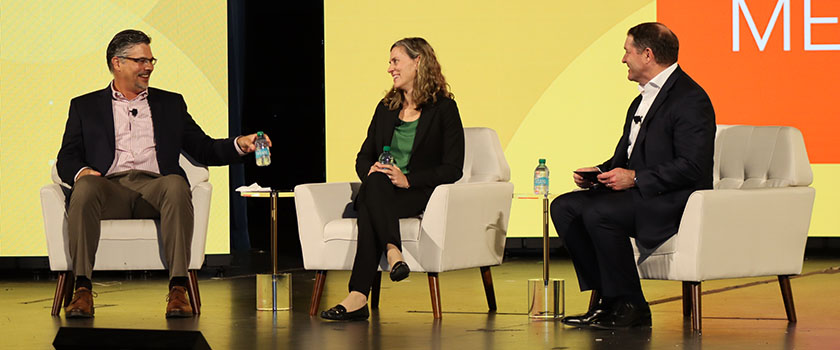
At the 2025 INFORMS Annual Meeting in Atlanta, attendees packed the plenary auditorium to hear Eric Phillips, Senior Vice President and Chief Digital Officer at Delta Air Lines, share how one of the world’s leading airlines is harnessing the power of operations research, data science and artificial intelligence (AI) to shape the next century of flight. As Delta celebrates its 100th anniversary, Phillips emphasized that the company’s success is built on both mathematical rigor and the human spirit that defines air travel.
Jayashankar (Jay) Swaminathan from the University of North Carolina at Chapel Hill welcomed attendees to the plenary and underscored the importance of connecting analytics with real-world decision-making, setting the stage for Delta’s story of human-centered digital transformation.
“The answer, as always, is math,” Phillips began, reflecting the analytical foundation of Delta’s global operation. However, he quickly added that Delta’s approach to AI is deeply human-centered. Rather than replacing people, the company uses technology to enhance safety, reliability and customer experience – keeping “people always at the center.”
Founded in 1925 as a crop-dusting business, Delta has grown into a global carrier operating 5,000 flights daily to 300 destinations, serving about 200 million customers each year. Phillips described this journey as “a century of connection,” noting that the centennial celebrates not only longevity but also a renewed commitment to innovation grounded in trust and service.
Airlines operate within one of the world’s most complex systems, in which scheduling, maintenance, airport logistics and customer needs intertwine under uncertainty. To manage that complexity, Delta relies on optimization, predictive analytics and AI to enhance operational efficiency and customer experience.
Phillips highlighted how Delta’s digital tools quietly orchestrate each journey. Every day, the airline manages roughly 250 million seats across 110,000 city pairs, with 3.5 billion pricing and scheduling optimizations performed nightly. Although invisible to travelers, these large-scale optimization systems embody operations research in action – dynamic, data-intensive and continually adaptive.
Among Delta’s latest innovations is Delta Concierge, a generative AI-powered personal assistant within the FlyDelta app. Concierge offers real-time travel updates and tailored guidance, functioning as a “digital red coat” – a nod to Delta’s iconic airport agents. “Imagine Concierge welcoming you, guiding you through TSA, helping you find your gate and suggesting a Sky Club stop,” Phillips said. “It’s not replacing people – it’s freeing them to focus on what matters most.”
Beyond customer tools, AI and machine learning are reshaping Delta’s operational core. Predictive maintenance helps technicians address aircraft issues before they disrupt schedules. At major hubs like Atlanta, Baggage AI applies real-time optimization – similar to Waze – to assign pickups at nearby gates, improving efficiency and cutting aircraft turnaround time by an average of 10 minutes.
Phillips invited colleagues Peter Butkowski, Managing Director of Operations, Digital, and Decision Science, and Amanda Bramlett, Head of Engineering Analytics at Delta TechOps, for a fireside chat offering a closer look at Delta’s analytics ecosystem.
Bramlett described how AI-driven predictive alerting now removes about 100 aircraft components monthly before failures occur, preventing delays. Her team, part of Delta’s Predictive Technology and Engineering division, also developed drone-based inspection tools. Delta became the first airline approved by the FAA to use drones for lightning strike inspections, reducing inspection time by 30% and returning aircraft to service faster.
Her group also built the SOAR platform, which uses large language models to consolidate maintenance data and surface key insights. A domain-specific BERT model powers AutoSearch, which retrieves repair histories and engineering references in seconds. “Our goal is to give technicians hours back,” Bramlett said. “The tools we build aren’t theoretical; they’re used daily by the people keeping aircraft safe and on schedule.”
Butkowski, who previously spent 15 years applying analytics at Disney, discussed how optimization and data science guide operational decisions – from crew pairing to gate assignments. He also said that there are three key components to run a good airline operation: 1) build a good plan, 2) anticipate the constraints of the day and 3) adjust the plan and execute as best as possible.
All three emphasized Delta’s investment in building a strong analytics community. Bramlett’s team includes professionals from diverse backgrounds (e.g., education, architecture and political science) demonstrating that success in data-driven aviation depends on curiosity and collaboration as much as technical skill. “Our work is visible,” she said. “We can see mechanics using what we’ve built, and it’s deeply rewarding.”
Butkowski added that Delta offers a unique environment for operations researchers seeking tangible results. “Our most important days are when operations look the worst,” he said. “That’s when our tools prove their worth – helping minimize disruptions and protect customers.”
In closing, Phillips addressed how Delta’s approach to AI differs from competitors. “We’re not using AI to replace human interaction – we’re using it to enhance it,” he said. From ticket counters to gates to boarding the aircraft, Delta’s people remain the company’s “secret sauce.” AI, in this vision, empowers employees to deliver more personalized, proactive and compassionate service.
“From our perspective at 30,000 feet,” Phillips concluded, “the future of travel is becoming increasingly intelligent – and fundamentally human.”
As Delta enters its second century, its vision of human-centered AI shows how the principles of operations research, optimization and analytics continue to drive innovation in one of the world’s most complex industries. In Phillips’ words, “Because we’ll never stop climbing.”
Jingjing Weng is a Ph.D. student in operations and supply chain management in the Department of Statistics, Operations, and Data Science at Temple University's Fox School of Business. She is a 2025 INFORMS NavigatOR.