
December 17, 2025 in AI & Aristotle
AI²: Escaping the AI Shallows with Aristotle’s Insight Loop
SHARE: PRINT ARTICLE: https://doi.org/10.1287/orms.2025.04.11

Is Generative AI Helping Us Make Smarter Decisions?
As a long-time member of INFORMS, and a CAP-X, I strongly believe in our shared mission to make smarter decisions for a better world. Beyond a tagline, it’s a guiding principle that defines how analytics should serve society. Most of the time, our tools – from optimization models to predictive algorithms – help us do exactly that: clarify uncertainty, sharpen reasoning and improve outcomes.
But the popularization of generative AI has raised new questions. Unlike traditional analytics, which are grounded in structured data and transparent logic, generative models offer speed and fluency – sometimes at the cost of depth and discernment. They summarize articles before we’ve read them, draft presentations before doing real analysis and generate fluent language that may sound insightful but lacks the structure required for analytical rigor.
Generative AI can help us get more done, but it is not a given that it will help us get more done better. When we offload too much of the reasoning process, we risk atrophying the skills that make great analysts: questioning assumptions, modeling relationships, testing logic and communicating nuance. The more we skip these steps, the weaker our cognitive muscles become.
So, we have to ask: Is generative AI helping us make smarter decisions or just more decisions, faster?
This article explores that question and introduces AI² – Aristotelian Insight amplified by Artificial Intelligence – as a constructive alternative: a way to use generative AI as a recursive thinking partner instead of a shortcut. We’ll explore how this model builds on centuries of structured reasoning, aligns with INFORMS’ mission, and transforms how we question, model, test, teach and communicate in the age of AI.
Shallow vs. Deep Thinking
Daniel Kahneman, Nobel laureate and author of “Thinking, Fast and Slow,” distinguishes two primary modes of thought. “System 1” is fast, automatic and intuitive. “System 2” is slow, deliberate and analytical.
In this article, we’ll refer to these simply as shallow versus deep thinking. Shallow thinking is efficient for everyday tasks but often superficial. Deep thinking is where structured insight, rigor and smart decisions are forged.
In today’s high-speed environments, generative AI often reinforces shallow thinking. Its fluent language and instant outputs make it easy to accept the first plausible answer without deeper scrutiny. But in analytics and decision science, fluency is not the same as rigor.
To make smarter decisions – the kind INFORMS champions – we need to engage more with deep thinking. That means refining our questions, testing our assumptions and building clarity step by step. Deep thinking enables analysts to catch errors, reason through uncertainty and apply structured logic, which are all core to analytic practice. The good news? Generative AI can help here too if we use it differently.
Instead of treating it as a tool for output, we can treat it as a tool for thought. That brings us to the core idea: using generative AI as a recursive thinking partner.
Generative AI as a Recursive Thinking Partner
Much of the scientific revolution was born in conversation, often in the coffeehouses of 17th- and 18th-century Europe. These spaces brought together disciplined thinkers from across domains – scientists, philosophers, mathematicians, engineers – to both refine ideas and confront them from different angles. A physicist might challenge a poet’s framing. A logician might disrupt a strategist’s assumptions. Their friction wasn’t a flaw – it was the sharpening stone. Recursion with diverse minds made ideas stronger.
Unlike today’s solitary, monotopic prompting, their conversations were recursive by design: structured loops of tension, contrast and refinement. Through these recursive dialogues, insights were sharpened like steel folded by an expert swordsmith, over and over until strong, elegant and clear. Those sharpened exchanges became the intellectual forge that helped shape modern science and systems thinking as we know them.
Today, we have something those thinkers never imagined: a thinking partner that’s always available, trained on vast amounts of global knowledge and capable of instant feedback. The question is whether generative AI can play the role those coffeehouse collaborators once did – helping us iterate, clarify and strengthen our ideas in real time.
The answer, in part, is yes [1]. In a 2023 Harvard Business Review (HBR) study, MBA students were asked to develop strategic plans. Those who used generative AI merely to produce content performed modestly. But those who used it to loop – question, refine, test and revise – produced higher-quality work with deeper insight and more originality. These students didn’t just ask AI for ideas; they used it to challenge their assumptions, test logic flows and refine their strategies iteratively.
The key insight wasn’t that AI produced better ideas – rather, structured looping with AI led to better thinking. When used this way, generative AI becomes a powerful accelerant for insight.
The Aristotelian Insight Loop
To better understand this recursive model, it helps to look back (roughly 2,500 years) to the birth of structured thinking in ancient Greece. That’s where we find the foundation of the looped reasoning process that still shapes science, strategy and modern decision-making.
Socrates taught us to surface assumptions through disciplined questioning. His student, Plato, introduced conceptual modeling and abstraction, tools for structuring complexity. Plato’s student, Aristotle, brought it all together: testing ideas against observation, teaching them in dialogue and preserving them in structured writing.
Together, they created a recursive framework for deep insight, the Aristotelian Insight Loop (see Figure 1). This five-part method of structured reasoning helped lay the foundation for science and systematic thought. It became the intellectual engine that powered everything from classical philosophy to the Enlightenment and modern analytics.
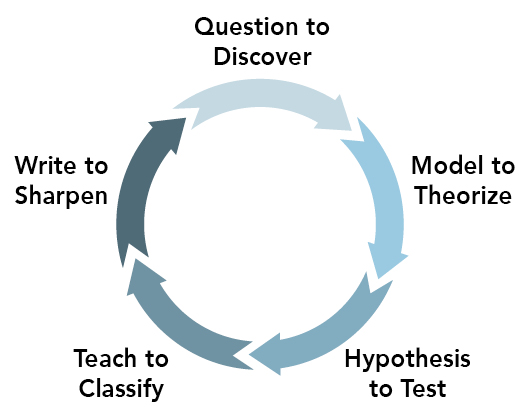
1. Question to Discover
Socrates believed wisdom began with recognizing what we didn’t yet understand. His method of inquiry (now called the Socratic Method) was more about surfacing untested assumptions than winning arguments. Today, this first stage mirrors how analysts define business problems or identify missing data, often using techniques like the Five Whys to uncover underlying causes. As with the Socratic Method, the goal is not vague complaints but sharp, humble curiosity. Modern learning science confirms that recognizing our own knowledge gaps – what psychologists call epistemic curiosity and metacognitive awareness – is a gateway to deeper learning and structured insight.
2. Model to Theorize
Plato’s legacy was abstraction. He built frameworks to explain justice, ethics and reality – conceptual models that gave shape to invisible patterns. In analytics, this step is just as crucial. Once we know what we don’t understand, we start sketching possibilities: influence diagrams, simulations, structured hypotheses. For instance, a supply chain analyst might model how weather disruptions affect inventory variability. We move from loose ideas to frameworks that help us make sense of complexity so that we can test them.
3. Hypothesize to Test
Aristotle’s genius was rigor. He didn’t stop at theory; he insisted ideas be tested. Observed. Measured. This is the foundation of modern analytics: the scientific method, causal inference, model validation. If questioning is humility and modeling is creativity, then testing is accountability. This principle (now known as falsifiability) became central to the scientific method, as formalized by philosopher Karl Popper. In this stage, we ask: Does our model work? Can it be falsified? What does the data say?
4. Teach to Clarify
Aristotle didn’t gather students to pass down finished truths – he brought them together to pursue truth through tension, dialogue and disciplined disagreement. His school, the Lyceum, was closer to a boxing ring than a lecture hall, where ideas were tested, countered and refined through intellectual sparring. Teaching meant confronting contradictions and clarifying what could not yet be fully explained. In this context, teaching wasn’t the end of knowing – it was how knowing happened. Teaching is recursive: As we explain something to others, we expose the gaps in our own logic. For analysts, this happens in design reviews, stakeholder briefings or team walkthroughs. Teaching forces clarity, disciplines intuition and turns complexity into structure.
5. Write to Sharpen
Aristotle wrote extensively, not to summarize, but to synthesize. Not as an afterthought, but as a final crucible for thinking. In analytics, writing does the same. Whether in reports, dashboards, executive summaries or even annotated code and model recommendations, we sharpen ideas through articulation. We carefully weigh our words to reduce ambiguity and preserve what matters most. Unlike the quick give-and-take of spoken conversation, writing formalizes ideas into shareable, inspectable forms – moving from shallow dialogue to structured insight. It enables others to think deeply with us, critique, refine and build upon our ideas. Through peer review, formal analysis and collaborative recursion, writing transforms isolated insight into collective progress – pushing ideas and decisions forward, making them better, stronger and ultimately, smarter.
This five-part loop, rooted in ancient insight, became the backbone of science, strategy and structured decision-making. Its power lies in recursion: Each pass clarifies assumptions, strengthens logic and improves decisions. Now, with generative AI, the same loop can be scaled and accelerated.
AI²: Accelerating the Aristotelian Insight Loop
AI² is the term we use for Aristotelian Insight amplified by Artificial Intelligence. It describes how the Aristotelian Insight Loop can be accelerated and democratized by generative AI, bringing structured reasoning to more people, quicker.
Today, AI enables us to engage with this loop at unprecedented speed and depth. What once required years of scholarly mentorship, handwritten drafts and painstaking debate can now be simulated, iterated and refined in hours or even minutes. AI doesn’t change the structure of the loop; it accelerates its cycle, expands access and deepens its application. AI delivers near-infinite speed and scope, personalized to your needs in real time. Instead of waiting for feedback or access to mentors, learners can instantly engage with the exact concepts they need – tailored to their stage in the loop and their depth of understanding.
Used intentionally, AI becomes a recursive thinking partner: immediate, individualized and always available. It invites more people into deeper thinking and gives every learner a partner for structured cognition. AI also opens the door to cross-disciplinary insight, connecting ideas from different fields through structured reasoning. Many of history’s greatest breakthroughs emerged this way, and generative AI makes that kind of lateral synthesis more accessible than ever.
As the earlier MBA student example from HBR shows [1], using AI recursively led to strategic plans that were both faster and more original than those produced through traditional methods.
AI now supports every phase of the loop:
- Questioning with deeper context and broader perspective
- Modeling with system maps and simulated environments
- Testing with access to global research and data
- Teaching through continuous feedback from AI dialogue
- Writing with real-time refinement and structure
Not every use of AI requires this depth. For operational summaries, basic reporting or task automation, generative AI can save time and streamline workflows. But when solving ambiguous problems, designing strategy or building models that influence real-world decisions, depth matters. In these moments, recursive structure is essential.
When used this way, in addition to accelerating cognition, AI² reinforces accountability. By walking through each phase of the Insight Loop, analysts build stronger, more traceable models. The structure encourages transparency in how assumptions are formed, tested and communicated, making decisions easier to defend and harder to obscure. In an era of black-box AI, recursive clarity becomes an ethical strength.
AI doesn’t replace structured thinking – it enhances it. It turns good thinking into better systems, and helps better systems lead to smarter outcomes.
Toward the Era of AI²
The recursive loop that once defined scholarship now defines scalable intelligence. With AI, structured thinking is no longer slow or exclusive – it’s accelerated, personalized and democratized.
In analytics, that means transforming how we question, model, test, explain and communicate. Analysts can now surface assumptions faster, refine models more thoroughly and write with clarity in real time. What once took weeks of iteration can now happen in hours without compromising rigor.
These recursive capacities directly map onto the INFORMS Analytics Framework™ – from business problem framing to solution deployment. Analysts use the loop to refine ambiguous problem statements, simulate dynamic systems, validate models with real data, and communicate insights across technical and nontechnical teams. Whether you’re diagnosing root causes in a supply chain or explaining model drift to executives, AI used recursively supports structure, clarity and collaboration. It strengthens both what we deliver and how we think.
For teams, AI² amplifies collaboration and consistency. Structured loops allow shared understanding and make decisions more transparent. For leaders, it sharpens synthesis and supports faster insight-to-action.
Beyond analytics, the implications are even greater. AI² can compress the time it takes to master complex domains, enabling faster fluency for learners at every level. Experts can also gain leverage – extending insight across disciplines, sharpening systems and accelerating innovation.
Most importantly, structured thinking becomes accessible. What was once confined to universities or research labs is now available to anyone with curiosity and a prompt. The loop that once shaped philosophy and science now lives in our tools and invites us all to use them wisely.
That is the promise – and responsibility – of AI².
A Call to Rethink How We Think
In the age of AI, in which anything that has ever been discovered is instantly knowable, knowledge alone is no longer a national advantage. The future will be won not by those who know the most but by those who can think the deepest – those who can sort signal from noise, wrestle with complexity and decisively act on what matters.
This shift requires us to rethink how we learn, teach and live. Our schools were built for delivery, institutions for scale. But the future demands discernment, clarity, recursion and moral courage, and that we stop outsourcing our thinking – and start sharpening it.
This is why AI² is more than a framework. In a world flooded with information but starved for discernment, it’s a blueprint for survival. It revives the ethos of the Lyceum as a truth-forging arena. A place where education is not passive absorption but active confrontation. Where students and analysts alike learn to fight for clarity, sharpen their logic through tension and build shared understanding under pressure.
We don’t need more answers; we need better questions and more resilient minds. AI gives us information. Only structured, recursive thinking gives us insight, wisdom and direction. That is the muscle we must build as a people and the future we must teach into being.
A nation that thinks deeply will not be easily misled. A society that teaches its people to fight for truth will not be easily undone.
This is the moment to choose depth over convenience and to think like our future depends on it – because it does. If you’re an analyst, start using AI to reason better. If you’re a leader or educator, build systems that reward clarity, not just output.
Reference
- Michael Olenick and Peter Zemsky, 2023, “Can GenAI Do Strategy?,” Harvard Business Review, November 24, https://hbr.org/2023/11/can-genai-do-strategy.
Joseph Cazier, PhD, CAP-X, is a clinical professor at Arizona State University and faculty director of its DBA in AI and Digital Transformation Leadership. He is the author of Leading in Analytics and coaches students and business leaders on using data to make better decisions.