
December 22, 2025 in Viewpoint
Electric and/or Autonomous? Unpacking the Road Ahead for the Future of Mobility
SHARE: PRINT ARTICLE: https://doi.org/10.1287/orms.2025.04.15
The automotive industry is undergoing two transformative shifts: the move toward electrification in the form of electric vehicles (EVs) and the rise of autonomy in form of autonomous vehicles (AVs). While these revolutions are often discussed separately, their intersection raises important questions about technological dependencies, market dynamics and policy priorities. This article explores three key dimensions of that intersection: 1) whether the future of AVs is inherently electric; 2) whether autonomy will accelerate the decline of internal combustion engines (ICEs); and 3) whether transition, electrification or autonomy should come first. By examining technical synergies, business initiatives and regulatory landscapes, this article aims to offer a nuanced perspective on how these innovations may evolve not in isolation but in tandem.
Future of AVs Is Inherently Electric
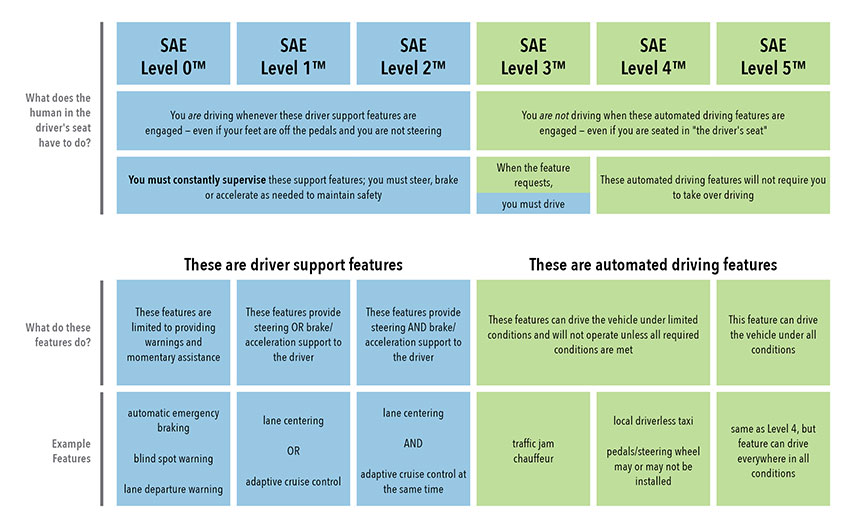
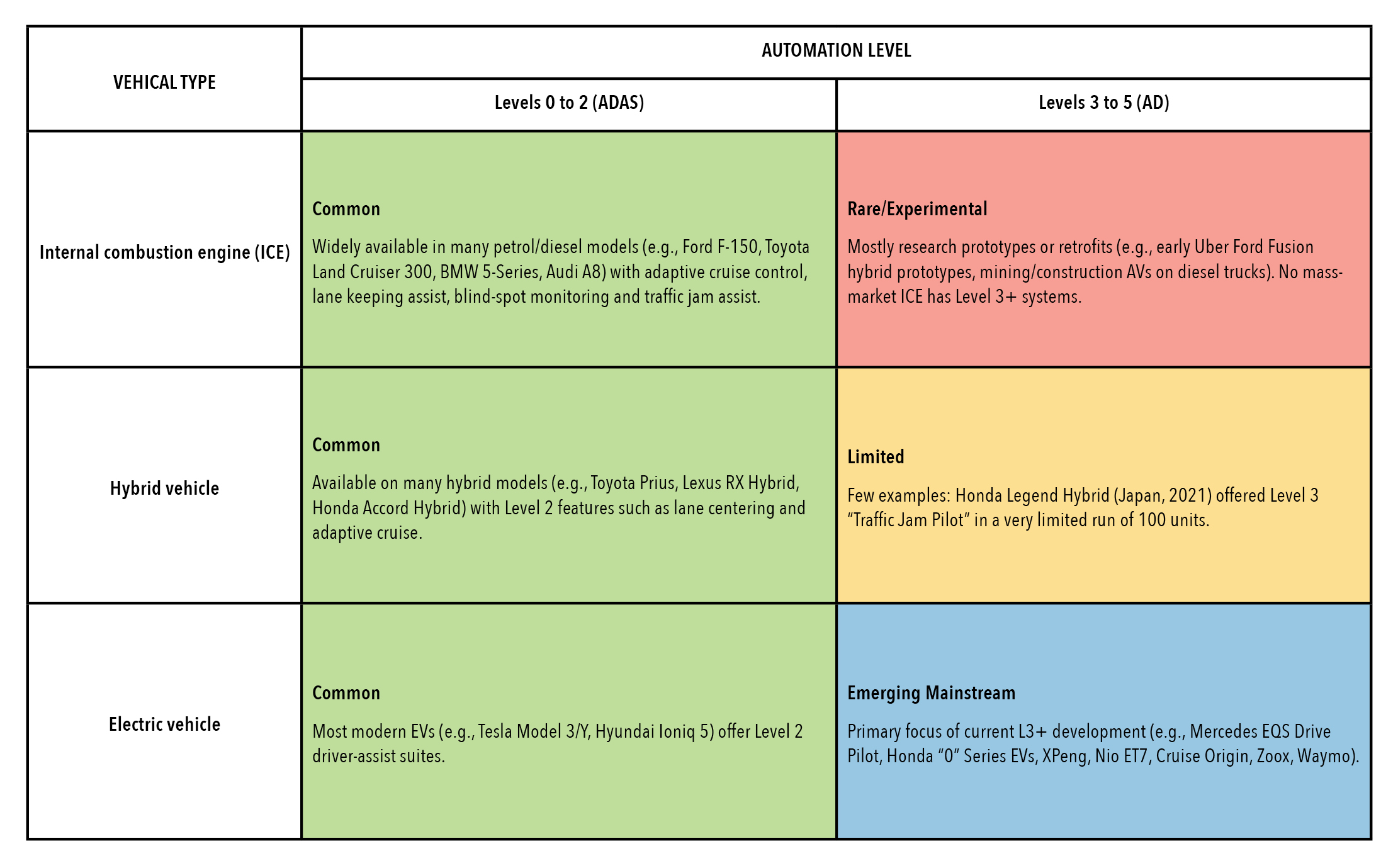
The Society of Automotive Engineers (SAE) defines six levels of vehicle automation (see Figure 1). Levels 0 (no automation) to 2 (partial automation) fall under Advanced Driver Assistance Systems (ADAS), and Levels 3 (conditional automation) to 5 (full automation) are classified as Autonomous Driving (AD) [1]. As summarized in Table 1, automation from Level 0 to Level 2 has become a common feature across all vehicle types – i.e., ICE, hybrid and EV. However, when we move toward higher levels of automation (L3 and above), a clear disparity emerges. These AD features are primarily deployed in pilot or experimental settings and remain relatively rare in ICE vehicles. By contrast, they are becoming increasingly mainstream in EVs, while adoption in hybrids remains limited. This signals that the more advanced stages of autonomous driving (AD features) will evolve predominantly on EV platforms, rather than on ICE or hybrid platforms.
Will AVs Accelerate the Death of the ICE?
In mobility services such as ride-sharing platforms and robotaxis, autonomous driving is already being commercialized. By contrast, in the consumer vehicle segment, most automation offerings remain at Level 2, or at best Level 3+, which are still common across ICEs, hybrids and EVs. This divergence makes the regulatory and business context especially important. The way investments flow into these technologies, and the pace at which safety, liability and consumer acceptance are resolved, will shape whether advanced autonomy truly accelerates the decline of the ICE. What seems clearer is that only the most advanced features of AD (i.e., Level 3+) have the potential to act as a catalyst, and even then, the trajectory is unlikely to be straightforward. However, the regulation around the safety feature will have a significant role to play.
Which Should Come First: Electrification or Autonomy?
Although ADAS features (Levels 0-2) are now standard across ICE, hybrid and EV platforms, higher levels of autonomy (Levels 3-5) demand something more fundamental. The computational load, redundant systems and always-connected architectures required for autonomous driving align far more naturally with EV platforms than with ICE or hybrid drivetrains.
This creates an intriguing dynamic. Automakers may wish to treat autonomy as a standalone innovation, but in practice, AD capabilities cannot be scaled without electrification. Even if firms are hesitant to fully embrace EVs, customer demand for the safety, convenience and prestige of autonomous features could force their hand. In other words, autonomy itself may accelerate the industry’s pivot toward electrification faster than regulation or fuel economics alone.
Electrification provides the enabling foundation; autonomy builds on it. Together, they redefine the trajectory of the industry. The real lesson for companies and policymakers is that these revolutions are not substitutes but complements. In that sense, electricity isn’t just powering the car of the future but also fueling the path to autonomy.
Regulation Across the Globe
Regulatory approaches to ADAS and higher levels of automation significantly vary across regions. As summarized in Table 2, mandatory ADAS requirements are concentrated in the EU, U.K., Japan, U.S. (limited to autonomous emergency breaking [AEB]) and partially China, whereas India and much of the Global South remain largely voluntary [2-6]. Regulation of Level 3-4 automation is tightly controlled through permits or specific approval frameworks, whereas Level 5 remains unregulated globally.
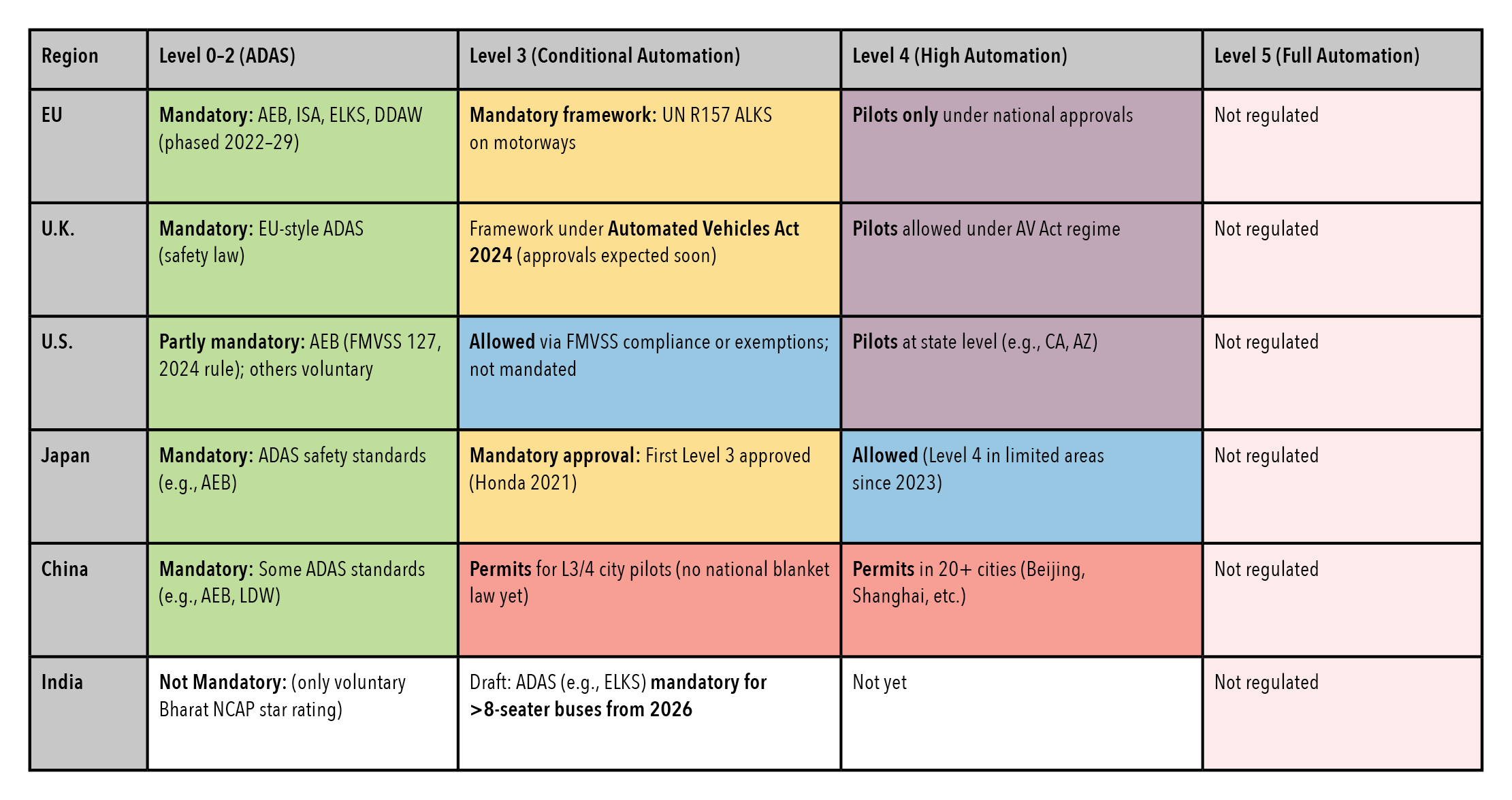
Note: AEB, Autonomous Emergency Braking (automatic braking if collision imminent); ALKS, Automated Lane Keeping System (hands-off driving in specific conditions; SAE Level 3); DDAW, Driver Drowsiness & Attention Warning (monitors driver alertness); DSSAD, Data Storage System for Automated Driving (black box for AV maneuvers); ELKS, Emergency Lane Keeping System (keeps vehicle in lane during danger); FMVSS, Federal Motor Vehicle Safety Standards (US vehicle regulations); ISA, Intelligent Speed Assistance (warns/prevents exceeding speed limits); LDW, Lane Departure Warning (alerts driver if drifting out of lane); NCAP, New Car Assessment Program (consumer vehicle safety rating).
This variation has important implications. Once regulations evolve to make Level 3+ features mandatory, it could represent a tipping point for original equipment manufacturers (OEMs). To comply with the new requirements and leverage potential cost advantages of electrification, manufacturers may accelerate the transition from ICE to EV platforms. In turn, this regulatory push would not only shape OEM product strategies but also indirectly drive broader EV adoption.
References
- Doll, G., Ebel, E., Heineke, K., Kellner, M. and Wiemuth, C., 2020. “Private autonomous vehicles: The other side of the robo-taxistory,” McKinsey & Company.
- National Policy Agency (NPA), 2022, https://www.npa.go.jp/english/bureau/traffic/selfdriving.html.
- Moss, T., 2025, “China proposes rulemaking on vehicle ADAS,” Repairer Driven News, June 11, https://www.repairerdrivennews.com/2025/06/11/china-proposes-rulemaking-on-vehicle-adas/.
- Wood, I., 2024, “New EU safety regulations mandate the use of ADAS,” ADAS and Autonomous Vehicle International, July 15, https://www.autonomousvehicleinternational.com/news/legislation/new-eu-safety-regulations-mandate-the-use-of-adas.html.
- Ramey, J., 2025, “Should the NHTSA mandate these safety systems?,” Autoweek, July 8, https://www.autoweek.com/news/a65332727/nhtsa-mandatory-adas-safety-systems.
- Sinha, S., 2025, “MoRTH mandates use of ADAS for vehicles with 8+ passengers starting April’26,” Telematics Wire, March 26, https://telematicswire.net/morth-mandates-use-of-adas-for-vehicles-with-8-passengers-starting-april26/.
Nandan Kumar Singh is an assistant professor in the Operations Management and Decision Science Area at FORE School of Management, New Delhi, India. He was a postdoctoral fellow in Production and Operations Management Department at the Indian Institute of Management Bangalore. He holds a Ph.D. in production and operations management from the Indian Institute of Management Visakhapatnam and previously served as a Visiting Research Scientist at New York University. Nandan also holds a Micro Masters credential in Supply Chain Management from Massachusetts Institute of Technology (MIT), Centre for Transportation and Logistics.