
March 8, 2026 in Basketball Analytics
Inside the Numbers Game: Analytics and the Next Era of Basketball
SHARE: PRINT ARTICLE: https://doi.org/10.1287/orms.2026.01.04
The Lineage of Analytics in the NBA
For much of its history, professional basketball has been defined by a blend of strategy and athleticism [1]. As player skills have continued to improve, so has the decision-making that shapes the sport. For decades, coaches and scouts leaned almost entirely on the “eye test” and basic statistics such as points, rebounds and assists to evaluate player performance. In the mid-1970s, the box score was expanded, introducing statistics such as offensive rebounds, turnovers, blocks and steals. Combined with gut instinct and film study, decisions hinged more on traits like athleticism and leadership than on data alone. These traditional methods shaped roster moves, starting rotations and playing styles in the NBA for decades.
In the late 1990s, however, the NBA began a dramatic transformation with the introduction of analytics. Play-by-play data was introduced in 1997, ushering in the era of real statistical analysis. Through the early 2000s, statistical analysis steadily gained traction, shaping both on- and off-court decisions – a shift accelerated by Moneyball – and by the late 2000s, the use of play-by-play data helped bolster a leaguewide analytical surge. In 2013, the NBA became the first U.S. professional sports league to implement player tracking for every game through its partnership with STATS SportVU [2]. Using high-resolution cameras in every arena and advanced computer vision technology, SportVU provided real-time tracking data based on speed, distance, player separation and ball movement, delivering the most detailed player and team analysis the league had ever seen.
The rise of advanced analytics through player-tracking technology led to developments in spatial analysis and new advanced metrics, used to assist coaches and organizations to make informed decisions that were previously based on instinct. This shift from counting statistics to tracking analytics has allowed the game of basketball to grow, improving player evaluation techniques as well as the quality of the game for fans and viewers. Statistical learning models heavily influence today’s NBA decision-making and are responsible for the modern revolution of emphasis on three-point shooting, offensive rebounding and load management.
Recent Technological Innovations
Hawk-Eye Optical Tracking
After the early SportVU era of tracking basketball, Second Spectrum was the NBA’s optical tracking provider beginning in 2016. At the same time, Hawk-Eye technology was being widely used in tennis and soccer, making line calls in grand slams and providing referees with quick offsides decisions during the 2022 World Cup [3]. In 2023, the NBA adopted Hawk-Eye, replacing Second Spectrum as the lead provider of optical tracking technology. Genius’ Second Spectrum still works with the NBA but in a more entertainment-focused way through League Pass [4]. These alternative telecasts feature advanced team and player statistical insights integrated directly into the stream, giving analytics-focused fans an ideal viewing experience. At the time, Second Spectrum had a “dot” tracking system using six cameras to track player torsos in 2D, which created a single point for each player at any given moment [5]. Hawk-Eye’s implementation of the “pose” tracking system uses 14 cameras that track 29 points on players’ bodies (arms, legs, hands, etc.) plus the ball in full 3D in near-real time and supports more accurate output data than Second Spectrum. As a result, the NBA announced that the leaguewide implementation of Hawk-Eye would begin in the 2023-2024 season.
Hawk-Eye’s main impact at the NBA level is twofold. First, the impact on the game is that Hawk-Eye’s technology supports better and faster officiating and reviews because it increases both the accuracy and the speed of calls. In Game 4 of the Nuggets vs. Clippers series in 2025, Hawk-Eye’s review showed that Gordon’s dunk went in just about a millisecond before the buzzer [6].
But perhaps Hawk-Eye’s biggest impact is at the team level [5]. Synergy Sports, which has long been one of the most widely used analytics platforms in basketball, is now owned by Sportradar, one of Hawk-Eye’s partners, and has begun combining its play-tracking tools with Hawk-Eye’s pose data. Nearly every basketball metric imaginable will be improved, and many new metrics will be created using this tracking technology. Over the past several years, NBA teams have consistently expanded their analytics departments, with advantages going to early adopters of new tracking tools and those able to integrate and utilize them most effectively (see Figure 1). In turn, the demand for analytically skilled basketball professionals has reached new heights.
![Figure 1: NBA analyst headcounts by season, 2009-2025 [7].](/cms/10.1287/orms.2026.01.04/asset/media/basketball_figure_1-rgb.jpg)
Figure 1: NBA analyst headcounts by season, 2009-2025 [7].
Training and Player Development
Player development in professional basketball has been revolutionized by blending innovation and technology with forward-thinking applications of analytics. Modern coaching staffs rely on tracking data, advanced visualization analysis and film study to develop players. Rather than replacing coaching instincts with analytics alone, new technologies are aimed at augmenting traditional coaching methods, providing teams with real-time performance improvement feedback.
Modern player development is dependent on the interpretation of data tracking by team analysts. By applying principal component analysis (PCA) to years of NBA player tracking and box score data, Abraham Montalvo demonstrates how players can be grouped into style clusters [8]. Some players are designated as shooters, defenders or ball handlers, which allows coaches to look beyond broader designations such as “guard” and “forward.” In turn, coaches can emphasize the specific traits necessary to be successful relative to others in their cluster. Newer tracking data focuses on player performance during real game scenarios; PCA can provide teams with complete feedback on areas of strength and weakness, allowing coaches to develop tailored training regimes for individual players. Drills based on a player’s statistical weaknesses represent an advanced analytics evolution from the antiquated, non-data-driven methods of the past.
Recently released research that simulated more than 11,000 NBA games highlights how player versatility can be quantified according to lineup-based performance levels, illustrating how different players alter their playing style based on teammate combinations and situational context [9]. Through this analysis, coaches can anticipate how differently players will perform based on specific lineup combinations.
Injury Prevention
Preventing injuries is critical for NBA teams hoping to compete in today’s data-driven league. Injuries have been on the rise in recent years, raising the stakes for keeping key players available [10]. Beyond the clear human and financial costs, each game that a starter misses could harm a team’s record, ultimately affecting seeding and playoff outcomes. Front offices and coaches now view injury prevention as a critical part of gaining a competitive edge on opponents, focusing on specific and measured rest, with unique regimens for each player [11].
Coaches regularly engage in load management to cycle players in and out of games, aiming to maximize productive output while minimizing the potential for injury. Although load management was originally centered around off days, it is now incredibly targeted. Teams monitor how each player’s load accumulates in games and throughout the season, carefully adjusting practice intensity and other training aspects to avoid injury with the goal of preserving player ability without sacrificing performance or health. Deciding which players to rest for each game is a decision that artificial intelligence (AI) has had increased control over. Some machine learning algorithms have erred on the side of caution, suggesting to rest multiple key players in individual games more frequently [12]. This practice, although beneficial for teams, frustrated many fans and the league, which issued a new rule to limit how many stars could be rested in marquee games. The goal of the increased rest is to ensure players are available and refreshed for key matchups that can affect playoff probabilities and ultimately maximize each team’s chances of winning the championship.
The league and individual teams have explored a variety of technologies to improve today’s load management, including wearables, optical tracking and sleep policies. Teams now use wearables to monitor player vitals and health signals during practices, flagging signs of fatigue for the coaching staff. Optical tracking of camera feeds in games translates individual player movements into categorized metrics such as sprints and jump landings. These specific profiles of a player’s in-game exposure to fatigue also produce flags for dangerous mechanics and abnormally high workloads on specific joints and the overall body [13]. Player rest is also critical for avoiding injuries; studies have shown that napping on game days improves play performance [14]. Many teams have established sleep minimums to ensure that their athletes are well rested each day of the season, with an emphasis on game days [15]. The abundance of data for each player enables teams to make informed decisions about load management, aiming to minimize injuries while keeping a full-strength team on the court.
Effect of Analytics
In-game Strategy
The most direct application of analytics is on the court, where coaches constantly make decisions. A head coach faces about 33 tactical decisions, on average, in a single game through substitutions, timeouts and challenges (see Figure 2, which does not include decisions that were not recorded in play-by-play data such as post-timeout plays, defensive strategy, starting lineups and many others). Over the course of a season, these choices alone add up to nearly 3,000 decisions that can be shaped by analytics. Models that quantify win probability or expected points added because of an action provide a framework for these decisions that need to be made quickly. Tracking data enhances lineup analysis, showing which combinations of players defend or score most efficiently. Automated decisions found through prescriptive analysis can act as a guide for consistent strategy for coaches.
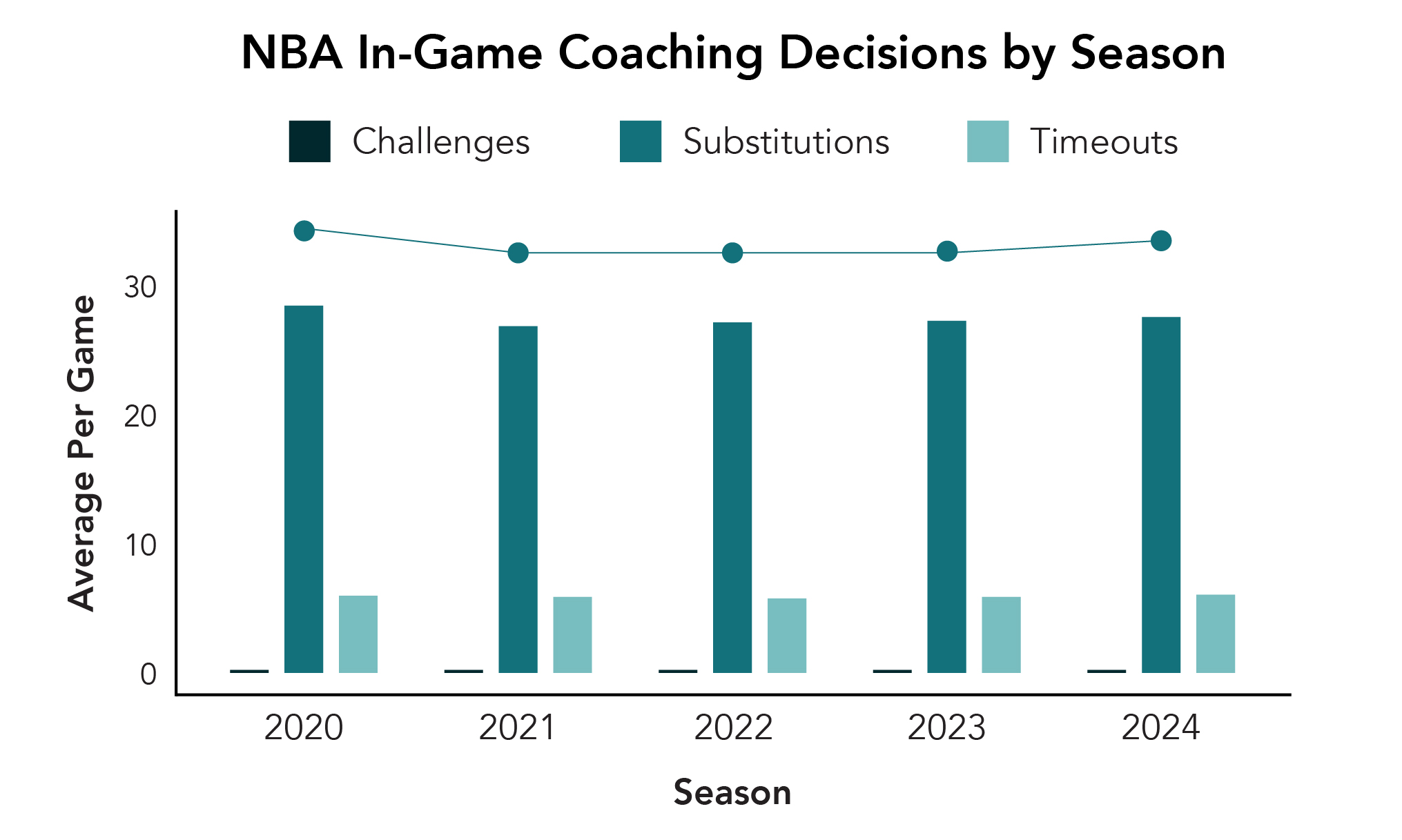
Figure 2: Average substitutions, timeouts and challenges made by a coach each game.
One recent example of analytics driving in-game decision-making is the lineup rotation involving Isaiah Hartenstein of the Oklahoma City Thunder during the 2025 NBA Finals. Head coach Mark Daigneault alternated Hartenstein between the starting group and the bench, based on lineup tracking data that measures which units possess the greatest efficiency. With Chet Holmgren in a double-big frontcourt, the Thunder had one of the best point differentials of their season, with a +7.0% offensive rebound advantage over nearly 500 minutes of regular season and playoff action [16]. They also saw a defensive rating of 109.9 points per 100 possessions on 679 possessions [17]. Analytics revealed this tall duo held back opponent field-goal percentage at the rim and extended the Thunder’s second-chance scoring on offense. Conversely, removing Hartenstein in earlier games to insert guard Cason Wallace allowed the Thunder to play with smaller, faster lineups that tracking data showed were better at defending the perimeter and forcing pace on the Indiana Pacers’ guard-oriented rotations [18]. By rotating through these different data-driven looks each game, the Thunder optimized their contests, demonstrating how lineup efficiency metrics and monitoring systems have become central to rotation and substitution planning.
Front Office and Long-term Decision-making
Off the court, analytics shape the choices that define team trajectories for years. General managers (GMs) and front offices face fewer decisions, but each often comes with more long-term impact. Across an entire season, a GM may only make about 50 key personnel decisions drafting players, signing free agents, negotiating extensions and executing trades (see Figure 3). Unlike the coaching staff, who manage countless choices every game, including substitutions, timeouts, challenges and other decisions, the GM’s fewer choices have a longer time horizon. Draft evaluations now incorporate computer visualization tracking data from college broadcast feeds, and player acquisition through trades focuses on which players will provide the best fit to a team’s structure. Similarly, analytics helps front offices evaluate contract negotiations when teams are trying to leverage additional value beyond a player’s market value.
![Figure 3: Average transactions made by a front office over the last 10 years. It is important to note that these also include G League transactions, Exhibit 10 contracts, two-way contracts and waiving players. [19]](/cms/10.1287/orms.2026.01.04/asset/media/basketball_figure_3-rgb.jpg)
Figure 3: Average transactions made by a front office over the last 10 years. It is important to note that these
also include G League transactions, Exhibit 10 contracts, two-way contracts and waiving players. [19]
A recent example of analytics in front-office decision-making is when the Denver Nuggets signed Jamal Murray to a four-year, $208 million maximum extension during the 2024-2025 offseason [20]. Although Murray’s strong statline (21.2 points, 6.5 assists and a 42.5% 3-point average) provides a reasonable baseline for his value, Denver’s front office supplemented traditional statistics with more advanced figures derived from computer visualization tracking data [21]. Using Second Spectrum data on two-man actions and assist pairings, the Nuggets analyzed Murray’s production during possessions with superstar Nikola Jokić, demonstrating their increased lineup efficiency when they share the court [22]. League reporting this season emphasized the Nuggets’ reliance on these metrics to project fit, highlighting how consistent scorers stabilize team offenses [23]. To increase production, high-impact scorers like Murray provide long-term lineup stability. Murray is a top 40 player when looking at volatility analysis, a measure of how consistent a player’s offensive production is across games. When an organization commits to a future-defining transaction, it leans on advanced analytics, forecasting a desired player’s fit and production well into the future.
The Future of Analytics
The next era of basketball analytics is emerging at the college level. Although the NBA has had more than a decade of access to advanced tracking data, most collegiate programs have historically lacked this data and in-depth analytics. However, that landscape is beginning to shift. More affordable tracking providers and an increase of students and professionals interested in this field have made advanced analytics increasingly more popular with NCAA men’s basketball programs. Among the elite of Division I basketball, some schools have already integrated tracking data through providers like Sportradar, SkillCorner and ShotTracker [24]. Whether through broadcast feed or in-arena cameras, the recent rise of tracking data in college basketball allows coaches to mirror projects and approaches that the NBA has been using for years.
As the sport continues to evolve, teams will find new ways to gain a competitive edge, and improvements in analytics represent a prime opportunity to find value in players and ideas that other teams pass on. By incorporating analytics into all levels of decision-making, NBA teams are making smarter, quicker and more efficient decisions, enabling them to compete at a higher level year after year. In a seemingly endless sea of data, the teams that can separate signal from noise will find themselves winning more games and becoming champions as the sport matures.
References
- “NBA Play by Play Data,” NBAstuffer, https://www.nbastuffer.com/analytics101/playbyplay-data/.
- https://pr.nba.com/stats-llc-nba-sportvu-player-tracking-data/.
- Kirk Goldsberry, 2023, “NBA to Use Hawk-Eye Tracking System to Follow Players, Ball,” ESPN, March 9, https://www.espn.com/nba/story/_/id/35818363/nba-use-hawk-eye-tracking-system-follow-players-ball.
- Euan Cunningham, 2023, “NBA and Genius’ Second Spectrum in League Pass-focused Deal Expansion,” Sportcal, March 9, https://www.sportcal.com/media/nba-and-genius-second-spectrum-in-league-pass-focused-deal-expansion/?cf-view.
- Ben Dowsett, 2023, “‘An Exciting Next Few Years’: Will Hawk-Eye Spark an NBA Data Revolution?,” Guardian, October 20, https://www.theguardian.com/sport/2023/oct/20/nba-hawkeye-data-analytics-insights.
- Ricky O’Donnell, 2025, “NBA Hawk-Eye Technology Changed 2 Huge Calls in Playoffs for the Better,” SB Nation, April 28, https://www.sbnation.com/nba/2025/4/28/24419402/nba-hawkeye-technology-reviews-aaron-gordon-dunk-lakers-wolves-lebron-foul.
- “NBA Teams That Have Analytics Department,” NBAstuffer, https://www.nbastuffer.com/analytics101/nba-teams-that-have-analytics-department/.
- Abraham J. Montalvo, 2024, “Development and Analysis of Basketball Statistics,” Working paper, Carroll College, Helena, MT, https://scholars.carroll.edu/server/api/core/bitstreams/d370cc06-826e-46e5-9964-d99f00e45ff1/content.
- Tianxiao Guo, Christophe Ley, Yixiong Cui, Yanfei Shen, Chengyi Zhang and Jing Mi, 2025, “Quantifying Player Versatility Through Lineup-based Playing Styles in Elite Basketball,” International Journal of Sports Science & Coaching, Vol. 20, No. 2, pp. 689-697, https://doi.org/10.1177/17479541241312390.
- Sam Amico, 2024, “NBA Injuries Skyrocketing, Already up 35 Percent Over Last Season,” Hoops Wire, November 12, https://hoopswire.com/nba-injury-news-skyrocketing-up-over-last-season/.
- Chi-Chung Chan, Patrick Shu-Hang Yung and Kam-Ming Mok, 2024, “The Relationship Between Training Load and Injury Risk in Basketball: A Systematic Review,” Healthcare (Basel), 12, No. 18, Art. no. 1829, https://doi.org/10.3390/healthcare12181829.
- Marcin Frąckiewicz, 2025, “The NBA’s High-tech Revolution in 2025: How AI, VR and Smart Tech Are Changing the Game,” Techstock2, September 15, https://ts2.tech/en/the-nbas-high-tech-revolution-in-2025-how-ai-vr-and-smart-tech-are-changing-the-game.
- Keith D’Amelio, 2020, “Physical Activity Demands of NBA Game Play,” Doctoral thesis, University of Technology Sydney, Sydney, https://opus.lib.uts.edu.au/bitstream/10453/147346/2/02whole.pdf.
- Aher Souabni, Omar Hammouda, Mehdi J. Souabni, Mohamed Romdhani, Wajdi Souissi, Achraf Ammar and Tarak Driss, 2023, “Nap Improved Game-related Technical Performance and Physiological Response During Small-sided Basketball Game in Professional Players,” Biology of Sport, Vol. 40, No. 2, pp. 389-397, https://doi.org/10.5114/biolsport.2023.116004.
- Baxter Holmes, 2019, “NBA Exec: ‘It’s the Dirty Little Secret That Everybody Knows About,’” com, October 14, https://www.espn.com/nba/story/_/id/27767289/dirty-little-secret-everybody-knows-about.
- Ethan Baca, 2025, “Using Four Factors to Explain 2024-25 OKC Thunder Dominance, Part Three: Rebounding,” Sports Illustrated, September 25, https://www.si.com/nba/thunder/onsi/news/using-four-factors-to-explain-2024-25-okc-thunder-dominance-part-three-rebounding-01k45xpbdgaf.
- Mark Nilon, 2025, “Isaiah Hartenstein Reveals Exciting Thunder Tweak That Should Scare Rest of NBA,” Thunderous Intentions, May 1, https://thunderousintentions.com/okc-thunder-isaiah-hartenstein-exciting-tweak-should-scare-rest-of-nba.
- Bryan Toporek, 2025, “OKC Thunder’s NBA Finals Lineup Change Shows Why They’re Ahead of the Curve,” Forbes, June 9, https://www.forbes.com/sites/bryantoporek/2025/06/09/okc-thunders-nba-finals-lineup-change-shows-why-theyre-ahead-of-the-curve/.
- https://www.basketball-reference.com/teams/ATL/2025_transactions.html.
- Arnie Melendrez Stapleton, 2024, “Jamal Murray Signs Reported 4-Year Maximum Extension with Nuggets,” NBA, September 12, https://www.nba.com/news/jamal-murray-nuggets-contract-extension.
- https://www.reuters.com/sports/nuggets-jamal-murray-agree-4-year-208m-extension-2024-09-07/.
- Fred Katz, 2025, “The Nikola Jokić Effect – How a Quiet MVP Front-runner Elevates His Teammates,” The Athletic, April 17, https://www.nba.com/news/the-athletic-the-nikola-jokic-effect-how-a-quiet-mvp-front-runner-gets-the-most-from-his-teammates.
- Meer Patel, 2025, “Beyond Averages: Measuring Consistency and Volatility in NBA Team and Player Offense,” Working paper, Columbia University, https://statmodeling.stat.columbia.edu/wp-content/uploads/2025/08/Beyond_Averages__Measuring_Consistency_and_Volatility_in_NBA_Player_and_Team_Offenses.pdf.
- Joe Lemire, 2025, “ShotTracker Client List up to 50 College Programs,” Sports Business Journal, February 19, https://www.sportsbusinessjournal.com/Articles/2025/02/19/shottracker-client-list-grows-to-50-college-programs/.
Tristan Robbins is an undergraduate student studying sport management, statistics and economics at UF. Landon McIntosh is an undergraduate student studying computer science and economics at UF. Will Robinson is an undergraduate student studying statistics at UF. Scott Nestler, PhD, CAP-X, PStat, is professor of practice and sport management at the University of Florida and director of the UF Sports Analytics Lab.