
March 2, 2026 in Marketing Science
From Content Factory to Capital Allocator: Reframing Marketing as a Sequential Decision System
SHARE: PRINT ARTICLE: https://doi.org/10.1287/orms.2026.01.11
Marketing’s Hidden O.R. Problem
Artificial intelligence (AI) now sits at the center of many marketing decisions. Systems generate content, adjust bids and offers, and modulate customer contact in near real time, all tracked through increasingly granular performance metrics. These capabilities, however, mask a deeper issue. The problem is not execution speed or model complexity but decision framing. In many cases, marketing AI is solving a short-term optimization problem in a setting that is inherently dynamic.
In practice, marketing decisions are treated as independent, short-term optimization tasks. Algorithms are built to maximize immediate response, attribution-adjusted return, quarterly return on ad spend or short-horizon revenue. This amounts to repeatedly solving a single-period optimization problem in an environment that is fundamentally dynamic. This framing treats short-term performance improvements as separable from longer-term enterprise value. Customer behavior, however, is not memoryless. Actions taken today shape future states, including engagement, fatigue, trust, price sensitivity and long-term profitability.
This article reframes marketing AI as a sequential decision system in which budgets, promotions, offers and exposures are allocated over time under uncertainty. Using an operations research (O.R.) lens, it focuses on state dynamics, reward formulation and policy evaluation rather than campaign-level optimization. The goal is not to introduce new algorithms but to clarify the decision structure that marketing AI systems are implicitly solving.
The Efficiency Trap: When Optimization Inflates KPIs but Erodes Profit
Most marketing AI systems are highly efficient at what they are asked to do. They efficiently maximize response rates, click-through or attributed revenue, when instructed to do so. In many organizations, this produces a familiar pattern:
- Frequent discounting to responsive segments
- Escalating contact intensity for high-engagement customers
- Reallocating budgets toward channels with short-term lift
Standard performance metrics improve, key performance indicators (KPIs) rise and attribution models report incremental impact. Short-term profitability may improve as well, but longer-term customer contribution often deteriorates.
This efficiency trap is particularly visible in mature retail and consumer packaged goods (CPG) environments, in which loyal customers are repeatedly targeted because they respond reliably. Over time, discounts cannibalize margin, frequent outreach accelerates fatigue and high-quality customers become conditioned to wait for incentives. The system behaves rationally within its objective function, even as enterprise value deteriorates.
The core issue is not algorithmic sophistication. It is problem formulation.
Why Attribution Models Fail as Decision Systems
Attribution models remain the backbone of many marketing analytics stacks. They estimate incremental contribution by channel, campaign or touchpoint and are often used to guide budget allocation. Although useful for retrospective analysis, attribution models are poorly suited to governing decisions over time. These models exhibit several structural limitations:
- Static framing that ignores state persistence
- Independence assumptions in environments with strong interactions
- Absence of transition dynamics
- Reward proxies that substitute revenue for contribution margin
As a result, attribution-driven optimization behaves like a sequence of myopic decisions. Each period’s allocation may be locally optimal, but the policy is not. This is analogous to managing an inventory system by optimizing daily sales without accounting for stockouts, replenishment cycles or holding costs. The system appears responsive, but performance degrades over time.
Marketing as a Sequential Decision Problem
A more appropriate representation of marketing decisions is a sequential decision system, where actions today influence future states and rewards. Marketing can be modeled as a Markov decision process or a related sequential framework:
- State: Customer engagement, fatigue, tenure, price sensitivity, margin profile
- Action: Offer level, contact decision, channel selection or holdout
- Reward: Incremental contribution margin
- Transition: How actions move customers between states over time
This framing immediately resolves many pathologies of conventional marketing AI. High-frequency discounting is no longer attractive if it degrades future state value. Excessive outreach is penalized when it increases the probability of disengagement or churn.
Importantly, this does not require perfect state observability. Even coarse state definitions outperform flow-based optimization when decisions are repeated over long horizons. Once marketing is reframed as a sequential decision problem, the objective naturally shifts from maximizing activity to allocating capital across time under uncertainty.
Marketing AI as a Capital Allocation System
Recent advances in agentic AI make this reframing operationally feasible. In this context, agentic refers to policy-driven systems that autonomously select and repeat actions over time based on observed state and predefined objectives.
Rather than treating AI as a content generator or tactical optimizer, these systems can be designed as policy learners that allocate marketing budgets across customers, segments and time periods. They behave like portfolio optimizers, allocating finite capital such as attention, incentives and marketing spend, while balancing exploration and exploitation to maximize expected long-term return.
System performance is driven far more by how states and rewards are defined than by the choice of algorithm. A simple policy optimizing the right objective will outperform a more sophisticated model optimizing the wrong one. This is where O.R. and AI intersect most productively. O.R. defines the decision structure, and AI supplies the learning capacity.
Policy Behavior Under Different Objectives
Customers differ in engagement decay, price sensitivity and contribution margin, and their behavior evolves as a function of prior exposure and purchase history. Two decision policies operate under identical information and budget constraints. The only distinction between them is the objective used to evaluate actions.
One policy prioritizes short-term response, allocating greater exposure to customers who have historically engaged. The other prioritizes long-term contribution, explicitly accounting for how current actions affect future customer value. The learning mechanism and available data are held constant.
Under repeated decision cycles, capital allocation behavior diverges. The response-focused objective concentrates capital on historically responsive customers, whereas the value-focused objective spreads capital to preserve future contribution.
Figure 1 illustrates how different decision objectives shape policy behavior over time in a marketing environment.
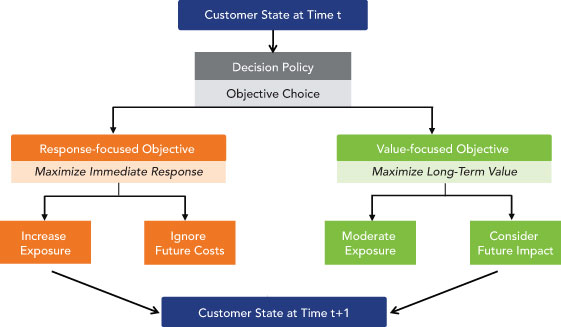
Figure 1: How objective choice shapes policy behavior over time.
Implications for Decision System Design
Reframing marketing as a sequential decision system has direct implications for how analytics are designed, deployed and governed at scale.
First, problem formulation matters more than algorithm choice. In sequential settings, how customer states are defined and updated has a greater impact on outcomes than whether the underlying policy is implemented with bandits, reinforcement learning or heuristic optimization.
Second, reward design determines behavior. Optimization systems reliably pursue what they are asked to maximize. If reward functions emphasize short-term response, systems will rationally favor actions that extract immediate value, even when those actions degrade future outcomes. Aligning rewards with long-term contribution is therefore a core design responsibility, not a modeling detail.
Third, uncertainty is structural rather than incidental. Customer behavior evolves because of prior decisions. Treating uncertainty as noise to be averaged away, rather than as a state-dependent feature of the system, leads to policies that overexploit transient signals and underinvest in long-term value.
Finally, governance must be embedded in the decision process itself. In sequential systems, oversight is expressed through constraints such as frequency caps, budget limits and protections against irreversible outcomes. These are not post hoc monitoring tools; they are first-order design decisions that shape how automated policies behave over time.
Conclusion
Automation in marketing is no longer optional. What remains a choice is how automated decisions are framed and evaluated over time. Marketing has always involved allocating scarce resources under uncertainty. What has changed is the scale, speed and persistence with which those allocations are now executed by AI-enabled systems.
Policy-driven decision systems grounded in operations research make it possible to treat marketing as what has long been in practice: an intertemporal capital allocation problem. When decisions are modeled explicitly as sequential and state-dependent, many familiar inefficiencies arise less from execution failures than from misaligned objectives. Over time, the quality of decision models is likely to matter more than content generation or algorithmic novelty in determining how marketing systems perform at scale.
Pavan Kunchala leads applied AI and decision science work at Tiger Analytics, focusing on large-scale decision systems for marketing, pricing and revenue growth management in CPG and retail. His work applies operations research and decision modeling to customer lifetime value and enterprise decision systems. He holds an MBA from the University of California, Berkeley.