
June 2, 2026 in Infrastruture
The Insight Loop: A Leadership Framework for Building AI & Analytics Maturity
SHARE: PRINT ARTICLE: https://doi.org/10.1287/orms.2026.02.03
Only 10% of executives report achieving significant financial benefit from their AI and analytics initiatives, according to a study in MIT Sloan Management Review. Another MIT report focused on GenAI reported that, as of 2025, up to 95% of GenAI pilot projects have failed to scale to enterprise-level impact. The problem isn’t the quality of AI tools themselves – it’s the lack of organizational learning.
Organizations that do see a healthy ROI from their initiatives build feedback loops that embed mechanisms for reflection, refinement, and recalibration. The organizations that successfully leverage their AI tools don’t necessarily have a better model; they have a better system that’s built to adapt over time.
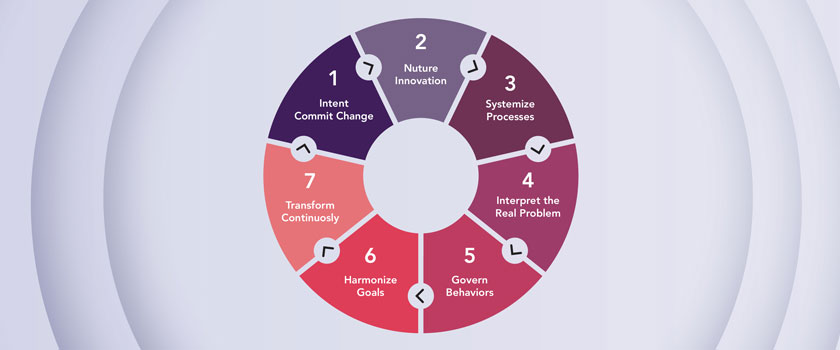
The INSIGHT Loop is a leadership framework built on seven functions: intent, nurture, systemize, interpret, govern, harmonize, and transform. Its end goal is organizational learning rather than reaching a specific destination. It’s not about flashy dashboards or clever pilots; it’s about how organizations grow real analytical maturity – the kind that survives turnover, budget shifts, and complexity.
Best visualized as a spiral in which each loop of action, reflection, and adjustment builds on the previous one, the INSIGHT Loop moves an organization forward in both depth and reach. The continuous movement that improves what we do today while imagining what’s next is the essence of the INSIGHT Loop.
Without a feedback loop, high-effort projects fail not because they’re wrong, but because they’re isolated. They have no scaffolding, nor the discipline absence. Maturity isn’t what you launch; it’s what you can repeat under pressure. Organizations need a way to evolve continuously, through leadership transitions, tech changes, and team turnover, without resetting progress every time.
The INSIGHT Loop isn’t a metaphor. It’s a functional architecture that doesn’t explain change – it enables it. Let’s break it down.
Intent: Commit to Lasting Change
Before you can build an analytics culture, you need to know why you are doing analytics in the first place – not just for a project, but for the long haul. The proverb, “When the music changes, so does the dance” is appropriate here. Intent demands adaptive clarity in motion. It means moving beyond, “How do we do this better?” to “What needs to change in how we think, act, and learn, starting now and continuing forever?”
Intent enables this shift. It creates the conditions for teams to question not just individual decisions, but also the assumptions beneath them about what matters, how success is defined, and which tradeoffs are acceptable. Determining intent pushes teams to reflect on the values, norms, and priorities that shape their actions.
Most organizations skip this step. They jump into implementing tools and dashboards without anchoring the change in long-term intent. That’s why so many analytics efforts stall; they’re chasing outputs, not building architecture. When intent isn’t structural, momentum fades as soon as the first initiative ends. What’s missing isn’t commitment, but clarity about the tradeoffs that matter, the behaviors that count, and the loops that need reinforcement.
Intent must be operational. If you can’t point out how it shapes decisions, it’s not functional.
For commitment to stick, intent must be translated into everyday behavior – that is, what gets rewarded and repeated, not as slogans, but as shared judgment and consistent action. That’s how intent becomes culture and change becomes real.
Nurture: Cultivate Pockets of Innovation
Learning flows not only from the center out, but also from the edges in, if you allow it.
Every organization emits sparks – emergent work driven by teams or individuals who are experimenting at the edges. But those sparks rarely ignite lasting change on their own. Without attention, support, and reinforcement, they fade before they can grow into something larger.
Too often, innovation stays trapped at the edge because the system doesn’t recognize it. Nurture is the leadership skill of turning weak signals into strategic assets. It requires listening without bias, evaluating without bureaucracy, and acting before the business case is obvious. Some of the most valuable innovations don’t start on the roadmap; they emerge in the gaps. Scaling insight isn’t about standardization. It’s about recognition and leverage.
An example of nurturing in practice: At one humanitarian NGO, local teams began setting up informal seed banks and food-sharing networks. These bottom-up efforts weren’t in the original plan, but leadership noticed, listened, and amplified them, turning local change into systemic learning.
Nurturing starts with noticing early signals of progress, protecting them from premature judgment, and giving them room to grow. That might mean dedicating a budget, assigning champions, or simply broadcasting early wins so others can follow. Rather than being passive, nurturing is an active leadership stance. When done well, it turns early potential into enterprise-wide change.
Systemize: Build Scalable Processes
Sustained impact doesn’t come from heroic effort or isolated wins. Rather, it comes from building scalable systems. In many organizations, analytics begins as handcrafted work with one team solving one problem, often guided by a handful of experts. But for real transformation, insights must move from project-level artifacts to embedded, repeatable processes that scale across the enterprise.
The challenge isn’t just doing something great once. It’s creating the infrastructure, standards, and habits that make that greatness routine. That means designing analytics pipelines, decision workflows, and feedback loops that work independently of individuals and improve with use. Without that continual movement, the practice of analytics stays fragile. Strong analytics depends on using memory, proximity, and context to turn individual talent into institutional strength. With that, capability survives the people who started it.
Interpret: Diagnose the Real Problem
A headache can be a symptom of anything from dehydration to serious illness. To effectively treat it, you must first know what’s causing it. Similarly, analytics teams must diagnose rather than simply respond when a problem presents itself. The questions analytics professionals are asked are rarely the real problem. Leaders and managers usually bring symptoms of a problem – such as a dashboard request, KPI trend, or data pull – when what they need is clarity on a deeper issue.
Misdiagnosis doesn’t just waste effort; it damages future momentum. When analytics delivers the wrong answer to the right-looking question, credibility drops. People stop asking, or they bypass the team altogether. The result isn’t just misalignment, it’s erosion.
Interpretation starts with listening, probing, and clarifying. Tools like the five whys, journey mapping, or failure-mode analysis help frame fuzzy requests into tractable questions. But tools only work when teams pause long enough to ask better questions and are willing to challenge what they already know. Without this rigor, misaligned analytics lead to rework, low adoption, and strategic drift, with decisions relying on polished outputs that miss the mark. Over time, trust erodes and future initiatives become harder to launch or sustain.
Govern: Reinforce New Behaviors
Governance is how you make change real. Not by inspiration alone, but by setting the conditions that reinforce what matters and make deviation costly. As David G. White, Jr., PhD, a cognitive anthropologist, puts it, culture isn’t what people say. It’s what they do under pressure.
To make change real, governance must confront common forms of resistance: clinging to outdated KPIs, reluctance to share data, and skepticism toward models that challenge intuition. Governance must surface these blind spots by creating structures that normalize dissent, encourage premortems,and reward small-scale adaptation. Mature systems create governance scaffolds that convert intention into habit.
Change doesn’t endure because people are told it matters, but rather because governance makes the right behaviors easier, safer, and expected. If you don’t govern it, the old culture will.
Harmonize: Unify Around Shared Goals
True harmonization isn’t just about working well together; it’s about aligning the organization around a shared strategy. As described by Keri E. Pearlson, Carol S. Saunders, and Dennis F. Galletta, “the information systems strategy triangle” highlights the importance of synchronizing business strategy, organizational structure, and technology. If one shifts and the others do not, the system breaks.
Harmonizing means not only breaking silos, but also aligning tools, teams, and timelines with the same strategic priorities. As Michael Porter writes in the Harvard Business Review, “The essence of strategy is choosing what not to do.” Harmony requires choices and discipline. One example: a Madagascar-based NGO faced a challenge when its field teams, program leads, and communications staff acted quickly during a crisis – but not together. Communications sent donor updates before the field team had verified the facts, creating confusion and reputational strain. The issue wasn’t talent; it was misalignment.
In response, leadership introduced a clear protocol: ground truth from the field would come first, followed by communications framing, all timed to the organization’s broader strategy. The result was faster coordination, clearer messaging, and stronger trust.
Harmonizing isn’t about consensus. It’s about synchronizing strategy so that every voice, every insight, and every action move in concert toward the outcomes that matter most.
Transform: Build a Continuous Loop
Transformation is not a destination, but a movement that feeds directly back into renewed intent. A spiral in which each loop builds on the last, creating both depth and reach, is the essence of the INSIGHT Loop. Each loop is a spiral staircase with same path but a higher view. That’s what makes loops scalable. Youcontinually revisit the same questions, but each time with better data, tighter logic, and stronger alignment.
Yet, many organizations fall into the trap of transformation fatigue. They push through bold, disruptive changes, but without embedding feedback and learning into their processes, momentum fades. Old patterns resurface, not because the strategy was wrong, but because the learning loops were never sustained. If people act but never reflect, or reflect but never adapt, the cycle collapses. This is how well-intentioned change efforts fade.
Step Into the Loop
If you're leading analytics or AI efforts in your organization, step into the loop. Determine where you’re strong, where you’re stalling, and where you need to restart. Make the loop your rhythm. The INSIGHT Loop is a blueprint for designing analytical capability that lasts. If you build it once and stop, it will decay. But if you build it to loop – across leadership, systems, and strategy – it gets stronger over time.
References
Argyris,C., 1991, “Teaching Smart People How to Learn,” Harvard Business Review, Vol. 69, No. 3, pp. 99-109.
Cazier, J., 2023, Leading in Analytics: The Seven Critical Tasks for Executives to Master in the Age of Big Data, Wiley.
Challapally, A., Pease, C., Raskar, R., Chari, P., 2025, “The GenAI Divide: State of AI in Business 2025,” MIT NANDA.
Inam, A., Cazier, J., 2024, “Analytics Maturity Guide: A Step-by-Step Guide for Unifying and Scaling Low-Maturity Analytics Programs,” International Institute for Analytics.
Pearlson, K. E., Saunders, C. S., Galletta, D. F., 2022, Managing and using information systems: A strategic approach (8th ed.), Wiley.
Porter, M. E., 1996, “What Is Strategy?” Harvard Business Review, Vol. 74, No. 6, pp. 61-78.
Ransbotham, S., Khodabandeh, S., Kiron, D., et. al., 2020, “Expanding AI’s Impact with Organizational Learning,” MIT Sloan Management Review and Boston Consulting Group. https://sloanreview.mit.edu/projects/expanding-ais-impact-with-organizational-learning/
White, D. G., Jr., 2020, Disrupting Corporate Culture: How Cognitive Science Alters Accepted Beliefs About Culture and Culture Change and its Impact on Leaders and Change Agents, New York: Productivity Press.
Tanvi Vishwasrao, MBA, is a business strategy and analytics professional with a background spanning the corporate, nonprofit, and international development sectors. Tanvi is currently pursuing a master’s degree in business analytics at Arizona State University, and she holds an MBA in corporate strategy from Lancaster University, UK. Her work has focused on digital transformation, data migration, and leveraging analytics to drive informed decision-making. Tanvi has led data-driven strategy and transformation efforts at an international NGO, and she is the founder of a social impact initiative in India that supports underprivileged dancers in building sustainable careers in the performing arts. Joseph A. Cazier, CAP-X, is a Clinical Professor, Faculty Director of the DBA program in Technology Leadership and associate director of the Center for AI and Data Analytics at Arizona State University. He is also the author of “Leading in Analytics: The Seven Critical Tasks for Executives to Master in the Age of Big Data,” as well as the creator of the new INFORMS professional course based on that book.