


June 22, 2026 in Disaster Preparedness
From Data to Water
Building Resilience in Rural Gambia with the Analytics Mindset
SHARE: PRINT ARTICLE: https://doi.org/10.1287/orms.2026.02.04

Reliable water access is not just a development issue. It is also a resilience issue that should be a fundamental human right. Being able to access dependable water resources lies at the heart of disaster preparedness, health, agriculture, and community stability. Many countries still lack this essential resilience against disasters big and small.
I was recently asked to assist The Gambia’s National Disaster Management Agency (NDMA) with its “Community Resilience Through Disaster Risk Reduction (DRR) Sensitization and Borehole Construction Project” in the country’s Central River Region (CRR) and Upper River Region (URR). The project is straightforward in its objective but profound in its implications. The NDMA is identifying rural villages in urgent need of reliable, sustainable, and affordable potable water and seeking funding to drill boreholes and install pumps – ideally, solar-powered systems – to provide long-term access to safe water.
Defining My Role
I was initially contacted by Sheikh Omar Trawalley, the project coordinator, on behalf of Gambian Vice President Muhammad B. S. Jallow and NDMA Executive Director Sanna A. Dahaba. I suspect that they reached out because I have been involved in several projects associated with water-related challenges. I made clear from the outset that I am not a hydrologist, water resource specialist, or engineer. My training is in statistics and operations research. Still, problems of resource allocation, measurement, and evaluation often benefit from statistical thinking. My association with Statistics Without Borders and the INFORMS Pro Bono Analytics initiative may also have played a role in their outreach.
But I traveled to The Gambia without a precisely defined role. I went, quite literally, on faith – primarily their faith – that I might be able to contribute meaningfully to this endeavor.
This project aligns with The Gambia’s commitment to the Sendai Framework for Disaster Risk Reduction, particularly Priority 4: enhancing disaster preparedness and “Building Back Better” in recovery and reconstruction. The Sendai Framework explicitly emphasizes strengthening critical infrastructure – including water systems – so communities are able to remain operational during and after disasters. Reliable water access is foundational infrastructure. Without it, communities are perpetually vulnerable.
Listen First
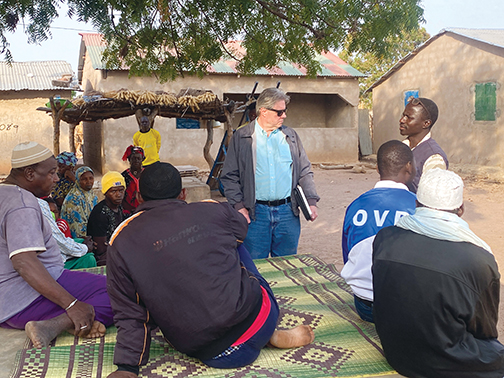
I spent three days in Banjul meeting with NDMA leadership and technical staff, and then I traveled seven hours into rural western Gambia to meet with village leaders and residents in the CRR and URR.
Reaching these villages required leaving paved roads and navigating deeply rutted dirt tracks for 30-60 minutes at a time. From the Gambian perspective – the only perspective that truly matters here – the principal barriers to clean water access are remoteness and funding constraints. For me, the biggest challenge was determining what my specific role would be in this effort. But this uncertainty is inherent in international community work; you must first listen.
I was confident that an analytics mindset could serve this project well. Admittedly, I think every project in which I engage can benefit from a healthy dose of disciplined thinking. At its core, this begins with curiosity paired with restraint.
When confronted with a problem, the instinct should not be to rush toward a solution, but to ask: What is really happening here? What do we know? What do we only think we know? What assumptions are we making without realizing it?
Problem-Solving with the Analytics Mindset
The analytics mindset brings crucial elements to problem-solving, including:
- It treats claims, impressions, and anecdotes as starting points rather than conclusions. The analytics mindset asks for evidence – not because people are untrustworthy, but because human judgment is inevitably shaped by limited perspective and biases (often unintentional and/or subconscious). It seeks to replace “this seems right” with “this is what the evidence suggests or supports.”
- It brings objective clarity. Before asking how to act, the analytics mindset encourages us to ask what success would look like. Whose goals matter? How are those goals prioritized? What trade-offs are acceptable? What constraints are nonnegotiable? Many difficult problems persist not because solutions are unavailable, but because the objective has never been precisely defined.
- It is deeply comparative. The analytics mindset rarely simply asks whether something is objectively “good.” It also asks, “Compared to what?” Is this improvement meaningful relative to the status quo? Is it better than plausible alternatives? Would a different allocation of effort or resources yield greater impact?
- It is forward-looking. Rather than focusing solely on explaining what has already occurred, the analytics mindset asks how decisions made today will shape tomorrow’s outcomes. It anticipates consequences – intended and unintended – and tries to understand how systems behave under stress, growth, scarcity, or change.
- It is sensitive to variability and uncertainty. This mindset recognizes that no plan unfolds exactly as expected. Rather than demanding absolute predictability, it often seeks robustness, that is, solutions that continue to function reasonably well even when circumstances shift.
- It approaches problem-solving with humility. The analytics mindset assumes that models, frameworks, and structured approaches are simplifications of reality – not reality itself. It values listening to people closest to the problem. Context, culture, and lived experience matter. A technically elegant approach that ignores human factors is rarely successful.
- It is ethical. Decisions informed by analysis affect real people, making transparency essential. The reasoning behind recommendations should be explainable in plain language. Stakeholders should understand how conclusions were reached and what risks accompany them.
- It emphasizes systems-thinking. Problems are rarely isolated. A change in one place often produces effects elsewhere. The question becomes not only, “Does this solve the immediate issue?” It also becomes, “How does this alter the broader system?”
Ultimately, the analytics mindset is structured curiosity, disciplined skepticism, clarity about objectives, awareness of trade-offs, attention to uncertainty, and respect for complexity. It is less about numbers and more about thinking carefully, deliberately, and responsibly before acting. This is what I believe is our discipline’s greatest strength, and it is the most important thing it (and we, as its practitioners) have to offer.
The Analytics Mindset in Practice
Through discussions with NDMA officials and village leaders, the team reached a consensus: securing funding would require a disciplined and organized collection of compelling and persuasive data and information. The information the team decided was needed includes:
- A clear summary of each village’s current water situation
- Sources of potable water and methods of obtaining it
- Monetary costs, travel burdens, risks, and time expenditures
- The number of people in households who would benefit (including children)
- The consequences of failing to secure safe water
- The technical justification for borehole depth and sustainability
- Evidence that projected supply would meet the Sphere/UN Refugee Agency (UNHCR) minimum of 15 liters per person per day. (The Sphere standards and UNHCR standards are aligned core humanitarian benchmarks focusing on life-saving water, sanitation, shelter, and health during crises.)
- Operational plans (manual vs. solar pumps)
- Intended uses: drinking, sanitation, hygiene, livestock, agriculture
- Governance structures for oversight, scheduling, maintenance, and financing
- A detailed, itemized, transparent budget
This framework emerged collectively from conversations among NDMA staff and village leaders. In that sense, it represents a solution developed by Gambians for Gambians.
There were several instances in these meetings when I sensed that we collectively recognized that the credibility of the project depended on the clarity and completeness of the information presented to potential funders. That realization shifted the discussion from “what we hope to do” to “what we must document,” which represents analytical thinking in action.
The NDMA team includes a GIS expert and is collaborating with seismologists to conduct subsurface imaging and vertical seismic profiling. These technical efforts are helping the NDMA team determine an appropriate borehole depth and articulate the steps necessary to avoid premature termination or excessive drilling. Here, analytics does not replace engineering; it complements it by ensuring the narrative presented to decision-makers is coherent, defensible, and evidence based.
Ultimately, success of this project will be measured by:
- Funding secured for drilling boreholes and installing pumps
- The number of people and households that gain reliable water access
- The sustainability of these solutions over time
The team will also preserve the collected data and periodically review it to assess efficacy beyond initial implementation. Impact assessment must be part of the design from the beginning.
Next Steps
Now that the field visits to The Gambia are complete, my role continues in developing data collection tools, helping my Gambian friends identify potential funders, and assisting with strategies for negotiations with funders. Although what we learned during the field visits and the relationships we formed during those visits are critical to the potential success of this project, this new phase may prove just as critical as the fieldwork.
The most rewarding aspect of this work has been the opportunity to collaborate with thoughtful, committed colleagues in The Gambia. The project is far from complete. But helping villages gain reliable, sustainable access to potable water will be profoundly meaningful for all involved.
For colleagues who wish to contribute to international, community-based initiatives such as this, my advice is simple: First, learn.
Learn about the country and its culture, infrastructure, governance, economy, customs, and the ways that people engage with one another. Ask about potential constraints and the aspirations of the people who you hope to assist.
Understand that your task is not only to impose a solution, but also to help communities find and develop the solutions that work for them. Too often, we try to quickly import approaches that have succeeded elsewhere without considering whether they are suitable under different conditions.
Albert Einstein once said: “If I had an hour to solve a problem, I’d spend 55 minutes thinking about the problem and five minutes thinking about solutions.” That perspective is indispensable in projects like this.
In the end, resilience begins not with drilling equipment or pumps, but with understanding and data that tell a truthful, complete story about the challenges communities face and the solutions they envision.
James J. Cochran is associate dean for research and professor of applied statistics at the Culverhouse College of Business, University of Alabama. He is chair of the INFORMS Magazine Editorial Advisory Board.
([email protected])