
June 16, 2026 in Military strategy
Data as a Strategic Asset
Transforming the U.S. Army into a Data-Centric Organization
SHARE: PRINT ARTICLE: https://doi.org/10.1287/orms.2026.02.06
In the twenty-first century, the currency of strategic advantage is data. For the United States Army, an organization of immense scale and complexity, the ability to harness data effectively is a prerequisite for maintaining overmatch against adversaries and ensuring the readiness of the force.
The Army’s leadership has recognized this imperative, treating data as a strategic asset second only to its people. The Secretary of the Army set a clear goal in 2022 for the force to become “more data-centric.” This imperative has been consistently reinforced by Army leadership, which recognizes that effective data management is foundational to both business operations and war-fighting capabilities.
However, the journey from being a data-rich, information-poor enterprise with a fragmented landscape of data “fiefdoms” to a truly data-centric organization is fraught with challenges. This was the reality the Army faced: a sprawling digital landscape characterized by inaccessible data silos, a lack of common standards, and a culture that had not yet fully embraced data as a strategic asset.
To accomplish its data goals, the U.S. Army embarked on a transformative journey to establish enterprise-level data governance, a path that aligns with both federal mandates and global best practices.
Here we chronicle the Army’s recognition of a critical strategic vulnerability; the formulation of a bold vision for federated data authority; and the establishment of empowered Command Chief Data and Analytics Officers to provide the specialized, dedicated leadership required to turn that vision into a reality. This is the story of how the U.S. Army is building the data foundation required to achieve decision dominance on the battlefields of today and tomorrow.
The Catalyst for Change
The problem facing the Army was not a lack of data, but an inability to access, understand, and utilize its data at the speed of relevance. For years, the Army treated its data as a byproduct of IT systems rather than a strategic asset, and ambiguity about data ownership prevented enterprise-wide access and utilization – challenges identified as typical obstacles in organizations before they establish formal data governance.
This fragmented data environment created significant strategic challenges and prevented the Army from accelerating mission outcomes due to the following:
- Decision latency. Commanders and decision-makers at all echelons were hampered by the inability to get a holistic, timely, and accurate picture of the battlespace or the enterprise. Data calls were manual, time-consuming, and often yielded inconsistent results, a classic symptom of poor data quality management.
- Impeded modernization. The promise of AI and machine learning could not be realized without vast quantities of clean, labeled, and accessible data. The Army’s data posture was a fundamental barrier to developing and deploying these next-generation capabilities.
- Lack of readiness and talent management. Critical enterprise functions, from predictive maintenance on vehicle fleets to managing the careers of more than 1 million soldiers and civilians, were hamstrung. It was impossible to answer fundamental questions about force readiness or talent distribution with speed and confidence.
- Poor interoperability. In an era of coalition warfare and Combined Joint All-Domain Command and Control, the inability to seamlessly share data internally created an
even greater challenge for interoperability with joint and coalition partners.
It became clear that without a radical shift from a network-centric model to a data-centric model, the Army risked ceding the information advantage to its adversaries. The existing structure was insufficient to meet the demands of a data-centric future.
A Deliberate Path
The Army’s transformation was a deliberate, multi-year effort guided by a series of foundational strategies and organizational changes, including the following:
- Setting the foundation (2018-2020). The journey began with early strategies, including The Enterprise Data Analytics Strategy for Army Business (2018-2022), which laid the groundwork for building enterprise-wide analytics capabilities and fostering a data-driven culture. This was reinforced by the DoD Data Strategy (2020), which introduced the crucial VAULTIS principles (visible, accessible, understandable, linked, trusted, interoperable, secure) and was updated in 2023.
- Establishing leadership (2020). A pivotal moment occurred in 2020 with the landmark appointment of Dr. David M. Markowitz as the Army’s first Chief Data and Analytics Officer. This move reflected a growing understanding across the federal government that leveraging data effectively requires dedicated and empowered leadership distinct from traditional IT management roles such as the chief technology officer.
- Setting the vision (2021-2022). With leadership in place, the Army released its Digital Transformation Strategy in 2021, providing the framework for modernization with the central goal of becoming a data-centric force. In July 2022, Army CIO Raj Iyer issued the Army Data Governance Roles and Responsibilities Memorandum, establishing a clear “chain of responsibility” for data, formalizing the roles of data stewards, and creating a governance structure. The memorandum has since been updated annually.
- Defining the approach and building the community (2023-2025). The strategy was given a technical backbone with the development of the Decision Dominance Orchestration Framework (DDOF), which provides a structured approach to data orchestration across the enterprise.
Concurrently, the Army established Command Chief Data and Analytics Officers across major commands responsible for translating enterprise policy into command-specific implementation. The Army data community convened at the inaugural Army Data Summit in 2024 and again in 2025 to advance its data-related objectives. These events brought the data community together to advance the goals of the Army’s data strategy and build a shared culture around data.
A Blueprint for an Integrated Data Ecosystem
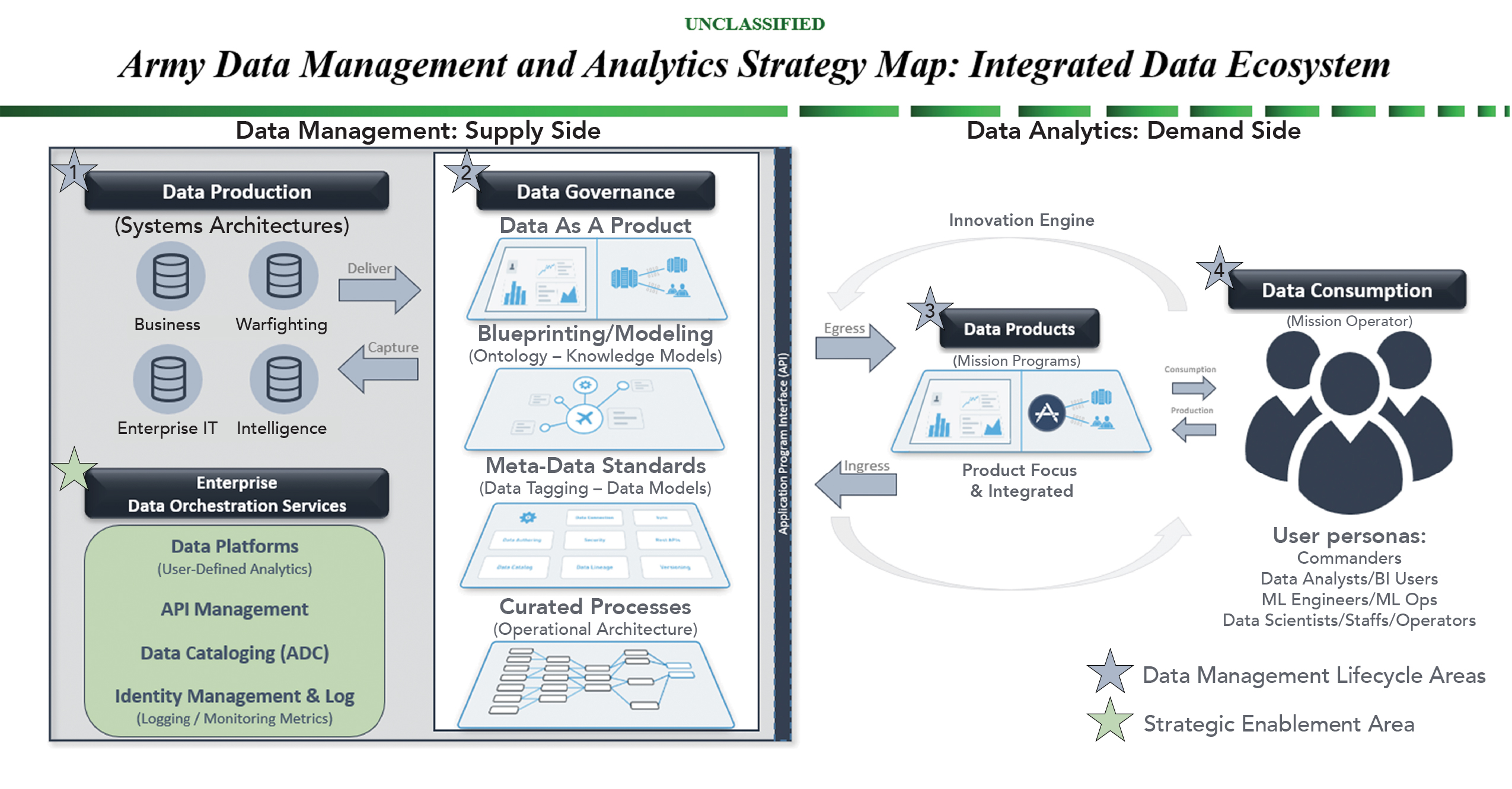
At the core of the Army’s technical strategy is the Army Data Management and Analytics Strategy (ADMAS) Map (see above). This map provides the conceptual blueprint for an integrated data ecosystem, separating the “supply side” of data management from the “demand side” of data analytics. The supply side focuses on data production and data governance. The demand side focuses on turning that data into data products for mission operators and enabling data consumption by business and warfighting personas.
Connecting these two sides are enterprise data orchestration services. This central hub enables the ecosystem to function and consists of data platforms, API management, data cataloging, and identity management. This architecture embodies principles of a data mesh – a decentralized approach where domain-oriented teams produce and own their data products while adhering to enterprise standards for interoperability.
From Data to Decisions
If the ADMAS Map is the architectural blueprint, the DDOF is the operational playbook for executing analytics projects. It provides a platform-agnostic six-phase lifecycle to transform data into decision-ready products.
The DDOF;s structure reflects a fundamental principle shared with frameworks such as the INFORMS Analytics Framework. That is, successful analytics begins not with data or technology, but with a clearly articulated problem, question, or opportunity. Too often, organizations fall into the trap of “solutions looking for problems” – deploying advanced analytics capabilities without first establishing what decision needs to be made or what operational challenge must be addressed. By mandating rigorous problem framing as phase 1, the DDOF ensures that every data product developed has a direct line of sight to a warfighter need or enterprise requirement, preventing wasted effort and ensuring that analytics investments deliver measurable mission impact.
The six phases of the DDOF are as follows:
- Problem framing. Transforming an operational need into a clearly defined, approved, and achievable data requirement.
- Data provisioning. Securing access to authoritative data sources, ensuring that the data is legally accessible and technically retrievable.
- Data wrangling. Transforming raw data into an analysis-ready form through cleaning, validation, and integration, ensuring it meets VAULTIS standards.
- Development. Building the functional data product, whether it’s a dashboard, model, report, or API.
- Test and evaluation. Validating that the product meets requirements, is fit for use, and provides accurate and reliable information.
- Operations. Deploying the product to production and establishing ongoing monitoring and maintenance.
This rigorous, phase-gated process ensures that every data product delivered is validated, trusted, and directly tied to a war-fighter need.
A Watershed Moment
Despite significant progress, the journey is far from over. The most formidable challenge is not technical, but structural. The current implementation of Title 44 U.S.C. §3520, which defines the Chief Data Officer (CDO) role, creates a situation where responsibility is not always matched with authority. While the CDO is responsible for data as a strategic asset, they often lack the independent enforcement authority to compel compliance across the enterprise. Internal policy guidance has at times remained advisory absent the CIO’s Title 10 backing, creating a disconnect between the data strategy and its execution.
However, the recently passed FY26 National Defense Authorization Act represents significant congressional reinforcement for data governance within the Department of War. Sections 1504, 2832, and 1533 of S. 2296 codify statutory requirements for data ontology, interoperability, and AI governance – elevating data management from policy guidance to legislative mandate.
This legislation directly validates and reinforces the foundational ADMAS principles that guide our work. While the new legislation provides significant top-down reinforcement, the path forward still requires a concerted effort to overcome decades of cultural inertia and build a truly data-literate force.
The Army will continue to execute the ADMAS. As of the publication of this article, more than 150 data products have been validated in the Army Data Catalog, enabling trusted AI/ML applications. The focus remains on maturing federated governance processes, expanding the data mesh, and scaling analytics and AI capabilities.
Achieving true data centricity will require pairing these internal efforts with the opportunities provided by the new legislative landscape to fully empower data leaders. This transformation is about more than just technology; it’s about fundamentally changing the way the Army thinks, operates, and fights.
Inclusion of this article is not, and should not be construed as, official Department of War (formerly Department of Defense) or Army endorsement of this publication.
References
44 U.S.C. § 3520 (2024). https://uscode.house.gov/view.xhtml?req=granuleid:USC-prelim-title44-section3520&num=0&edition=prelim
DAMA International, 2017, DAMA Data Management Body of Knowledge (2nd ed.).
Foundations for Evidence-Based Policymaking Act of 2018, Pub. L. No. 115–435, 132 Stat. 5529, 2019. https://www.congress.gov/115/statute/STATUTE-132/STATUTE-132-Pg5529.pdf
Garciga, L., 2025, “Army data stewardship roles and responsibilities (Fiscal Year 2025)” https://armypubs.army.mil/epubs/DR_pubs/DR_a/ARN43678-PPM_CIO-071-000-WEB-1.pdf
Kovalevich, D., 2024, “The Inaugural Army Data Summit: Operationalizing Data Centricity and Decision-Making,” Office of Enterprise Management, U.S. Army. https://www.army.mil/article/276528/the_inaugural_army_data_summit_operationalizing_data_centricity_and_decision_making
Lustig, I., Bos-Beijer, J., 2025, “The INFORMS Analytics Framework™: A Road Map for Success with Analytics,” OR/MS Today.
National Defense Authorization Act for Fiscal Year 2026, S. 2296, 119th Cong. https://www.congress.gov/bill/119th-congress/senate-bill/2296/text
Office of the Chief Information Officer, 2020, “Army Installs New Chief Data Officer,” U.S. Army. https://www.army.mil/article-amp/241038/army_installs_new_chief_data_officer
Office of Management and Budget, 2019, “Federal Data Strategy: A Framework for Consistency,” Memorandum M-19-18. https://www.whitehouse.gov/wp-content/uploads/2019/06/M-19-18.pdf
U.S. Department of the Army, 2021, “Army Digital Transformation Strategy.” https://api.army.mil/e2/c/downloads/2021/10/20/3b64248b/army-digital-transformation-strategy.pdf
U.S. Department of the Army, 2022, “The Army Data Plan.” https://api.army.mil/e2/c/downloads/2022/10/13/16061cab/army-data-plan-final.pdf
U.S. Department of the Army, 2018, “The Enterprise Data Analytics Strategy for Army Business (2018-2022). https://www.army.mil/e2/downloads/rv7/professional/enterprise_analytics_strategy.pdf
U.S. Department of Defense, 2023, “Data, Analytics, and Artificial Intelligence Adoption Strategy: Accelerating Decision Advantage.” https://media.defense.gov/2023/Nov/02/2003333300/-1/-1/1/DOD_DATA_ANALYTICS_AI_ADOPTION_STRATEGY.PDF
Alfred D. Hull serves as the director of Advanced Application Architecture & Delivery at weElevateIT, where he advises federal clients – including the Department of War – on the enterprise delivery of data and application capabilities in support of the Department’s Financial and Audit Readiness Strategy. Jordan H. Yahiro, CAP-X, is the chief of the Data Strategy, Policy, and Governance & Oversight Division supporting the U.S. Army Chief Data and Analytics Officer, where he is advancing the Army’s data-centric transformation. Jordan also serves as the president of the Washington, D.C. chapter of INFORMS.