
June 11, 2026 in World Cup
What Smarter Scheduling Can Deliver
Optimizing the World Cup Schedule to Reduce Travel Distance and Jet Lag
SHARE: PRINT ARTICLE: https://doi.org/10.1287/orms.2026.02.11

The 2026 FIFA World Cup is larger and more geographically dispersed than any previous World Cup. Forty-eight teams divided into 12 groups of four are playing in a group stage format in 104 matches across 16 cities in the U.S., Canada, and Mexico. From June 11 to July 19, the frequent long-haul trips required by this year’s competition mean athletes are facing disrupted sleep, reduced recovery time, and the familiar strain of jet lag when matches start soon after crossing time zones. For organizers, heavy travel also increases logistics complexity and can raise costs.
The key to reducing this travel burden without changing the tournament format can be achieved with a practical, data-driven approach. The idea is straightforward: keep the published group stage format intact (number of rounds, date windows, and standard operational rules), but rearrange the order in which matches are assigned to stadiums and days so teams can travel shorter distances among their matches. When travel distance decreases, time-zone changes typically lessen as well – an important benefit for the well-being of players.
Athletic performance depends on many factors, and it is widely accepted in sports science and player workload monitoring that travel and time-zone changes are meaningful stressors. Small scheduling choices – such as whether a team’s next match is in the same region or on the opposite coast – can meaningfully change the total burden for players across all 48 teams in the World Cup.
Redesigning The World Cup Schedule
To address this issue, we studied a “schedule-comparable redesign” problem. In plain terms, this means we preserved the public structure of the group stage, changing only the assignment of matches to specific stadiums and days.
To keep the redesign realistic, we adopted a set of tournament rules that reflect the published games calendar and incorporate basic stadium feasibility. They are:
- Each match is scheduled exactly once within its assigned round.
- The daily rhythm of the tournament stays consistent with the published calendar (e.g., the number of matches that occur each day in each round).
- Stadiums host a reasonable number of matches over the group stage, avoiding both underuse and overconcentration.
- Stadium operations are respected: A stadium is not assigned matches on consecutive days, and additional spacing is required early in the tournament to allow turnaround.
- Within each group and round, paired matches follow coordination rules, including simultaneous play in the final round to protect competitive integrity.
- Each team plays in exactly one stadium per round; a match can be placed in a stadium only if both teams are assigned there for that round.
Within these constraints, the redesign chooses where each team plays in Round 1, Round 2, and Round 3, and it assigns each match to a feasible stadium/day slot. The primary objective is to minimize total team travel between consecutive rounds (Round 1 → Round 2 and Round 2 → Round 3). Travel is measured using standard great-circle distances among host cities.
Benefits of an Optimization Model
At its core, the problem is an assignment puzzle with many rules. Each match needs a stadium and a day. Each team needs a consistent venue in each round. Stadiums have limits on how frequently they can host. Certain matches must be coordinated within a group, and the last round must be played simultaneously within each group.
An optimization model is a disciplined way to search through the enormous number of possible assignments while enforcing these rules. The model treats each potential assignment (for example, “Match 17 is played in Stadium X on Day Y”) as a yes/no decision. It then chooses a consistent set of yes/no decisions that satisfies all rules and yields the smallest total travel distance between consecutive rounds.
Importantly, the method is adaptable. If organizers introduce additional venue blackout dates, transportation constraints, or broadcast-driven requirements, those can be represented as additional “allowed/not allowed” rules. The same approach can then produce an updated best-in-class schedule under the new requirements.
Distance is the primary optimization target because it is intuitive and directly linked to logistics. However, distance alone does not fully reflect the physiological challenge of crossing time zones.
To quantify this second dimension, we grouped host venues into three time zones – Pacific, Central, and Eastern – and counted a “time-zone crossing” whenever a team’s next match is in a different zone than its previous match. Each team has two inter-round transitions, so it can experience zero, one or two crossings in the group stage.
This metric is intentionally simple. It does not attempt to model direction (east vs. west), the number of rest days available for adjusting to new time zones, or individual differences among players. Its value is that it provides an organizer-friendly way to compare schedules and to highlight where the calendar forces repeated transcontinental movement.
Key Results
The optimized schedule tends to keep teams in the same broad region across consecutive rounds. Movement is unavoidable in a tournament spanning multiple countries and time zones over a concentrated time span, but the redesign reduces “back-and-forth” patterns that drive fatigue and complexity.
At a high level, the model favors geographically compact paths for each team across its three group matches. When feasible, it also keeps the two inter-round legs (Round 1 → 2 and Round 2 → 3) short for multiple teams within the same group, so travel reductions are shared rather than concentrated on a single team.
Using the optimized schedule produced significant advantages:
- Total inter-round team travel drops from 61,324 miles (based on the currently published schedule) to 30,861 miles – a reduction of approximately 50%.
- Improvements are broad-based across groups rather than being driven by a single outlier.
- Time-zone crossings across all 48 teams drop from 24 to 4 – an 83% reduction.
The time-zone improvement is particularly notable because time zones were not the primary objective. Crossings fall sharply because the schedule keeps teams geographically closer between matches, which naturally reduces large east-west moves.
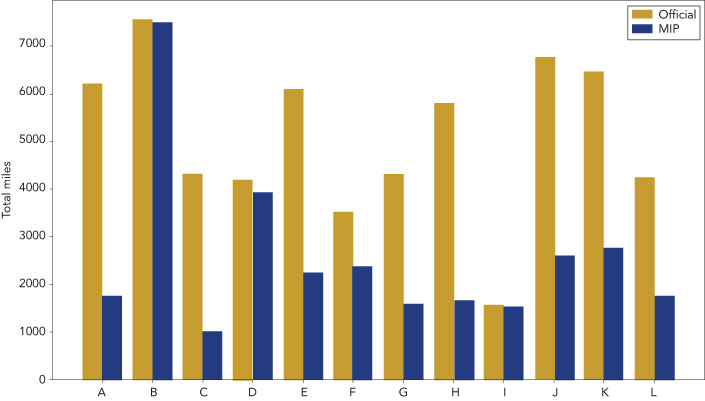
Figure 1: Total Group Travel: Official (Yellow) vs. MIP (Blue)
The results of this exercise are detailed in Figures 1-2. Figure 1 reports the total miles traveled by group (combining the four teams in each group), comparing the published schedule against the optimized schedule. The yellow bars in the graph correspond to the official FIFA schedule, and the blue bars correspond to the optimized schedule. Several groups show large travel reductions when the published pattern requires long coast-to-coast movement. A few groups show smaller changes, which is expected when flexibility is limited by fixed requirements and capacity patterns.
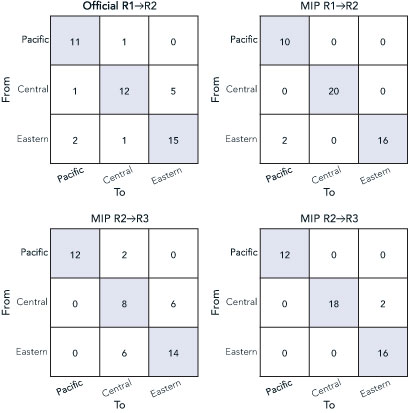
Figure 2: Anticipated time zone transitions
Figure 2 summarizes time-zone transitions. It contains two 3 × 3 transition tables: one for Round 1 → Round 2 and one for Round 2 → Round 3. Venues are grouped into three time zones (Pacific, Central, Eastern), and a crossing occurs when a team plays in different time zones in two consecutive rounds. Rows indicate the time zone in the earlier round (“From”), and columns indicate the time zone in the next round (“To”). Diagonal entries represent teams that stayed in the same time zone (no crossing), and off-diagonal entries represent time-zone crossings. The optimized schedule concentrates the counts on the diagonal, which is what reduces total crossings. For Round 1 → Round 2, the official schedule involves 10 time-zone crossings, whereas the optimized schedule involves just two crossings. For Round 2 → Round 3, the official schedule involves 14 time-zone crossings, and the optimized schedule again involves just two crossings.
Practicality of an Optimization Approach
World Cup scheduling is a multi-stakeholder problem. Competitive integrity, stadium operations, security, transportation, broadcast needs, and local constraints all matter. Travel minimization is not the only objective, but it is one of the few that can be measured cleanly and communicated transparently.
A structured optimization approach provides three practical benefits:
- It makes trade-offs explicit. If a particular operational rule forces more travel, the impact can be quantified rather than debated abstractly.
- It supports credible “what if” scenarios. Organizers can test alternative policies – such as stricter stadium turnaround rules, venue blackout periods, or different daily patterns and immediately see how travel changes.
- It improves communication. Clear metrics (e.g., miles and time-zone crossings) help explain decisions to stakeholders, including teams, medical staff, and operational partners.
In short, optimization is best viewed as decision support; it does not replace human judgment, but it helps surface schedules that improve player workload while remaining compatible with operational realities.
Limitations and Next Steps
This analysis is based on a publicly available schedule structure. Many field constraints that organizers must respect, including detailed stadium availability windows, local security considerations, contractual broadcast requirements, and city-level transportation constraints, are not publicly accessible and therefore are not included here explicitly.
In practice, these constraints can be incorporated by adding additional rules that fix or forbid specific match/venue/day assignments. The same method can then be rerun to identify the best schedule under the full set of constraints.
There are also natural extensions that would better reflect player recovery. Time-zone crossings could be optimized directly alongside distance, and crossings could be weighted by travel direction and by the number of rest days between matches.
Even with these limitations, the main message is clear: Keeping teams geographically compact across consecutive rounds can sharply reduce total travel miles and stabilize time-zone exposure – two factors closely tied to athlete recovery and workload.
References
FIFA World Cup 2026 Scheduler, Research paper optimization demo, https://igorlucindo.github.io/fifa-world-cup-2026-scheduler-APP/
FIFA World Cup 2026 Scheduler, Code and computational outputs repository, https://github.com/hamidrezavalidi/FIFA_World_Cup_2026
Hamidreza Validi is an assistant professor in the Department of Industrial, Manufacturing, and Systems Engineering at Texas TechUniversity. His research focuses on mixed-integer programming and its applications, with publications in Operations Research, Mathematical Programming Computation, INFORMS Journal on Computing, and INFORMS Journal on Optimization. His honors include the 2023 INFORMS Best Dissertation Award in the Telecommunications and Network Analytics Section and the 2021 INFORMS Computing Society Harvey J. Greenberg Research Award. Rogelio Gutierrez is a PhD candidate in Systems and Engineering Management at Texas Tech University and an engineering manager with 12+ years of experience across semiconductor manufacturing, heavy industrial operations, assembly, and aerospace production. His research focuses on optimization methods for large-scale production systems and decision-making frameworks that improve throughput, capacity utilization, and overall performance. Igor Cardoso is a PhD student in the Industrial, Manufacturing, and Systems Engineering Department at Texas Tech University. His work centers on mixed-integer programming and large-scale optimization. He develops algorithms and mathematical models for complex industrial challenges, including network-based portfolio optimization and GPU-accelerated optimization solvers.