


June 23, 2026 in membership
A Big Tent, by Design
SHARE: PRINT ARTICLE: https://doi.org/10.1287/orms.2026.02.23
An assistant professor in a business school.
A full professor in an engineering school.
A data scientist at a global retailer.
A military analyst.
A nonprofit program director.
A PhD student in applied math.
A consultant working solo.
All of them are part of INFORMS. That’s not accidental; it’s by design.
Our strategic plan commits to “taking a big tent approach to all activities to ensure that all individuals and organizations within our wider community are served well.” I’ve been sitting with that phrase lately, not just as a description of who we are, but as a reminder of what we’re trying to be. This month, I want to take you on a tour of our big tent. Because I think most of us, even those who have been members for years, underestimate how big it really is.
Who’s in the Tent*: Where You Work
Let's start with where our members work, because the range is genuinely remarkable.
Academia alone contains multitudes. Our academic members work in business schools, engineering programs, mathematics departments, statistics programs, and beyond. They hold faculty positions at R1 and R2 research universities, regional universities, liberal arts colleges, and community colleges. They are graduate students just entering the field, postdoctoral researchers building their expertise, and senior administrators shaping institutions. They are lecturers, adjuncts, and department chairs.
The industries we represent are just as broad. Our members work in large multinational companies, mid-size and small businesses, and solo consulting practices. They work in healthcare, finance, retail manufacturing, technology, transportation, energy, and entertainment. Some manage teams of dozens of analysts. Others are the only people in their organizations who know what operations research and analytics means (and probably spend half of their time explaining it!).
Government and military members are also in our tent. They work at federal agencies, in the armed forces, and at the state and local level, applying analytical thinking to problems that range from logistics and procurement to public health and national security.
And then there are our nonprofit members. These members are at foundations, NGOs, associations, and mission-driven organizations. They are using the tools of our field to allocate scarce resources, measure impact, and make the case for evidence-based decision-making in sectors that don’t always reward it.
Who’s in the Tent: What You Work On
The disciplinary breadth of our community is just as striking. INFORMS is home to researchers and practitioners working in operations research, management science, analytics, data science, artificial intelligence, machine learning, decision science, industrial and systems engineering, statistics, applied mathematics, economics, behavioral science, and emerging areas such as quantum computing.
These varied disciplines represent different terminology, different methods, different journals, and different conferences, but they often address the same underlying questions: How do you allocate scarce resources? How do you make better decisions under uncertainty? How do you design systems that work? (I hope you are all using our INFORMS Analytics Framework – nudge, nudge.)
That shared purpose is what makes cross-disciplinary exchange possible – and it’s increasingly where the most interesting work is happening.
Who’s in the Tent: Who You Are
Our community reflects extraordinary demographic breadth. We include members at every career stage, including students just starting out, mid-career professionals navigating transitions, and senior leaders who have shaped the field for decades. We include members across a wide range of identities, shaped by their ethnicity, race, gender identity, age, and more. We include members from more than one hundred countries, cultures, and educational traditions. Many were trained in one country and now live and work in another.
The U.S. remains our largest membership base, but we are seeing significant and sustained growth in Asia and across the globe. That geographic expansion isn’t just a membership metric; it represents incorporating new perspectives, new challenges, and new energy into our community.
Where you started, where you trained, what you look like, the languages you speak, and where you are in your career all shape how you perceive problems and, of course, what solutions you can imagine. That’s not incidental to what we do; it is what we do.
How the Tent is structured; The Foundations of Our Tent
A big tent only works if there is structure to support it, and I’m proud that INFORMS has built that structure deliberately over many decades.
Our peer-reviewed journals advance knowledge and create a shared foundation of ideas across the field. Our annual meeting and specialty conferences create spaces where people connect across sectors, disciplines, and career stages in ways that don’t happen anywhere else. Our subdivisions — societies, sections, forums, and chapters — create smaller communities within the larger whole, where members can find colleagues who share their specific interests or experiences.
Those smaller communities matter enormously. Groups like the Minority Issues Forum, Women in OR/MS, and Pride create spaces where members can both contribute and belong. Early-career communities help people find their footing. Chapters bring INFORMS closer to home, regionally and institutionally.
Beyond community, we support professional growth through the Certified Analytics Professional (CAP) credentials, continuing education, and career resources, including our job board and career advice. And our awards and honors program, one of our crown jewels, recognizes excellence across the full spectrum of what I’ve just described: across sectors, disciplines, career stages, and demographics.
This isn’t a collection of offerings assembled over time. It’s an ecosystem designed to support people at every stage of their careers from every path in our field.
What the Tent Demands
I've spent most of this column celebrating the breadth of INFORMS, and I mean every word of it. But I want to end with a challenge.
A big tent is easy to celebrate when everyone inside of it agrees. The real test of that tent is what happens when they don’t.
When members feel strongly enough about the direction of their professional community to organize, advocate, challenge, and push, that is not a sign that the tent is failing. Rather, it’s a sign that the tent is working. People who feel they belong feel entitled to participate. People who feel invested in something want to give voice to how it evolves. That’s not a problem to be managed. It’s a feature to be embraced and a community functioning as it should.
What a big tent demands, then, is not only the inclusion of different kinds of people, but also the inclusion of different kinds of voices. It demands processes that are worthy of the trust members place in them. It demands leaders who create and maintain governance structures that can channel different needs and perspectives productively.
We all have a right to be included. And we all carry a responsibility to include others, especially when their views, experiences, or visions differ from our own. This can mean stepping up, stepping together, or stepping back.
That is what turns breadth into belonging and ensures a professional community is worth our time, investment, and commitment.
* While I tried to include examples of all our constituents and stakeholders, it’s not possible to fully capture in one column. If you weren’t included in one of my laundry lists, I apologize. I may not have specifically named you, but you are here in spirit, and I assure you that you belong here. Feel free to email me at [email protected] to
let me know.
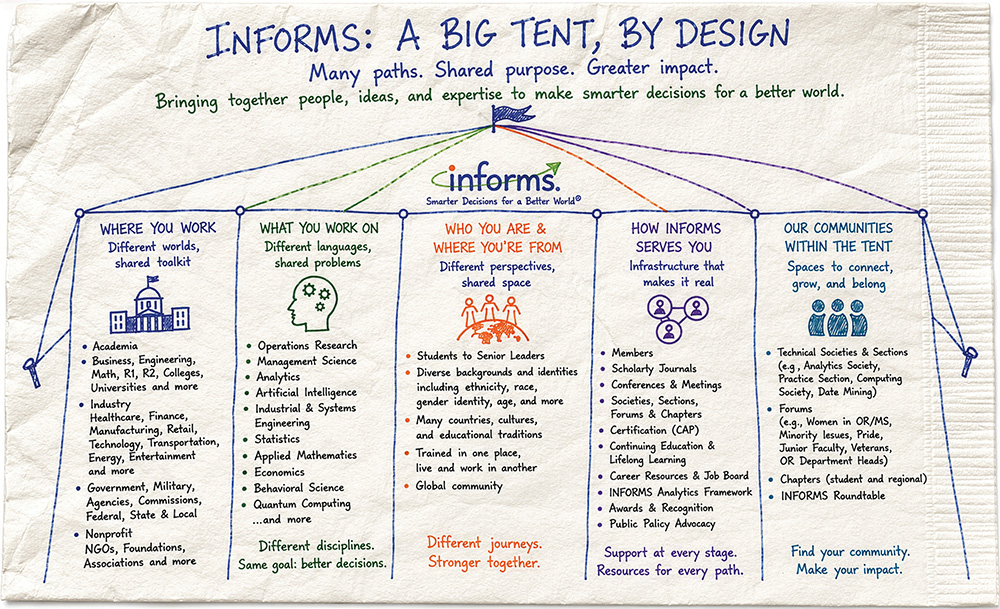
Help Needed! I spent time drawing up a visual of my thoughts. It isn’t perfect yet. I need your help. Let me know what you think and any suggested edits you may have. (And, yes, I used AI because my handwriting and art skills are terrible.)
Elena Gerstmann, Ph.D., FASAE, CAE, is the executive director of INFORMS (5521 Research Park Drive, Ste. 200, Catonsville, MD 21228). She can be reached via email or by phone at 443-757-3521.
([email protected])