September 3, 2026 in Community
The INFORMS Community
SHARE: PRINT ARTICLE: https://doi.org/10.1287/orms.2026.03.09
Thank you for taking the time to read my second update from the President’s Desk. Over the last several months, I have been reflecting on what makes the INFORMS community unique. My purpose here is not to propose solutions, but rather to remind us of one of our greatest strengths: the breadth of perspectives that come together within a single professional home.
As many of you know, INFORMS brings together people whose work touches operations research and management science, creating opportunities to interact, exchange ideas, and build collaborations. Yet despite this shared identity, we remain somewhat fragmented.
Consider just the academic community. Our members come from R1 universities and many outstanding institutions without that designation. They work in business schools, colleges of computing, engineering schools, mathematics departments, and other academic units. Some focus primarily on research, while others devote much of their energy
to teaching and educational innovation.
The same diversity exists among practitioners. Some work in large, established manufacturing companies, while others are part of technology firms or startups. Some organizations have extensive analytics teams, while others rely on a single OR/MS professional. Even within industries, priorities differ. The revenue management challenges faced by airlines, for example, are distinct from the supply chain challenges encountered in trucking or rail transportation.
Within our technical communities, differences abound as well. A classic example is the distinction between discrete and continuous optimization. Beyond our professional identities, we also bring a wide range of personal experiences and backgrounds. Our members represent different cultures, ethnicities, genders, career paths, military experiences, and regions of the world.
Many of these groups are now large enough to sustain vibrant communities on their own. Yet we continue to invest in something larger. We share a belief, one I consider a fact, that we are better off as part of the broader INFORMS community.
Why is that?
Setting aside the personal relationships many of us have built across these groups, I believe the most important reason is that the most interesting and consequential problems are best addressed through respectful collaboration among people with different perspectives and expertise.
Consider the relationship between academics and practitioners. What they bring to one another is not redundancy, but complementarity. Advances in theory become more powerful when informed by real-world challenges. At the same time, practice benefits from rigorous methods, new perspectives, and fresh ideas.
As a stochastic modeler, I naturally appreciate the role of mathematical models, and many of my colleagues work in deterministic modeling. Yet models alone do not solve problems. Success also depends on estimating, calibrating, and tuning parameters; understanding which theoretical advances can be translated into practice; and identifying the problems that matter most within a particular industry or sector. Many practitioners excel in these areas, and their contributions add immeasurable value to our collective efforts.
This is only one example. I could just as easily point to the importance of educators and researchers who are helping our profession navigate the rapidly evolving role of AI in the classroom. Or I could highlight the opportunities for mutual learning between the United States OR/MS community and our colleagues around the world.
I will conclude with a simple reminder: no part of INFORMS belongs exclusively to any particular subgroup. Every community within INFORMS is open to everyone. We are stronger because of our diversity of experiences, perspectives, and expertise, and we are better when we engage across those differences.
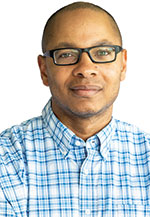
Mark Lewis is the Maxwell M. Upson Professor of Engineering at Cornell University. He is the 2026 INFORMS President.