September 3, 2026 in AI Adoption
The AI Divide at Work
Where Employees and Employers Agree and Disagree on AI’s Promise
SHARE: PRINT ARTICLE: https://doi.org/10.1287/orms.2026.03.12

Multiple recent surveys indicate vast differences between employers and their employees in how they perceive AI usage in the workplace. Much of this variance has to do with employees’ trepidation of how AI will affect their privacy and job security and whether their employers are preparing them for how AI will change the workplace overall.
In 2024, a global ADP Research Institute survey of nearly 35,000 private-sector employees in 18 countries found that 85% of employees believe that AI will impact their jobs within the next 2-3 years.1 Workers recognize that they will need to be open to changing how they work to accommodate AI usage in their organizations.
But training remains an issue. A 2023 Boston Consulting Group survey of nearly 13,000 workers in 18 countries found that employees recognize the need for AI training and upskilling, but few say they have received it. Employers tend to express more optimism in this area. In another survey, 72% of employers said their employees are at least adequately trained on AI, while 53% of workers said the same.2
Employees hold their employers responsible for preparing them for AI-enabled workplaces. A study reported in CIO magazine in 2024 found that of 2,500 full-time employees in the US, UK, Germany, and India, 74% say that employers are to blame for their AI skills gap.3
As a result, few employees feel prepared to use AI in their current roles, with 32% saying they are “very uncomfortable” using AI, according to a Gallup survey.4 Gallup suggests three key strategies for supporting AI adoption within organizations: companies should communicate their plans for AI integration early, clearly establish guidance for AI use in the organization, and provide training aligned to employees’ roles.
Given the disconnect between employees and employers on the effects of integrating AI into the workplace and preparing for its potential impacts, we set out to further illuminate what needs to be done to better align employers’ and employees’ perceptions of AI and how key policies and programs can bridge this gap.
How Employees Use AI
Slingshot’s 2024 Digital Work Trends Report reveals a significant disconnect between managerial expectations of how employees should be using AI and how they use it in reality.5 Findings show that employers have implemented AI to support employees’ initial research for tasks and projects (62%), help employees manage their workflow (58%), and analyze data (55%). Yet nearly two-thirds of employees (63%) say they are primarily leveraging AI to double-check their work.
Many employers recognize that they also are not using AI to its fullest potential. Nearly half (45%) say they haven’t yet implemented AI because their company’s data is not ready. Often, this means data is siloed across the organization and not accessible. Employees also recognize this problem. Thirty-two percent say they need more training regarding data before their company is ready to support AI; 77% say they are lost on how to use AI in their own careers.6
Yet many workers believe in AI’s promise. A 2024 survey by Insight Enterprises in partnership with The Harris Poll found that 75% of employees believe investing in AI-powered devices will help their employer stay competitive, and a similar number (73%) expect to be more productive in their daily lives.7 But close to half (45%) are also cautious that AI-powered devices will make what they do less relevant to their employer.
Workers also have trepidation about privacy issues in the workplace. A 2023 Pew Research survey found that most Americans report unease or uncertainty when contemplating potential uses of AI by employers to monitor workers.
A study by Microsoft explored the impact of AI on the employee experience, predicting that AI will initially widen the skills gap but ultimately help talented professionals elevate their roles within organizations.9 This kind of insight can guide the development of targeted training programs and AI adoption strategies.
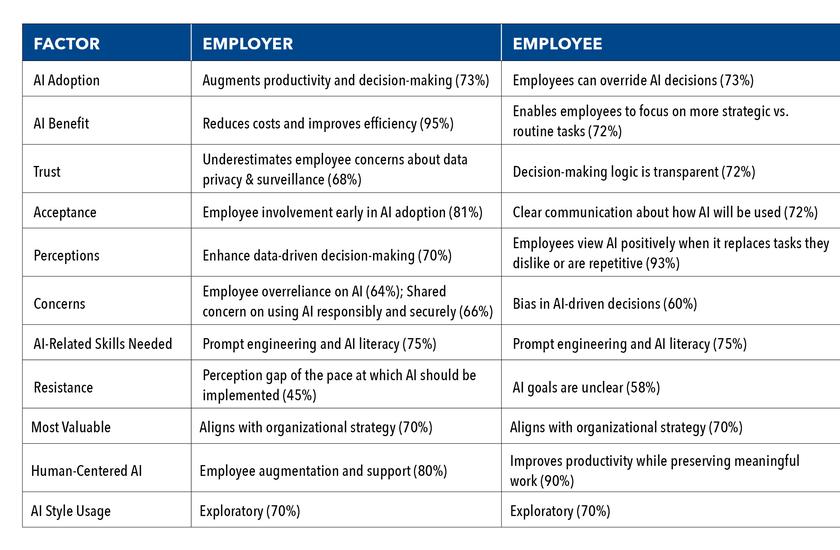
Table 1: Factors most valued in AI adoption in the workplace
The Role of Government
Although federal AI policy priorities have evolved, workforce development and AI literacy remain central themes to be addressed. Policymakers should continue to focus on workforce displacement, workers’ rights, privacy, workforce upskilling and adaptation, balancing innovation with appropriate safeguards, mitigating discrimination, ensuring data privacy, improving transparency and explainability, and supporting worker retraining programs.10 The National Institute of Standards and Technology continues to play an important role by developing voluntary frameworks and guidance for trustworthy AI and emerging technologies. Future policy efforts should continue to support workforce preparedness while fostering responsible AI innovation.
Some researchers have advocated that the equal opportunity merit principle is an ethical approach for fair AI employment decision-making.11 Others have found that workers’ distrust in workplace AI stems from perceiving AI as a job threat.12 Another found that there is a need for proactive adaptation strategies in terms of employment policies.13
In February 2026, the U.S. Department of Labor issued an AI Literacy Framework, which emphasizes preparing pathways for employees’ continued learning in AI and equipping managers and others to support that learning.14
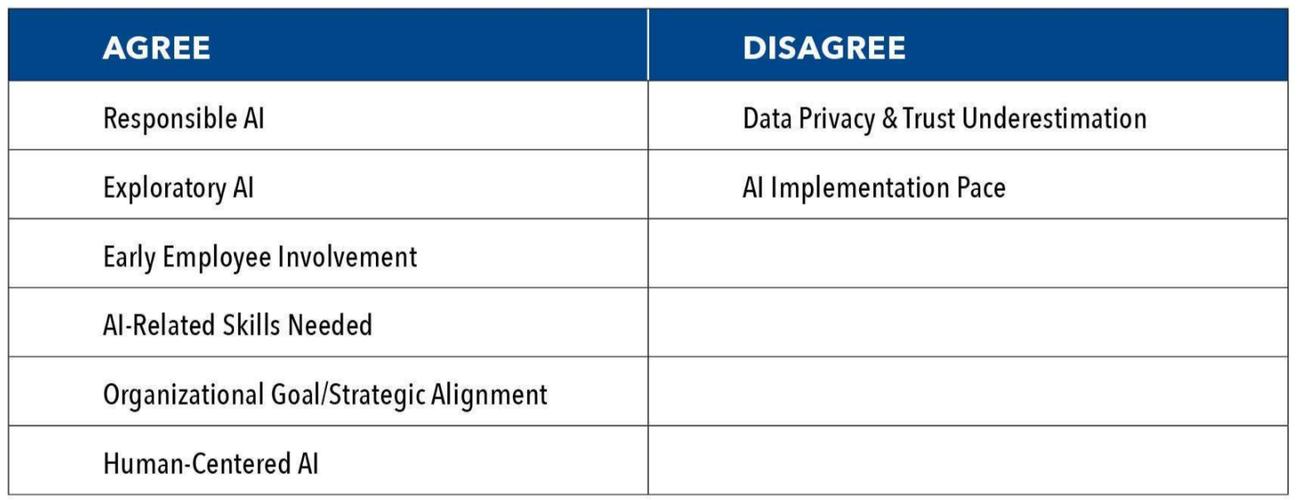
Table 2: Perception alignment between employers and employees
Further Discussion
To better understand employer and employee perceptions of AI, we created a survey to gather further insights into this issue. We piloted a 25-question Qualtrics survey through the Corvinus University School of Executive Education and Development database to gain clarity on the different perceptions of AI among workers, managers, and executives in the United States and Hungary.
In addition, we used a convenience-based sample to send the survey to alumni, students, and corporate contacts at the Corvinus University of Budapest, Hungary. The respondents represented 49% workers and 51% managers and executives. We also conducted follow-up interviews with C-level executives of leading companies in Hungary. The key results from the multiple-choice survey given to employers and employees with the aggregated top responses are shown in Table 1, and observations are recorded in Table 2.
Executive Perspectives
Our interviews with members of the C-suite indicated that this segment is most focused on:
- How organizations use AI
- Data management and access
- Governance and oversight
- Customer impacts
- Practical business applications rather than purely technical AI development
The executives also indicated that they use AI for exploratory purposes 70% of the time, and 30% of the time for confirmatory purposes.
Interviewees recognized that employees will see fundamental changes from the deployment of AI in the workplace. One commented, “This is more of a transformation than a direct replacement, and that will present challenges for employees.” Another said, “So, I don’t think knowledge workers or white-collar workers will be replaced in entirety, but they will have to change their mindsets.”
Discussion and Recommendations
Based on the preliminary survey, interviews, and supporting literature, several steps can better align the perception of AI between employees
and employers.
- First, organizations must build trust. Open and transparent communication can reduce employees’ fears that AI will replace them and help clarify AI’s role in the workplace. Organizations should increase AI literacy by educating employees about AI’s capabilities and limitations, demonstrating how AI can support idea generation and decision-making, and providing opportunities to develop skills for human-AI collaboration. Employees also want to retain the ability to override AI recommendations and keep “a human in the loop.”
- Second, both employers and employees need to adopt a new mindset. One company interviewed expects AI to generate 40% of its developers’ code by 2027, illustrating how rapidly work is changing. As with any major technological shift, effective change management is essential. Involving employees in AI selection, development, and implementation builds trust and increases the likelihood of successful adoption. Equally important is providing practical training, including developing employees’ prompt engineering skills for generative AI systems.
- Finally, organizations should encourage the use of both exploratory and confirmatory AI. Survey results suggest exploratory AI is used more frequently. However, each approach serves a distinct purpose. Exploratory AI supports front-end idea generation and creative exploration, while confirmatory AI is typically used after independent analysis to validate decisions. Used together, these approaches can strengthen decision quality. Organizations should educate employees about both methods and provide examples of how they complement one another in practice.
Together, these recommendations can help create a shared vision for AI adoption between employers and employees. Future research will expand the survey to a broader international audience, with specific emphasis on Central Europe, and further examine the complementary roles of exploratory and confirmatory AI in organizational decision-making.14-19
References
1. Hanowell, B., Richardson, N., 2024, “Most Workers Think AI Will Affect Their Jobs. They Disagree on How,” ADP Research Institute, https://www.adpresearch.com/worker-sentiment-ai-impact/.
2. Beauchene, V., de Bellefonds, N., Duranton, S., Mills, S., 2023, “AI at Work: What People are Saying,” BCG, https://www.bcg.com/publications/2023/what-people-are-saying-about-ai-at-work.
3. White, S., 2024, “74% of Workers Suggest Employers to Blame for Their AI skills Gap,” CIO, https://www.cio.com/article/3542980/74-of-workers-suggest-employers-to-blame-for-their-ai-skills-gap.html?amp=1.
4. Den Houter, K, 2024, “AI in the Workplace: Answering 3 Big Questions,” Gallup, https://www.gallup.com/workplace/651203/workplace-answering-big-questions.aspx.
5. Slingshot, “2024 Digital Work Trends Report,” https://www.slingshotapp.io/2024-digital-work-trends-report/.
6. Robinson, B., 2024, “77% of Employees Lost on How to Use AI in Their Careers, New Study Shows,” Forbes.
7. Insight Enterprises, 2024, “Insight Survey: Employees Embrace AI in the Workplace, Want More Training, Guidance from Employers,” https://investor.insight.com/news-releases/news-release-details/2024/Insight-Survey-Employees-Embrace-AI-in-the-Workplace-Want-More-Training-Guidance-From-Employers/default.aspx.
8. Rainie, L., Anderson, M., McClain, C., Vogels, E. A., Gelles-Watnick, R., 2023, “Americans’ Views on Use of AI to Monitor and Evaluate Workers,” Pew Research Center, https://www.pewresearch.org/internet/2023/04/20/americans-views-on-use-of-ai-to-monitor-and-evaluate-workers/.
9. Knudssen, E., 2023, “Surveying Employees About AI at Work,” Microsoft, https://techcommunity.microsoft.com/blog/viva_glint_blog/surveying-employees-about-ai-at-work/3951915.
10. Liebowitz, J., McAlindon P. (eds.), 2026, Leveraging AI for Business Innovation, World Scientific Publishing.
11. Chan, G., 2024, “AI Employment Decision-making: Integrating the Equal Opportunity Merit Principle and Explainable AI,” AI & Society Journal, Singapore Management University, Vol. 39, pp. 1027-1038, https://ink.library.smu.edu.sg/cgi/viewcontent.cgi?article=6476&context=sol_research.
12. Zirar, A., Ali, S. I., Islam, N., 2023, “Worker and Workplace AI Coexistence: Emerging Themes and Research Agenda,” Technovation, Vol. 124.
13. Olaniyi, O., Ezeugwa F., Okatta C., Arigbabu A., Joeaneke P., 2024, “Dynamics of the Digital Workforce: Assessing the Interplay and Impact of AI, Automation, and Employment Policies,” Archives of Current Research International, Vol. 24, Issue 5, pp. 2454-7077.
14. U.S. Department of Labor, 2026, “U.S. Department of Labor Releases AI Literacy Framework Providing Foundational Content Areas, Delivery Principles to Guide Nationwide Efforts,” https://www.dol.gov/newsroom/releases/eta/eta20260213.
15. Liebowitz, J. (ed.), 2024, Pivoting Government Through Digital Transformation, Auerbach Publications.
16. Liebowitz, J. (ed.), 2025, Achieving Digital Transformation Through Analytics and AI, World Scientific Publishing, World Scientific Publishing Co. Pte. Ltd., number 13939.
17. Liebowitz, J. (ed.), 2024, Regulating Hate Speech Created by Generative AI, New York: Auerbach Publications.
18. Liebowitz, K., Liebowitz J. (eds.), 2025, Digital Transformation in Government: Insights, Experiences, and Best Practices, World Scientific Publishing.
19. Merlo, T. R., Liebowitz J. (eds), 2026, Ethical AI and Data Science: Building Trustworthy and Transparent Systems, Auerbach Publications.
Jay Liebowitz recently served as the inaugural Executive-in-Residence for Public Service at Columbia University’s Data Science Institute. His main role was to infuse data science and analytics into the U.S. federal government, with support from the Partnership for Public Service. His recent books are “Pivoting Government Through Digital Transformation” (Taylor & Francis, 2024) and “Digital Transformation for the University of the Future” (World Scientific Publishing, 2023). His newest book, due to be published in mid-2024, is titled, “Regulating Hate Speech Created by GenAI” (Taylor & Francis). Andrea Ko is the head of the Institute of Data Analytics and Information Systems at the Corvinus University of Budapest, Hungary. She can be reached at [email protected]. Laszlo Eszes is the head of the Corvinus-SEED (School for Executive Education and Development) at the Corvinus University of Budapest, Hungary. He can be reached at [email protected]. 
([email protected])