


September 6, 2026 in Last Word
Using O.R., Math, and Art to Motivate Beauty, Advocacy, and Fun
SHARE: PRINT ARTICLE: https://doi.org/10.1287/orms.2026.03.17
O.R.’s blend of mathematics, computation, and application has interested me since my first course in linear programming. It was a computer science course that I took on a lark way back in the spring of 1988 as an undergraduate student of mathematics. I enjoyed the course and sought an undergraduate research experience in O.R. the following year; I was fortunate to have had a math professor guide me through a project on Lemke’s algorithm.
This project had two contemporaneous continuations germane to our community. The first was that I later worked with a fellow math student on a MATLAB version of Lemke’s algorithm that was once distributed as an LCP solver. (As a sidenote, that student is now Dr. Leanne Holder and my spouse of 32 years.)
The second was that my research mentor, Dr. Jeffrey Stuart, continued to dabble in O.R., and he later wrote the first version of linprog, which is still distributed on MATLAB’s file exchange. The aesthetic mathematical power of O.R. to solve diverse, clever, and salient problems, especially when coupled with modern computing, had hooked me, and I decided
to continue with mathematics and its applications in O.R.
The Alure of O.R.
The happenstance through which I discovered O.R. is not unique, and many colleagues have mentioned how they also stumbled onto O.R. as students of mathematics. It is like we had been meandering through a vast mansion of rigor and logic and had paused for a respite in a comfortable cubbyhole, one that had happened to open to O.R.’s enticing landscape. We were drawn to that landscape by the aura of alluring problems, similar to how the wafting smell of baking bread draws one toward an appetite. We had been unaware of our hunger, but we couldn’t leave without sampling what there was to enjoy.
People in O.R. similarly find their way to myriad enclaves, with some finding engineering or computer science, others business or analytics, and a few, like me, staying close to mathematics. Indeed, I never wanted to leave the esoteric and elegant rigor of mathematics because its challenges had fostered an austere beauty, and its puzzles and comeliness had both tickled my competitiveness and won my heart.
Jerry King makes the case in The Art of Mathematics that mathematicians and engineers share an appreciation of beauty because both disciplines are, at their cores, about the artful application of known principals to solve problems.
As such, mathematicians and engineers are closer to one another than they are, for example, to the sciences. The shimmer of a well-constructed combination of elements to establish something new, and to see how different pieces dovetail to unravel a truth that had previously been a mystery – that is the stuff of a content intellectual life, and it is what has drawn me to both mathematics and O.R.
Getting the Band Back Together
I adore sharing mathematics and O.R. with students, and I have fortunately had 27 years as a mathematician at two outstanding undergraduate institutions. Several of my students have continued with O.R., drawn, like myself, to the clever and practical utility of mathematics to solve real-world problems. I have especially enjoyed whetting their appetites by guiding them in undergraduate research, although, if I’m honest, my students have instead regularly guided me. It can be breathtaking when an inquisitive and bright young mind, one that is unjaded by the literature and unencumbered by normative trains of thought, posits a question.
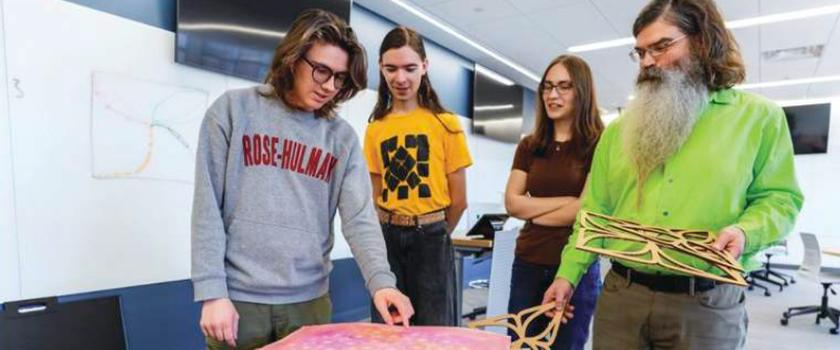
My latest cohort had six students, five of whom had been in one of my Calculus III courses in fall 2022. The pandemic had been hard, especially so for me with regard to education, and this group of crack students had worn jubilation on their countenances as we explored together, in the same room, the subtly of decomposing acceleration into tangential and normal components and the importance of having positive definite Hessians when seeking to minimize functions.
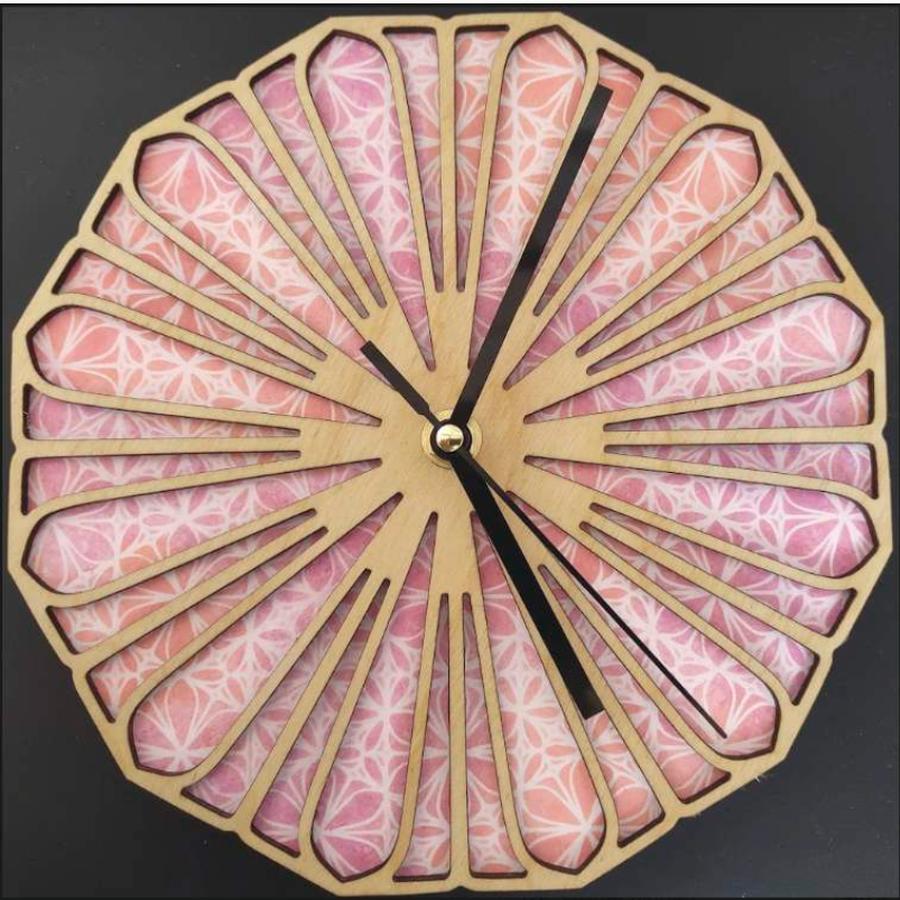
Figure. 1 A central path tiling framed by central paths makes a nice clock .
The old adage that you don’t know what you’ve got until it’s gone had proven true; I found that the exhaustive chaos of the pandemic had not diminished my joy for the free-flowing banter of discovery with my students. It was clear that it was time, as the Blues Brothers would say, to get the band back together.
The six of us began meeting on Friday afternoons. I brought cookies, and they brought interest and enthusiasm. I pitched a few ideas, and they selected a project on math and art that I had been toying with for years. I have no formal art education, but I had followed Bob Bosch’s award-winning Opt Art projects.1 I had also always been intrigued by the images that I had created to illustrate the central path for my linear programming students. This structure is important to the field of optimization, enough so that some have argued that it revolutionized the discipline.2 But it is also beautiful
.
So every Friday we would shed our academic responsibilities, chomp on sweets, and learn about the mathematics and behavior of the central path, often well into the evenings. The experience of being surrounded by exuberant sophomores who were willing to start their weekends by studying convexity, the implicit function theorem, duality, and how the central path converges was therapeutic after the pandemic. By mid-year, we had a reasonable mathematical background and working code. One of the students, Connor Tasik, a double major in mathematics and computational science (and a minor in art), wrote their own g-code so we could print paths with an FDM printer. It was magical, and for the first time, we could touch, twirl, and admire a physical central path. This project had become more than fun – it had become productive!
Art and Advocacy
The project continued to grow mathematically, computationally, and artistically, and our low-dimensional focus prompted an amusing mathematical result. We were specifically motivated by a desire to create a surface of central paths to limn depictions of tulips, with the goal being to create a bouquet of central paths.
Mathematics majors Ben Glancy and Alexa Renner proved an equivalence between central paths in a cube and central paths in a right circular cylinder – a relationship that was quizzical because paths for different algebraic descriptions of the same geometry typically differ. Our result countered this sentiment and instead showed that central paths among different geometries, and subsequently different algebraic descriptions, were the same. The result meant that we could artistically mimic the beauty of a tulip by generating paths in a polytope. While printing tulips has remained elusive (our svg files are sadly unmanageable), we have been able to print bouquets of daisies and thistles.
The beauty of mathematics is typically restricted to those with training, but our project advanced a rigorous and whimsical aesthetic available to everyone, and as such, it has become a springboard to advocate for mathematics and O.R. Rose-Hulman’s chapter of the Association for Women in Mathematics sponsors an annual "Sonia Math Day" for high-school students, and we have thrice led math and art events. Our first interactive presentation was in spring 2024. An electrical engineering student, Rebecca Testa, built circuits and physical controls that linked to our graphical interface and our computational platform. Angela Milkowski, a biomathematics and chemical engineering student, created the graphical interface, and Thor Catteau, a mathematics and computational science student, created the computational platform.
Participants used the controls to design patterns of central paths, and they later received customized acrylic backpack tags with etchings of their designs. The combination of math, engineering, and art had been a hit, and we continued in 2025 and 2026 by respectively guiding participants on how to use SolarFast to create customized prints and by having participants individualize T-shirts with tessellations of central paths.
The project reached new heights in summer 2025 when Connor Tasik dedicated themself to creating a large-scale work of art. Museum-quality pieces require a significant amount of industry. There is an ever-present learning curve; the labor of experimenting with form, color, and material; a constant barrage of pesky challenges; and the seemingly infinite tedium of careful and meticulous repetition.
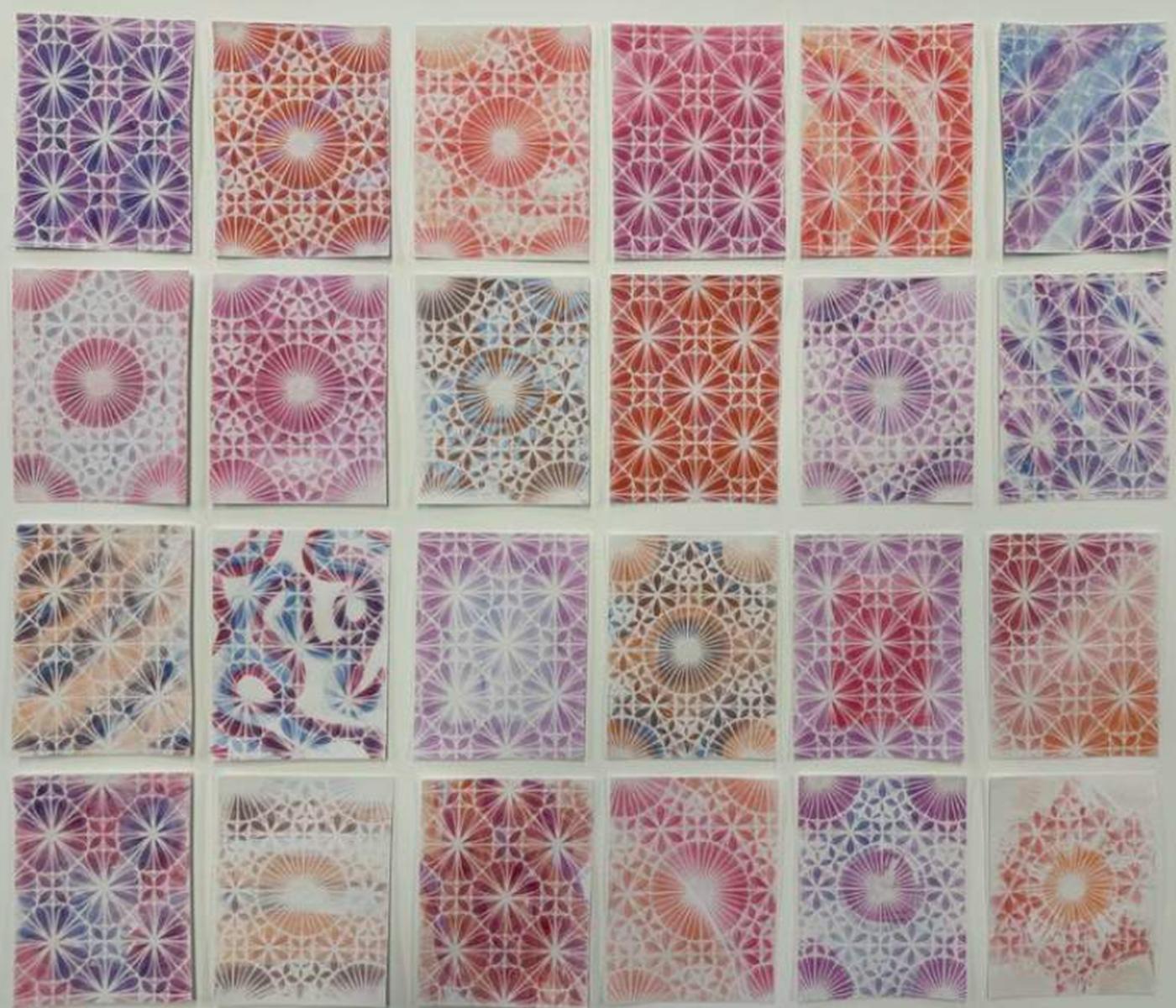
Figure 2. Central path art created by Sonia Math Day participants.
Connor had a complete concept after six weeks of investigation, and they prototyped their 10.5- × 4-foot piece in the area in which it would hang. I thought it was spectacular, but I had no idea if a real artist would agree. A few days later I turned the corner to walk by the prototype, and there sat our resident artist, Soully Abas, whom I knew would be honest. We are all familiar with the gnawing angst of reading referees’ critiques of our own work, and this interaction promised to be similar, albeit face-to-face.
I said hello to Soully and braced myself, and she turned and said, “I'm mesmerized.” It was the most succinct and affirming review of my career, and I relaxed. Soully and our art curator, Christy Brinkman-Robertson, were keen supporters that summer, and they thankfully provided space, materials, and guidance. Connor toiled for weeks thereafter to
complete their vision, and we celebrated the piece’s installation at Homecoming that fall.
The project has taken, and continues to take, other turns. We now have a paper that will appear in the Journal of Mathematics and the Arts, and Connor has two pieces in Rose-Hulman's permanent art collection and two others published in Rose-Hulman's Ink magazine. We have held three art shows at regional mathematics conferences and will hold another at this year’s "Modeling and Optimization: Theory and Applications" (MOPTA) conference.
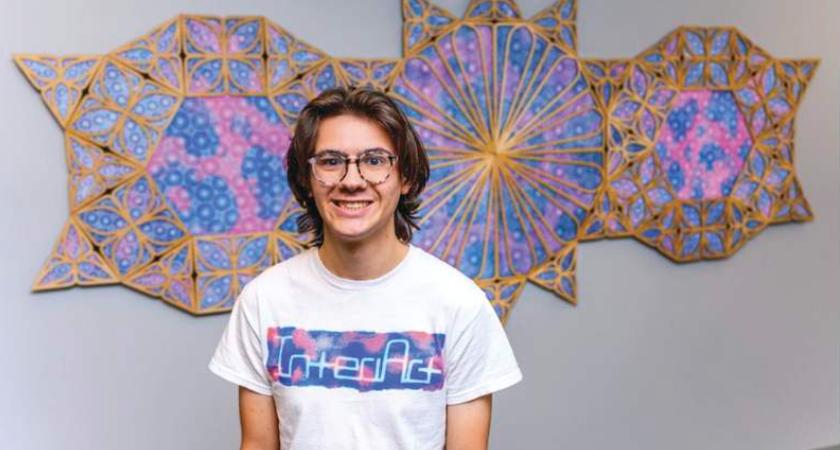
Figure 3. Connor Tasik with their InteriSpective installation (photo courtesy of Rose-Hulman/Bryan Cantwell)
Last spring I received an email from Elena Gerstmann inviting me to represent INFORMS on the Conference Board of Mathematical Sciences (CBMS), which is an umbrella society of 19 professional mathematical organizations. The CBMS is celebrating 2026 as The Year of Math, which is a national campaign advocating for America’s appreciation of mathematics. I was happy to accept the position and was eager to promote INFORMS within this broad mathematical community. After all, we want more talented math students ambling into those comfortable cubbyholes that open to the sweet and warm landscape of O.R.
This desire is ubiquitous and replete, and not only within INFORMS, but also among students, educators, industry, and, dare I say, society writ large. We are thus planning to hold a fifth art exhibit at the 2026 INFORMS Annual Meeting in San Francisco to promote how the mathematical beauty of O.R. can be visible to a large audience. This event depends on funding, but I am hopeful, and I encourage you to visit and chat should it happen. I look forward to seeing you in November.
References
- Bosch, R., 2019, Opt Art: From Mathematical Optimization to Visual Design, Princeton University Press.
- Wright, M. H., 2005, “The Interior-Point Revolution in Optimization: History, Recent Developments, and Lasting Consequences,” Bull. Amer. Math. Soc., Vol. 42, pp. 39-56.
Allen Holder is an associate professor of Mathematics at the Rose-Hulman Institute of Technology and area editor of Computational Biology and Medical Applications for the INFORMS Journal on Computing.