
November 2, 2026 in Optimization
Beyond the Bus Route
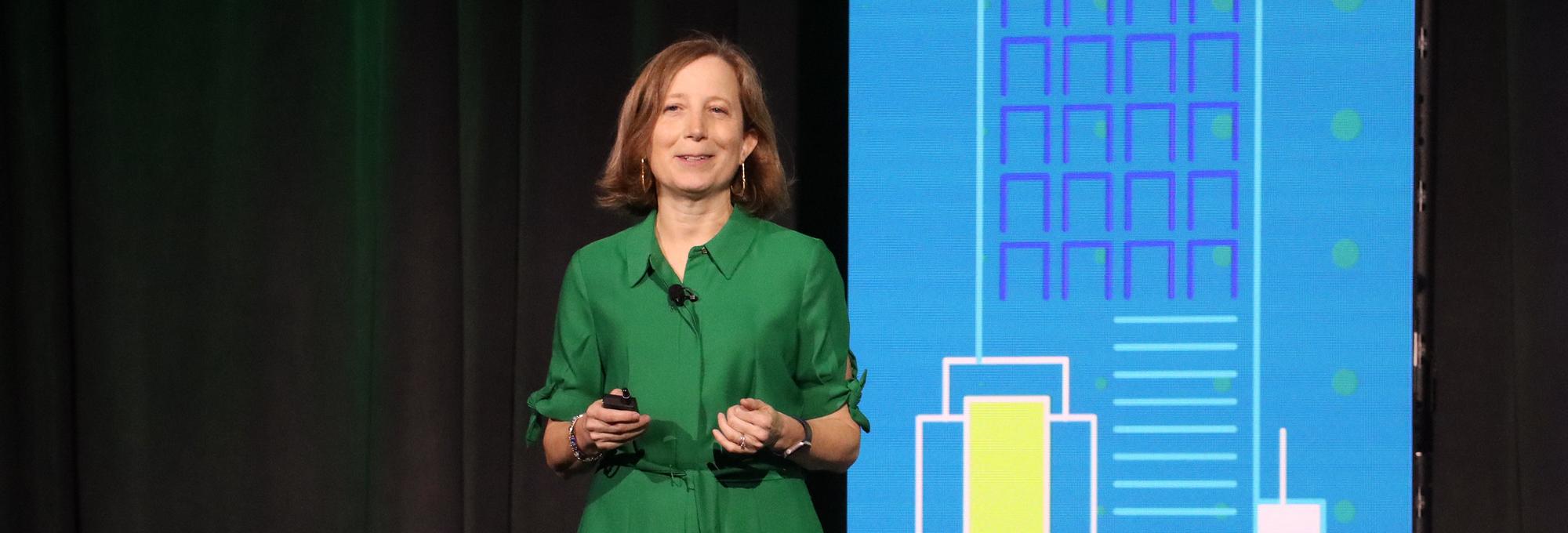
In her plenary at the 2026 INFORMS Annual Meeting, Karen Smilowitz demonstrated how operations researchers can both optimize school bus routes and earn community trust
SHARE: PRINT ARTICLE: https://doi.org/10.1287/orms.2026.03.25n
Optimizing a school bus route can look like a straightforward problem: pick up students, deliver them to school efficiently, and keep costs down. But when demographics or budgets change and routes must be redrawn to meet emerging student and community needs, it becomes much more difficult.
Which children can walk to school? Which neighborhoods stay together? Which students have a school around the corner, and which must travel across town to access education?
For Karen Smilowitz, Associate Provost for Undergraduate Education at Northwestern University and the James N. and Margie M. Krebs Professor in Industrial Engineering and Management Science at the McCormick School of Engineering, the answers to those questions became personal when her children’s school district in Evanston, Ill., faced budget costs that forced them to rethink and optimize their bus routes. Eliminating some bus lines emerged as one way to keep cuts away from classrooms, she explained.
Smilowitz, whose research focuses on transportation and logistics, saw an opening to use her operations research skills to have a real impact on her community, and she volunteered to participate in her school district’s transportation study. That volunteering commitment would turn into a sustained exploration of how bus routing impacts public education when Smilowitz’s conversations with the superintendent grew into a research proposal and a broader partnership.
Bringing Operations Research to the Table
In her plenary presentation, Smilowitz described how operations research can help school districts design both effective transportation systems and enhance quality education. The goal, she said, was not simply a better bus route, but a better process for determining where routes should lead. “School bus transportation is never simply about just transportation,” Smilowitz told the audience.
Ultimately, effective school transportation requires connecting technical expertise with local knowledge and cost considerations, keeping the well-being of children and families uppermost in mind.
Smilowitz explained that determining bus routes involves several interlocking elements: preparing data, selecting stops, designing routes, setting school start times, and scheduling departures. Bus stops must serve students within an acceptable distance. Staggering school start times can accomplish that by enabling the same bus and driver to serve more than one school each morning, improving fleet utilization.
Smilowitz said that planners may not need to know every turn of every route to optimize pickup schedules. Approximation methods can help estimate the consequences of different district boundaries before detailed routing begins. Smilowitz’s research team initially explored how Evanston’s roughly grid-shaped street network could support those estimates.
Yet efficiency alone cannot inform what an acceptable route assignment looks like. Smilowitz traced that challenge back to the history of school desegregation, when bus transportation became a tool for achieving racial balance in schools after the historic Brown v. Board of Education decision in 1954 that banned segregated schools. That history complicated any claim that a computer-generated assignment was inherently impartial; the burdens and benefits were not shared equally.
Keeping Community in the Loop
Another school initiative to restore bus access to a neighborhood school brought Smilowitz’s research group into a new planning process. Their assignment was to build tools that supported potential options rather than make decisions for the school board, administration, or community.
The team used “streams” to present options – possible pathways through schools, grades, and programs for students living in a particular block – to present the community with options. Rather than treating each bus assignment as an isolated choice, Smilowitz said, a stream could incorporate priorities such as keeping neighborhood children together as they progressed through the district schools. Capacity, demographics, travel considerations, and geographic boundaries could then inform the model.
Crucially, Smilowitz said, the process ran in both directions. Researchers presented maps, community members identified problems, and the team revised the possibilities. For example, a boundary that seemed reasonable mathematically might split a neighborhood across a major road. Seeing the map helped participants identify constraints that had not been captured by the planners.
Over six months, Smilowitz said the team examined at least 150 bus route scenarios. That sustained exchange shaped both the proposed solutions and the modeling choices. Explicitly examining community-defined alternatives made the process more transparent.
Human Connections
Smilowitz pointed to opportunities for artificial intelligence to translate between community language and technical terminology, capture recurring feedback, and speed model reconfiguration. But she also emphasized the importance of retaining human involvement in community decisions and promoting shared understanding rather than treating technology as an obvious answer.
Ultimately, effective school transportation requires more than connecting stops on a map. It requires connecting technical expertise with local knowledge and cost considerations, keeping the well-being of children and families uppermost in mind. The strongest route is not necessarily the one a model selects alone, Smilowitz concluded. It is the one a community can understand, help shape, and trust to carry its children toward new opportunities.
Barbara is the editor of OR/MS Today and Analytics.