November 5, 2026 in Medicine
Engineering Better Health
Merging Engineering and Clinical Care to Redefine Healthcare Delivery
SHARE: PRINT ARTICLE: https://doi.org/10.1287/orms.2026.03.29n
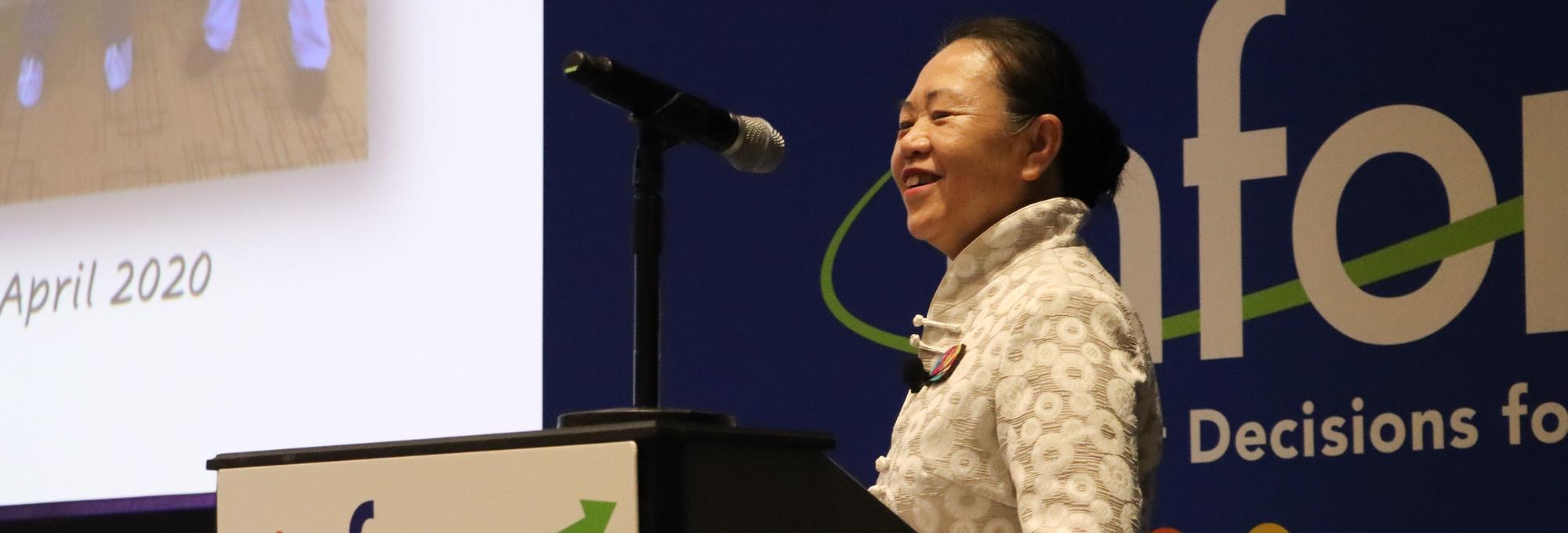
Tueng Shen opened her keynote address at the 2026 INFORMS Annual Meeting with the example of a patient whom her research aims to help. For that patient, who resides in rural Idaho, a medical visit can mean a 12- to 18-hour drive to Seattle. The patient has an artificial cornea that has helped him live independently, but aging has brought other health concerns, and nearby medical care remains limited. Those limited resources and difficulty navigating technology compound the challenges facing patients far from major medical centers, said Shen.
That patient’s experience framed Shen’s key message: better healthcare requires reaching patients earlier and understanding what happens between appointments.
A University of Washington cornea surgeon who earned an engineering PhD before entering medicine, Shen described a career spent translating between disciplines. Now the inaugural Associate Dean of Medical Technology Innovation, a joint position between UW Medicine and College of Engineering, Shen urged her audience to see rural access and delayed treatment as challenges in system design as well as clinical care.
From Snapshots to Prevention
“We see snapshots of patients, but we don’t really know the whole story,” Shen said. When physicians only see their rural patients once every three or four months, long stretches remain in which changes in health may go unnoticed.
COVID-19 showed how quickly established practices can change, Shen affirmed, as it spurred patients and clinicians to adopt telehealth out of necessity. With affordable sensors, robotics, and AI now converging, Shen sees an opportunity to extend the shift from treating disease to preserving health.
Shen connected this goal to an ancient Chinese medical principle: treating illness before it begins. What has changed, she suggested, is the availability of tools that can bring early detection and intervention to more people.
Shen said that ambition guides UW’s Kren Engineering-based Medicine Initiative, supported by George and Martina Kren. By bringing clinicians and engineers together from the start, the program aims to detect early signs of trouble in the body much as engineers identify faults in complex systems.
Turning Monitoring into Decisions
One example Shen gave of this convergence of medicine and engineering is DocBot, an experimental robotic health assistant designed for homes and rural clinics. Cameras, microphones, and local AI processing can help track a patient’s vital signs, gait, posture, and surroundings. In a demonstration, the system read a displayed blood pressure measurement and offered basic guidance. Shen emphasized that it was not a diagnostic device.
The approach reflects how clinicians work: observing patients, listening to them, and interpreting information. Cameras and microphones offer a way to capture those inputs outside the clinic, including readings from existing instruments.
A second project Shen described involves a tiny, biodegradable biosensor being developed to detect inflammatory signals associated with intrauterine infection. Designed to communicate with a skin patch and smartphone, it could give clinicians earlier warning of problems during pregnancy.
From Observance to Action
However, said Shen, collecting more information is only part of the task. When should an alert trigger intervention? Which changes warrant a trip to the clinic, and when can someone safely stay home? Shen invited the audience to help address these unanswered analytical questions.
“They are organizational problems. They are data problems,” Shen said of healthcare’s challenges. The opportunity lies in designing systems that turn observations into timely, useful decisions.
Shen closed with the analogy of watercolor painting: an artist works with intention, even as pigment and paper interact unpredictably. Healthcare, too, demands decisions within a complex system that cannot be fully controlled. For Shen, collaboration offers a way to turn that uncertainty into earlier, better care.
Yuewei Ling is a PhD student in Management Science and Engineering (MS&E) at Stanford University. Her research focuses on health policy, decision science, and clinical toxicology. Currently, she is developing AI-augmented decision models and simulations to inform the design and evaluation of health programs and interventions.