
November 5, 2026 in Location Science
Is Location Science Still Relevant?
Elena Fernández Says Yes, but Challenges Remain
SHARE: PRINT ARTICLE: https://doi.org/10.1287/orms.2026.03.30n
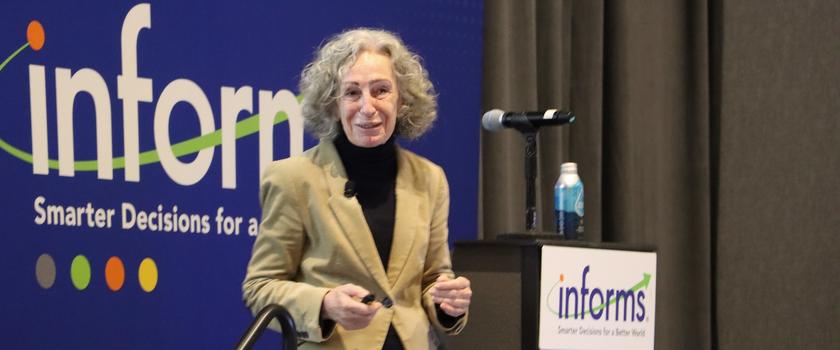
After decades of theoretical advances, increasingly sophisticated optimization models, and applications across multiple disciplines, one might wonder whether the mature field of location science still has room for innovation.
For Elena Fernández, professor of Operations Research at the University of Cádiz and recipient of the 2021 INFORMS Lifetime Achievement in Location Analysis Award, the answer is a resounding yes.
During her keynote, “Location Science, Once More: New Challenges for a Mature Area,” at the 2026 INFORMS Annual Meeting in San Francisco, Fernández reflected on the field’s evolution, its expanding applications, and the challenges that continue to create opportunities for researchers.
From Classical Geometry to Real-World Applications
Fernández traced location science from its origins in geometry and economics to the mathematical programming and network optimization advances that shaped the field during the twentieth century.
Using a visual she called the "Location Tree of Life," Fernández illustrated how location science has branched into engineering, computer science, geography, and business. Today, its applications extend far beyond determining where to locate facilities, encompassing humanitarian logistics, disaster management, healthcare, last-mile delivery, and transportation networks.
Yet this expansion raises an important question about maintaining a shared research identity as location problems become increasingly specialized.
Beyond Efficiency: New Challenges for Location Models
A central theme of Fernández’s keynote was the need to better reflect real-world complexity in location models. She emphasized the importance of incorporating user preferences and equity into facility location decisions, particularly in service-oriented applications.
“And what is equity? What is fairness?” Fernández asked while discussing how location models can balance service quality among users and workloads across facilities.
She also highlighted ongoing challenges in hub location and network design, including economies of scale, congestion, capacity constraints, and the need for solution methods capable of handling increasingly complex models.
Bridging Strategic and Operational Decisions
Another important challenge Fernández identified was the disconnect between long-term strategic decisions and changing operational conditions. While facility locations often remain fixed for years, demand, costs, and operating conditions continuously evolve, potentially changing which decisions would be most effective.
“If we knew in advance the demand, the evolution of the data that we have, maybe we would decide on a different location,” Fernández observed.
Although uncertainty modeling and robust optimization help account for changing conditions, Fernández questioned whether existing approaches fully address this challenge, encouraging further research into better integrating strategic and operational decisions.
A Mature Field with Room to Grow
Fernández also identified data representation, spatial analysis, machine learning, and data-driven optimization as promising directions for future research.
Her concluding message reinforced that, despite decades of progress, location science remains a broad field with important unanswered questions. As researchers continue to address fairness, user behavior, uncertainty, and interconnected decisions, the field’s maturity is not a limitation, but a foundation for continued innovation.
Juana Jaramillo Rios is a PhD student in Supply Chain and Analytics at the University of Missouri–St. Louis. Her research applies operations research, econometrics, and behavioral modeling to address challenges in humanitarian logistics, transportation systems, and supply chain resilience. Her work spans disaster preparedness and recovery, multimodal freight transportation, consumer behavior, and public policy, with applications including relief distribution, inland waterway transportation, and last-mile delivery. Juana is passionate about using analytical methods to generate insights that support more resilient, efficient, and socially impactful systems.