
November 5, 2026 in Optimization
Three Ways GPUs Could Speed Up Integer Optimization
SHARE: PRINT ARTICLE: https://doi.org/10.1287/orms.2026.03.31n
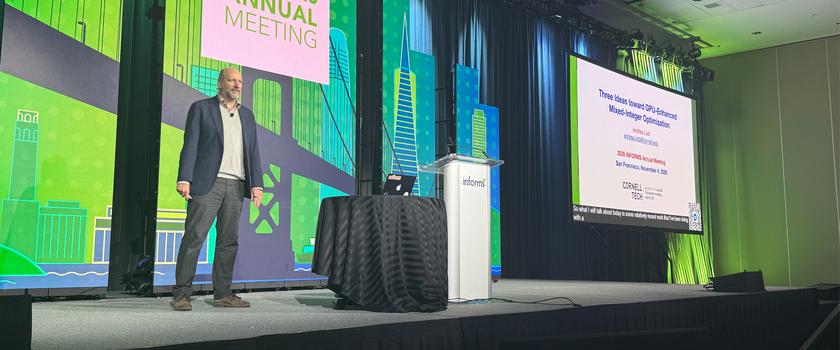
GPUs have been particularly successful in machine learning and have helped bring us ChatGPT – everyone go-to buddy these days. They have enabled faster training of neural networks, which helped demonstrate their real-world usefulness in the early 2010s. But is that it?
Andrea Lodi, the Andrew H. and Ann R. Tisch Professor at the Jacobs Technion-Cornell Institute at Cornell Tech and the Technion, says a lot of the world’s problems can be mapped into mixed integer optimization problems. A keynote speaker at the 2026 INFORMS Annual Meeting in San Francisco, Lodi gave the example of Google Maps – the shortest-path problem. What if Google Maps could tell you a better route within nanoseconds of your query?
The world is full of optimization problems like these, said Lodi. From electricity grids to your Amazon deliveries, operations researchers around the world are constantly mapping real-world business problems into mathematical problems that a computer can understand and solve.
Lodi talked about better ways to bring the benefits of GPUs to this particular set of problems. Computers solve such problems through a series of repeated steps (an algorithm) and repeated checks to determine whether the solution they have is the best one possible. However, computers do this sequentially or serially through CPUs.
At a very high level, Lodi suggested identifying and organizing the parallel parts of these algorithms that could potentially be delegated to GPUs – what they are good at. The big caveat is that the time saved by solving these smaller problems in parallel on GPUs must outweigh the time spent organizing the work and moving data between CPUs and GPUs.
Lodi suggested three specific strategies:
- Instead of testing possible next choices one at a time, evaluate them together on a GPU and use the results to choose how to continue the search more effectively.
- Keep in mind that the CPU keeps track of the search and coordinates the work, while the GPU performs batches of calculations for multiple parts of the search simultaneously.
- Use AI to predict intermediate results for several parts of the search together, then check whether they provide enough mathematical evidence to rule out some possibilities and avoid further calculations.
Lodi also highlighted ongoing work with his collaborators and outlined a direction for the field: developing new algorithms for an era in which GPUs play an increasingly central role. Making the most of that computing power requires rethinking how we solve these problems, he said.
Ronak Tiwari is a third-year doctoral student at WHU – Otto Beisheim School of Management. His research interests lie at the intersection of retail analytics, forecasting, and data science, with a focus on improving decision-making in retail operations. He also serves as editor of OR/MS Tomorrow, the INFORMS student magazine.