
October 11, 2026 in Data4Good
Developing Analytics Judgment Through the Data4Good Competition
How students and practitioners learn to frame problems and explain their decisions in a civic AI challenge
SHARE: PRINT ARTICLE: https://doi.org/10.1287/orms.2026.4.01n
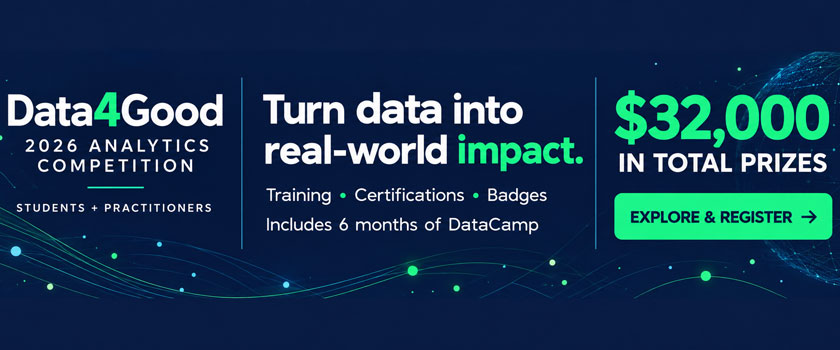
Launched in 2022, the Data4Good Analytics Competition helps students prepare for analytics careers and gives practitioners a way to develop their skills by working through a real client’s problem. In 2026, this global event is inviting undergraduate and master’s students from the same institution and degree level to compete in teams of three to four. A new practitioner track this year welcomes professionals and doctoral students to enter individually or in teams of up to four. Participants create portfolio work and compete for cash prizes.3 Registration for the 2026 Data4Good Analytics Competition closes on October 18, 2026.
The competition is rooted in how AI is changing the work of analytics. Today, an AI assistant can produce a working prototype before a team has even decided what problem to solve. “Vibe coding,” building software through plain-language instructions and rapid iteration, has opened the door to people with far less programming experience.1 The opportunity is enormous. So is the need for people who know what to ask.
Analytics professionals must ask themselves: Whose needs are we meeting? Which decision should change? Will the data be available when it matters? As technical work becomes easier to start, the answers become a larger part of a contributor’s value. We want students and practitioners to explain how they arrived at a recommendation, including the constraints and assumptions that shaped it.
The Data4Good competition offers participants technical credentials, training in problem framing, and leadership opportunities across both student and professional tracks. Participants learn to connect their choices to stakeholder needs before putting those lessons to work in the case.2,3
Applying Analytics to a Real Scenario
Participants in both competition tracks use data from the City of Tempe, Arizona, to predict emergency-call priority and tackle an open-ended challenge tied to city performance goals.3 Consider a model with excellent accuracy: if it relies on information gathered after a call has already been assessed, it cannot help at intake. Finding that mismatch is part of the work.
Similarly, a proposal to improve a city performance measure needs someone who can act on it, resources to support it, and a way to assess progress. These practical questions make problem framing consequential. As Paulina Abramowicz recently explained in Analytics, that work begins before the model.6
Data4Good’s training gives participants two complementary frameworks. The INFORMS Analytics Framework (IAF) connects business and analytics problem framing to data, methodology, model development, deployment, and life cycle management.4 It keeps attention on what happens after an analysis is delivered: who uses it, what they need, and when the approach should change.
Joseph Cazier’s “Leading in Analytics” course teaches the second framework, Karl Kempf’s “Five Manageable Tasks:” team, problem, data, tools, and execution. These tasks help participants examine a project’s organizational needs. The course also covers organizational maturity and responsibility.5 An executive champion can secure resources, a business process owner understands daily operations, a technical expert knows what can be built, but whose perspective is missing from the team’s recommendation?
Credentials, Prizes, and Portfolio Work
Training becomes more useful when participants can test it on a case. Kaltura’s agentic avatar, a conversational AI guide on the competition website, draws on case knowledge that includes information beyond the published brief. Participants can ask about the problem and challenge their solution design, for example, by exploring what could make a recommendation impractical. That creates another opportunity to practice by asking useful questions and revisiting assumptions.
All registered participants receive a six-month DataCamp subscription and a Microsoft Azure AI Fundamentals (AI-901) exam opportunity through the $25 per-person entry fee. The exam is scheduled during the competition and proctored remotely. Badge opportunities include SAS AI Foundations or SQL Essentials, Databricks, Leading in Analytics, and the INFORMS Business Problem Framing course. Those who excel in the competition may receive access to the Certified Analytics Professional Essentials (CAP-E) prep course, which also offers a course badge.3 These milestones help participants show preparation, while the case and presentations show how they apply what they learned.
Data4Good offers $32,000 in cash prizes across the student and practitioner tracks. Each of five regions recognizes an undergraduate and a master’s team and one winner from the practitioner track, totaling 11 winning entries, each earning $2,000. Regional student champions must attend the national championship hosted by the prestigious Johns Hopkins University’s Carey Business School in spring 2027 to receive their regional awards. The undergraduate and master’s national champions will each receive an additional $5,000.3 Those awards recognize outstanding work, while the learning and portfolio opportunities give participants reason to persist throughout the competition. Regional champions are also invited to submit a write-up of their solution to the Data and Analytics for Good journal.
Competition organizers and volunteer judges determine regional and practitioner champions from the total points earned through quizzes, credentials, and the case submission. Kaggle performance accounts for half of the case score, and expert judges score posters and pitch videos, each worth one-quarter of the score, that consider problem framing, methods, recommendations, and communication. As organizers and educators, we want participants to explain the choices behind their work: an assumption tested, a constraint uncovered, or a result that changed the team’s direction, along with what they checked when AI assisted the work.
Beyond the Competition
From 2022-2025, Data4Good has recorded 3,555 participant registrations, 999 registered teams, and 2,154 passes on Microsoft Azure Fundamentals (AZ-900) or Azure AI Fundamentals (AI-900) certification exams. Past projects addressed language access, healthcare documentation, bereavement support, and AI reliability. In a 2025 post-competition survey, 88% of respondents said the competition helped them fill a skill gap they could showcase to employers.2
Faculty can integrate the competition into a course, and employers can incorporate it into staff development. At Butler University in 2025, students in Dr. Matthew Lanham’s Predictive Analytics course completed the case alongside AI-900 certification and INFORMS and SAS badge opportunities. Ninety-four percent earned AI-900, and every student produced a project poster for a portfolio. Employers can give participating staff time to learn and ask them to explain one decision the experience helped them make more carefully.
That learning extends to professionals and doctoral students.3 The civic case enables them to bring professional experience to a new setting and discover where familiar approaches need adjustment.
Lessons from these competitions also inform PULSE, the Purpose-driven Unified Learning for Skills and Engagement framework developed by Dr. Lanham with Butler University colleagues Dr. Jason Davidson and Dr. Ankur Gupta. Their working manuscript connects preparation, guided practice, purpose, and evidence of professional capability.2 Its emphasis on reflection encourages participants to carry the reasoning behind a project into their next opportunity.
Master the Problem by Mastering the Process
As AI changes work, the habits we reward will help shape workplace culture. We can use our growing technical abundance to serve others by making a public service easier to navigate, supporting a nonprofit, or helping someone gain access to information. Doing that well takes curiosity about people’s needs and a willingness to explain and improve our process.
Registration for the 2026 Data4Good Analytics Competition closes on October 18, 2026. Visit the competition website for details and registration and follow Data4Good on LinkedIn for social updates and opportunities from sponsors. Bring a question worth asking and use the experience to become a better contributor.
References
1. Microsoft Design, 2025, “Vibe coding makes prototyping close to code, closer to users,” https://microsoft.design/articles/vibe-coding-makes-prototyping-close-to-code-closer-to-users/.
2. Lanham, M. A., Davidson, J., and Gupta, A., "PULSE: A Motivational Framework to Enhance Technical Education Through Scalable Project Based Learning," Unpublished working manuscript.
3. 2026 Data4Good Analytics Competition, “2026 Data4Good Kickoff,” September 11, presentation; current competition information and opportunities: https://www.datacamp.com/event/data4goodcompetition.
4. Bos-Beijer, J., McMillan, N., and Johnson, L., 2026, “INFORMS Analytics Framework (IAF): The Proven Guide to Developing Analytics Solutions,” Data4Good training, September 18, presentation.
5. Cazier, J., 2026, “Leading in Analytics: The Seven Critical Tasks for Executives to Master in the Age of Big Data,” Data4Good webinar, September 25, presentation.
6. Abramowicz, P., 2026, "Before the Model: Why Business Problem Framing Determines Analytics Value," Analytics, July 29. https://doi.org/10.1287/LYTX.2026.02.08.
Matthew A. Lanham, PhD, CAP-X, is an assistant professor of business technology and analytics at Butler University’s Lacy School of Business, and he is the founder of the National Data4Good Analytics Competition. He earned his PhD in business information technology at Virginia Tech. Dr. Lanham’s research examines predictive and prescriptive analytics and using analytics for good. He serves on the INFORMS Analytics Certification Board and SAS Faculty Advisory Board, and he is president-elect of the INFORMS Analytics Society. Joseph Cazier, PhD, CAP-X, is a clinical professor at Arizona State University and faculty director of its DBA in AI and Digital Transformation Leadership. He is the author of Leading in Analytics and coaches students and business leaders on using data to make better decisions.