

April 7, 2008 in Analytics News
PATIENT FLOW
The new queueing theory for healthcare.
SHARE: PRINT ARTICLE: https://doi.org/10.1287/LYTX.2008.02.04
From birth to death, we are all part of the healthcare system. We rely on both public and private organizations to provide preventive care (such as inoculations) and to treat our illnesses, diseases and injuries. Healthcare is perhaps the strongest determinant of both our quality of life and our longevity.
Worldwide, and in the United States in particular, healthcare consumes an increasing percentage of our economic product. This rising cost can be attributed in part to aging populations and the expense of new, advanced treatments. Just as importantly, it can be attributed to inefficiencies in healthcare delivery. Simply put, the science of healthcare has progressed much more rapidly than our ability to manage healthcare as a truly integrated system.
Patient Flow
PATIENT FLOW represents the ability of the healthcare system to serve patients quickly and efficiently as they move through stages of care. When the system works well, patients flow like a river, meaning that each stage is completed with minimal delay. When the system is broken, patients accumulate like a reservoir, as in the chronic delays experienced in many big city emergency departments. Put another way, good patient flow means that patient queueing is minimized; poor patient flow means that patients suffer considerable queueing delays.
Healthcare systems resemble any complex queueing network in that delays can be reduced through:
- synchronization of work among service stages (e.g., coordination of tests, treatments, discharge processes),
- scheduling of resources (e.g., doctors and nurses) to match patterns of arrival, and
- constant system monitoring (e.g., tracking number of patients waiting by location, diagnostic grouping and acuity) linked to immediate actions.
But healthcare has unique features that make queueing problems particularly difficult to solve:
- Waiting creates additional work for clinicians. Patients must be monitored and served while waiting, and their conditions even deteriorate, necessitating additional work once they are seen. Thus, as queues become large, the workload increases and the capacity to serve patients deteriorates.
- It can be difficult to distinguish productive waiting (e.g., recovery) from unproductive waiting (e.g., waiting for tests). In a traditional queueing system the most desirable outcome is a zero time in system with instantaneous service; in a hospital, it is undesirable to push length of stay all the way to zero, as patients need to be monitored and cared for during recovery periods. The result can be conflicting objectives in managing hospital beds as a limited resource.
- Healthcare organizations operate within a unique regulatory and business environment that falls partly in the private sector and partly in the public sector. Hospitals may find it impossible to manage queues through pricing, and reimbursement schemes may be misaligned with costs. For example, under the Emergency Medical Treatment and Active Labor Act (EMTALA), hospitals are mandated to see all patients presenting to emergency rooms independent of their ability to pay. Thus, the economic environment precludes queueing solutions often found in the private sector, such as peak-period pricing. At the same time, physicians frequently act like independent entrepreneurs, making it difficult for healthcare organizations to fully integrate their systems under sound managerial practices.
Characterizing Patient Flow
MY FIRST EXPOSURE to the field of patient flow came through the Institute for Healthcare Improve ment (IHI), an outstanding organization devoted to improving the quality and value of healthcare. IHI’s approach centers on the open sharing of best practices within “collaboratives,” groupings of hospitals and clinics, clinicians and managers, organized around common objectives, such as reliability, safety or patient flow.
Important to the operations research community, IHI has emphasized evidence-based decision-making, meaning that performance measures and patient outcomes should be tracked and integrated into a system of continual improvement. Though not directly linked to industrial engineering, management science or operations research, IHI has adopted these field’s methods, focused on making radical improvements in health, not through creating new technology or treatments, but through using what we have now to maximum benefit.
At the University of Southern California, my colleagues David Belson, Maged Dessouky and I have used this philosophy as the launching point for a comprehensive evaluation of the Los Angeles County/University of Southern California (LAC/USC) General Hospital, one of the largest hospitals in the country. Like many urban public hospitals, healthcare at LAC/USC is dominated by the flow of patients through its emergency department. Patients by and large come to LAC/USC for one of two reasons: They believe that they have no other option due to lack of health insurance or they have suffered trauma or another emergency condition somewhere in the hospital’s vicinity and were taken there by ambulance or helicopter.
As at all hospitals, care is provided through many specialized departments, such as radiology, surgery and various types of patient wards, as well as by ancillary departments, such as admissions, medical records, laboratory, pharmacy, housekeeping and transportation. A patient arriving through the emergency department encounters repeated waits as he or she progresses from stage to stage, waiting for rooms, equipment, physicians, nurses, technicians, beds, medications, records, gurneys, orderlies and continuing care facilities once the patient is ready for discharge. As in other hospitals, when the system becomes overloaded, the patient may wait hours or even days from being seen in the emergency department until placement in a ward. A patient may have to wait days or even weeks for a surgery. These conditions are in some respect extreme, but certainly not unusual throughout the United States.
Our work has revealed that healthcare professionals are unusually committed to their jobs, even when working under extremely challenging conditions. They show a passion for their work and a camaraderie that is unlike what we have seen in other economic sectors. Yet clinicians, in particular, are frustrated because they cannot control activities that occur outside their own departments.We have also observed three major causes of queues in hospitals:
- Idle capacity due to a failure to synchronize complementary resources (e.g., ensuring that needed technicians, nurses, physicians, supplies, patients, etc. are present at the same time to provide a needed service).
- Inadequate communication to ensure downstream departments are prepared to receive patients from upstream departments and to ensure that all parties are prepared for foreseeable demand.
- Inefficient processes that require more work than necessary or un-needed repetition of work.
For example, patients may wait for placement in a hospital bed because:
- Other patients are waiting too long to complete the discharge process.
- Beds remain idle too long from when a patient departs until a bed is prepared for the next patient, until “bed control” is notified of its availability, and until the next patient is transported to the bed.
- Communication is poor between the emergency department and the ward as to the exact time patients will arrive and the care needed immediately upon arrival.
- The suitability of individual beds for individual patients cannot be ascertained due to inadequate processes for tracking patients and their medical records and inadequate processes for tracking the state of hospital beds.
Similar observations can be made in surgical and radiological departments. A patient with a serious fracture cannot be operated on until the CAT scan is completed, which is delayed because there is a shortage of technicians, because cycle times are too long (the result of not sufficiently prepping patients before the test), or perhaps even because there is an inadequate number of gurneys to transport patients. Surgical capacity is wasted due to cancellations, because surgical times are mis-estimated or because insufficient hours are scheduled.
Techniques
HEALTHCARE SYSTEMS can be changed for the better through a strategy that combines participation and creativity. But change cannot be sustained without vigilance and without analysis based on data. Herein lies the opportunity for the O.R. community. For instance, the O.R. community can work with hospital clinicians and administrators in these areas:
- Process modeling to ascertain how patients are currently served, to determine where inefficiencies exist and to prioritize future changes. Process modeling can reveal unnecessary repetition, miscommunication, and inconsistency in methods.
- Simulation modeling both to evaluate new processes and to understand and demonstrate the current causes of delay. For instance: simulating delays before and after, implementing a new appointment system, changing the methodology for assigning patients to beds, or implementing an electronic patient record system.
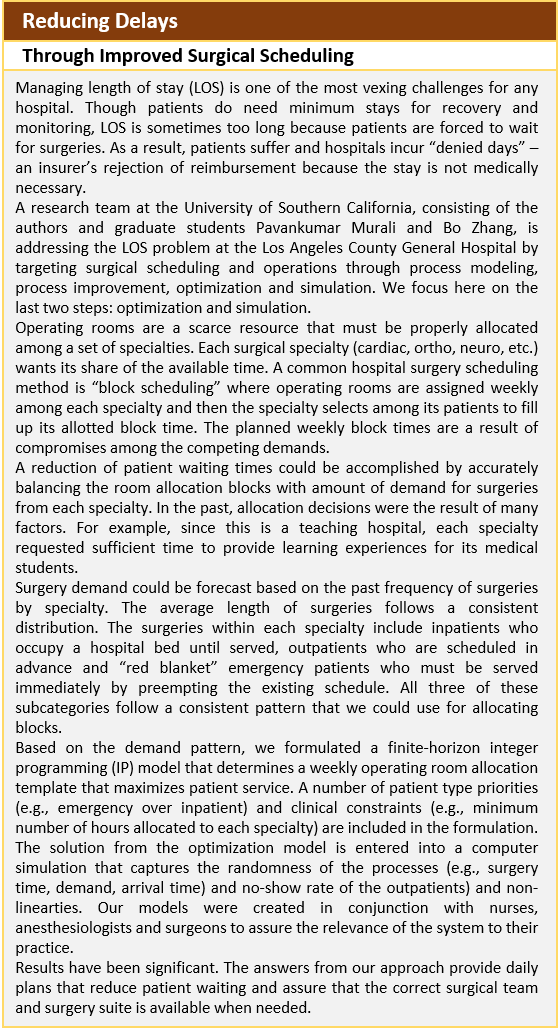
- Optimization can be used in many aspects of system design, such as scheduling nurses, scheduling operating rooms or facility layout.
- Queue analysis is invaluable when executed on a real-time basis to highlight the delays currently experienced throughout a hospital, and to make this information available to all key decision-makers, so that they can better understand delays both upstream and downstream, and act on these delays through reallocation of resources and appropriate prioritization of patients.
Future Challenges
THE RESEARCH CHALLENGE in patient flow goes back to the uniqueness of healthcare queues, namely understanding the human elements of the queueing system.
- In some hospitals, the demand for patient care is perpetually larger than the capacity to serve patients. Unlike what theory may predict, queues do not grow without bound – instead, the system is brought to equilibrium by patients who leave without being seen.
- The capacity and motivation to serve patients are greatly impeded when queues grow long, in the form of crowded waiting rooms, queues of patients waiting for placement to beds, and patients occupying beds while waiting for surgeries or tests. The performance of healthcare systems and its many actors (patients, nurses, doctors, administrators) under these stressed conditions is largely unknown and, for this reason, it can be extremely difficult to predict the effects of change.
Beyond these two examples, it is critical to create an environment whereby change is embraced throughout the organization and,in particular, to change the perspective from “how others are causing problems for my area”to “how I can make the entire system operate better.” The collaborative approach advocated by IHI is therefore essential.
The O.R. community can make a difference in the field of patient flow. This is not just a matter of improving efficiency. It is a case where our methods and talents can reduce suffering and save lives.
Randolph W. Hall, Ph.D., is director of USC CREATE and professor in the Epstein Department of Industrial and Systems Engineering at the University of Southern California (USC).