

June 2, 2008 in Back on Track
On The Right Track
Netherlands Railways improves service, boosts profiles, wins Edelman with impressive use of O.R.
SHARE: PRINT ARTICLE: https://doi.org/10.1287/LYTX.2008.03.02
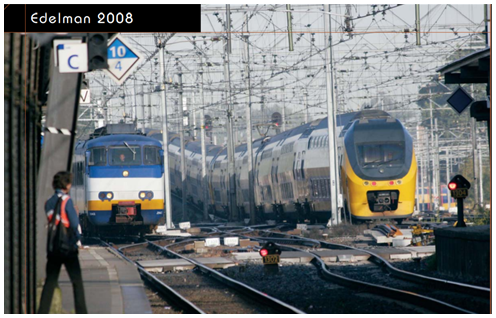
To understand just how important the passenger railway system is to the 16.5 million people who live and work in the Netherlands, consider that more than half the citizens are frequent if not daily train passengers, and on certain corridors during rush hour, upward of 70 percent of the people who commute from one city to another do so by train. Thus in Holland, most people’s lives literally revolve around the train timetable, so when the trains start running late because demand starts overwhelming the system, it’s not only a big problem for the train operator, it’s a big problem for the Dutch people and the Dutch government.
That was the situation Netherlands Railways (NR), Holland’s dominate passenger rail carrier, faced in 2006. The volume of traffic on the Dutch railway network had nearly doubled, from 8 billion passenger kilometers in 1970 to 15.4 billion in 2006, yet NR’s basic infrastructure and timetable had remained virtually unchanged for 35 years. The problem was further complicated by the fact that NR owned and operated the trains but not the track. The track belonged to the government, which was reluctant to spend the billions of dollars it would take to upgrade and expand the entire infrastructure.
So what do you do, given the infrastructure and cost constraints? If you’re Netherlands Railways, you turn to operations research and analytics to address the things you can control – the number and configuration of trains (“rolling stock”), the rescheduling of crews and, most importantly, the revamping of the timetable – while convincing the government, with data-driven evidence, to invest money in rebuilding a crucial segment of track. The results: better service, more profits and the 2008 Franz Edelman Award for Achievement in Operations Research and the Management Sciences from INFORMS.
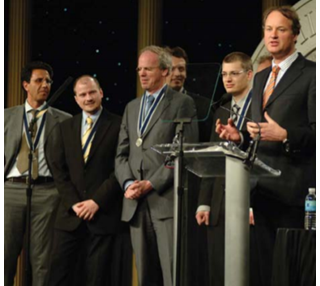
INFORMSsponsored dinner gala as other team members look on.
First awarded in 1972, the Edelman is considered the “Super Bowl of O.R.” and the “crown jewel” in the INFORMS portfolio of awards. The Edelman has traditionally honored projects that dramatically and demonstrably improve a critical component of a corporate or government entity’s core business operation, thereby giving the client organization a competitive advantage This year’s award, presented at a gala dinner celebration during the INFORMS Conference on O.R. Practice in Baltimore, capped a nearly yearlong effort to identify and verify outstanding achievement in operations research and the management sciences. As part of the competition, an international cast of six finalists made their cases during a daylong series of presentations in Baltimore, after which a panel of judges led by 2008 Edelman Committee Chair Brian Denton met to pick the “best of the best.” INFORMS President Cynthia Barnhart announced the winner before a packed ballroom later that evening.
The award-winning entry, entitled “The New Dutch Timetable: the O.R. Revolution,” told in dramatic fashion how operations researchers working with Netherlands Railways constructed an improved timetable that increased on-time arrival of trains by 3 percent, boosted passenger satisfaction by 2 percent and added 40 million euros (approximately $60 million) in profit to the bottom line for NR in the first year (2007) alone.In addition, annual profits are expected to grow to 70 million euros (approximately $105 million) in coming years, making further increases in mass transit possible and simultaneously reducing road congestion and pollution from greenhouse gases.
“I think the real winner tonight is the population of the Netherlands,” said Bert Meerstadt, COO and vice chairman of the executive board for NR, who accepted the Edelman Award on behalf of the winning team. Noting that the new timetable had already produced all-time record highs in terms of passengers, profits and punctuality, Meerstadt said that Netherlands Railways is on track to become the “best performing railway operation in Europe.
“Operations research provides us with detailed insight on the relationship between several key factors, such as cost and service,” Meerstadt added. “With it, we are able to make better decisions, and that’s why we encourage further use of O.R. within our company. In my opinion, we no longer run without it.”
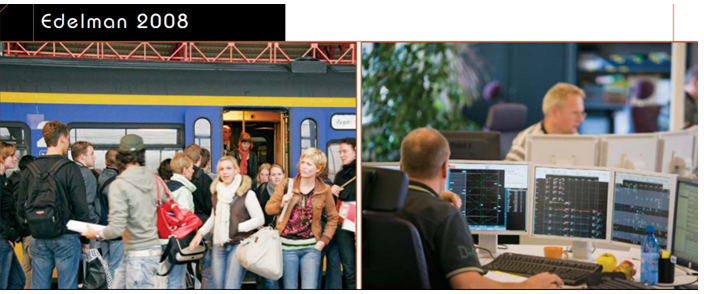
“But more important than all of these records and financial figures is the fact that Netherlands Railways will play an even more significant role than ever before in the county’s mobility. With the new timetable we are able to transport more passengers on the existing network. In this way we are both helping strengthen the Dutch economy improving the global environment.”
Using O.R. the team developed and compared 10 new timetables, selected the best two and ultimately produced an 11th timetable that was implemented. “Our timetable is basically our reason for living, it’s at the heart of what we do,” said Meerstadt.
When the new timetable was implemented in December 2006, it made front-page news throughout Holland. When NR won the Edelman, it made front-page news once again. Literally minutes after accepting the prize in Baltimore, Meerstadt was on the phone with reporters back home, telling them the good news, even though it was 4 o’clock in the morning in the Netherlands. “They told me to call, but only if we won,” Meerstadt quipped. “It’s a fantastic feeling, and it really makes me proud of all the people who have worked on this.”
The members of the winning team included Erwin Abbink, Pieter-Jan Fioole, Dennis Huisman, Leo Kroon, Roelof Ybema and Meerstadt of the Netherlands Railways; Matteo Fischetti of the University of Padua; Gábor Maróti of Erasmus University Rotterdam; Lex Schrijver of CWI; and Adri Steenbeek of Safiro Software Solutions BV.
Needless to say, the construction of a railway timetable for about 5,500 daily trains presented a complex problem, a problem that was further complicated by multiple rolling stock configurations and crew scheduling constraints.A delay in the construction of the critical section of track between Utrecht and The Hague only added to the complexity, forcing the NR team to do some last-minute crew and train rescheduling. Constraint and integer programming were among the O.R. methods brought to bear. Details of NR’s prize-winning work will appear in the JanuaryFebruary 2009 issue of Interfaces, along with technical papers from the other five finalists.
Graham Rand of Lancaster University in the United Kingdom and Tom Spencer of Walden University in New Jersey served as coaches for the prize-winning team from NR.When asked what he thought impressed the judges the most about the winning entry, Spencer outlined a laundry list of possibilities. “First of all, it was an extremely complex problem that had a huge impact on the country,” he said. “I think the fact that NR partnered with several universities and professors, and that many of the algorithms they developed have been utilized by other organizations besides NR impressed the judges. Complexity, impact and portability are always important.And the team did a really good job of presenting their case, including the videotaped segment from the Dutch minister of transportation.”
Despite everything the NR team had going for it in the competition, Spencer – whose longtime involvement with the Edelman includes stints as a coach, judge, committee member and competitor – was “shocked”when Barnhart announced NR as the winner.
“Was I surprised?” Spencer said.“Absolutely.I was shocked. Shocked in the sense that there were so many strong entries, and any one of the six finalists could have won. NR was a fun group to work with. There was a great deal of synergy between the team members. These guys liked each other, they were excited and enthusiastic about the competition, and that all came across to the judges.”
Spencer also noted that Meerstadt, the COO of Netherlands Railways and a certified train engineer, drove the very first train under the new timetable. It arrived on time.
Peter Horner is the editor of Analytics magazine.
([email protected])