

November 30, 2008 in Analytics News
Practice Makes Perfect
Preview of the 2009 INFORMS Conference on O.R. Practice, A "Must-Make" for Any Analyst.
SHARE: PRINT ARTICLE: https://doi.org/10.1287/LYTX.2008.06.07
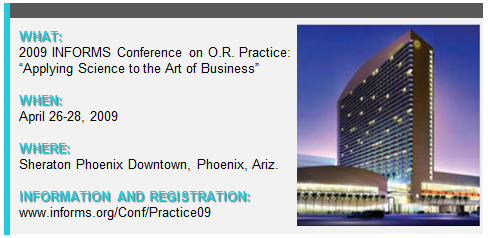
The INFORMS Conference on O.R. Practice, set for April 26-28, 2009 in Phoenix, Ariz., more than lives up to its name. Designed by practitioners for practitioners involved in the task of “applying science to the art of business,” the conference will bring together analysts of all stripes and interests for an intensive, high-value and diversified program.
From forecasting to financial analysis, from supply chain management to digital marketing, the conference has spanned the spectrum of analytical interest areas with a series of presentations from recognized world leaders in their respective fields. Supply chain, finance, healthcare and sustainability are among the many “hot topics” under consideration for the upcoming conference. The 2009 program –a total of approximately 80 sessions grouped into eight focused tracks a day for two days – will once again make the INFORMS Practice Conference the one “must make” event of the year for analysts of every persuasion.
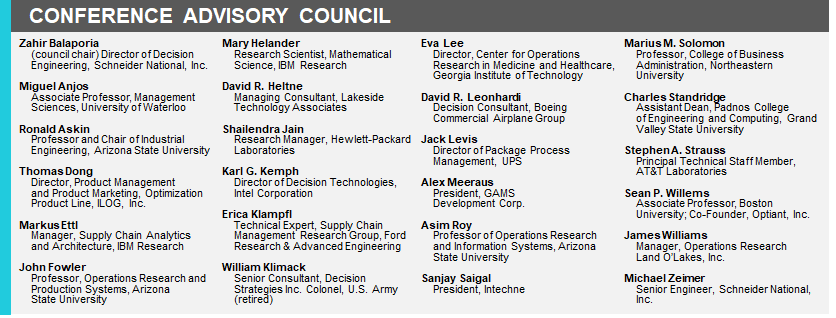
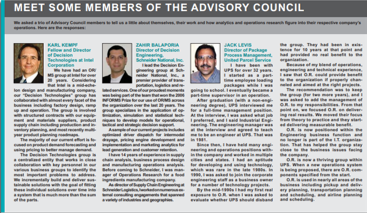
The key to the conference’s ongoing success is its Advisory Council, an allstar line-up of practitioners and academics drawn from leading companies and universities (see box). The council is responsible for developing the topic tracks, inviting speakers and organizing the series of presentations that comprise the heart of the conference.
Network Events
ALONG WITH ITS world-class presentations and plenary speakers, the conference is well-known for its unparalleled networking events such as the “Birds of a Feather” gatherings and luncheons, which give attendees face-to-face time with industry leaders and fellow practitioners in their respective interest areas.
Other special events scheduled for this year include the INFORMS Professional Colloquium (real-world career guidance for practice-oriented graduate students), Soft Skills Workshop (real-world “people” skills for decision analysts and OR/MS professionals) and the Richard E. Rosenthal Young Practitioner Connection (introduces junior faculty and young industry practitioners to well-established researchers and practitioners).
As far as special events are concerned, the conference highlight is no doubt the annual Edelman Competition and Awards Gala that honors in spectacular fashion the world’s best examples of applied operations research and management science. Recent winners of the Edelman Award include Netherlands Railways, Sloan-Kettering Cancer Center, Warner Robins Air Logistics, General Motors, Motorola and UPS.

Put it all together and you have a conference that, from just about any analyst’s point of view, can’t be missed. For more information on the conference, see http://meetings.informs.org/Conf/ Practice09/.
Analytics in Action
“I’VE ATTENDED EVERY INFORMS Practice Conference since 2001, and in my opinion, it is the best place to see analytics in action,” says Zahir Balaporia, director of Decision Engineering at Schneider National, Inc. and the chairperson of this year’s council. “It’s also the best place to meet my counterparts in other companies and industries and swap thoughts and ideas. I’m particularly interested in hearing where folks are succeeding or struggling in integrating operations research into corporate decision-making.”
Balaporia notes that last year he set up a benchmarking visit with United Parcel Service thanks to contacts and relationships he had developed over the years at the conference.
One of those UPS contacts, Jack Levis, is another member of this year’s conference advisory council. “The O.R. people I meet through INFORMS at the Practice Conference are some of the smartest and most talented people I know,” says Levis, director of Package Process Management at UPS. “They have a great technical and business sense and are very creative. I believe that my organization and I gain a lot of benefit by hearing what they are working on and approaches they have used to solve real-world business problems.

“For that reason, half of the UPS people who come to the Practice Conference are not O.R. practitioners. They are business people who need to see a different perspective for creating plans and making decisions.”
Karl Kempf, director of Decision Technologies at Intel Corporation and another member of the Advisory Council, considers the diversity of topics and attendees at the INFORMS Practice Conference one of its greatest strengths.
Common Ground
“WHILE THE SPECIFIC PROBLEMS differ from one industry to another, we have at least two things in common,” Kempf says. “First, there are decision algorithms that have broad applicability, and we learn a lot from each other in seeing the technical details of implementations in other industries. Second – and for me the most important – we all face very similar non-technical problems and gain great benefit from hearing about how we have overcome them.
“Convincing some people that there are decision algorithms that can help them make faster, better decisions is a problem that every decision scientist faces regardless of the industry they work in. Couching the problem so that both the business people and the technical folks can discuss it is often difficult, as is delivering what sometimes is a sophisticated solution so that it fits into a current business practice and the business people can understand it enough to have confidence in it. That is the reason I attend every year.”
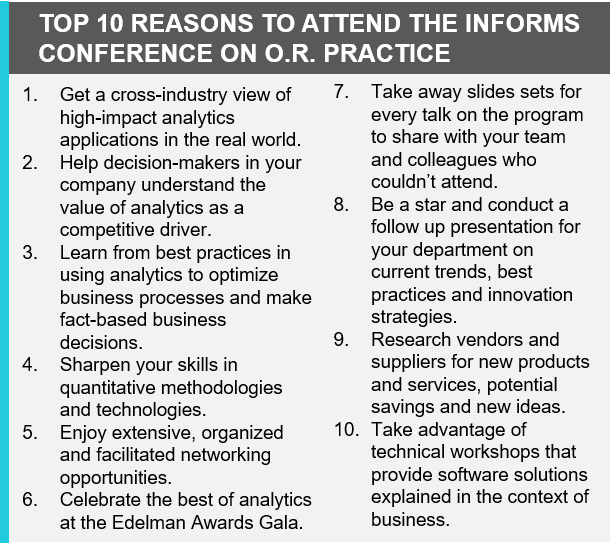
Asked what makes the conference so valuable, Kempf ticks off a laundry list of benefits. “One facet is the size of the conference; it’s kept intentionally small and focused on practice,” he says. “Another is the effort put into selecting track topics that are meaningful to the audience and attracting the best speakers on those topics. Then there are the networking events on every day of the conference, from a reception to orient first-time attendees to birds-of-a-feather sessions to seating at lunch by industry group.
“The point of all of this is to put attendees together with folks they can and should network with and give them high quality, timely content to talk about – the richest possible learning experience.”
Business Trends, Pressures
WHEN ASKED THEIR THOUGHTS about the role of analytics in the business world in general these days – trends and pressures, challenges and triumphs, frustrations and successes –Balaporia, Levis and Kempf offer further insight into both the formal presentations and casual conversations attendees can expect to experience at the upcoming INFORMS Practice Conference.

“While building and solving complex problems will always be a challenge, I focus more on the implementation challenge,” Balaporia says. “I appreciate mathematical elegance and sophistication, but value delivered after implementation is what counts at the end of the day. And that implementation challenge/problem is just as hard to solve.
“The conference gives me the opportunity to connect with folks who might help me, and that’s great. Or I might be able to help them, and that’s great too. If we have the same problem and can’t help each other, then that’s group therapy and that’s feels good, too.”
Adds Levis: “Many companies have been applying technology to improve their business for a number of years. UPS, like these other companies, is starting to run out of the ‘low hanging fruit’ that technology alone provides. To take the next step, advanced analysis, decision support and optimization are required.”
“The tougher the market, the tougher the competition, the more you need to make the best use of every scrap of information you can glean,” sums up Kempf. “The same goes for all of the experimental knowledge that you and all of your colleagues inside the company and all of your collaborators outside the company can muster. Those with the best knowledge and information – and the best analytics to use them to make the fastest and best decisions – win!”
Peter Horner is the editor of Analytics magazine. Terry V. Cryan is the INFORMS director of meetings.
([email protected])