

April 5, 2010 in Corporate Profile
Analytics at UPS
An inside look at the technical tools empowering a $50 billion delivery and logistics company that operates in more than 200 countries worldwide.
SHARE: PRINT ARTICLE: https://doi.org/10.1287/LYTX.2010.02.04
Founded in 1907 as a messenger company in Seattle, Wash., United Parcel Service (UPS) has grown into a $51.5 billion corporation by clearly focusing on the goal of enabling commerce around the globe. Today, UPS is a global company with one of the most recognized and admired brands in the world. UPS has become the world’s largest package delivery company and a leading global provider of specialized transportation and logistics services. Every day, UPS manages the flow of goods, funds and information in more than 200 countries and territories worldwide.

Analytics, specifically operations research (O.R.), has been an important tool at UPS for a very long time. In 1954, our then CEO, George Smith, said the following: “If we did not have operational research, our rate of growth might have been affected. As we grow in size, our problems increase geometrically. Without operational research, we would be analyzing our problems intuitively only, and we would miss many opportunities to get maximum efficiency out of our operation.”
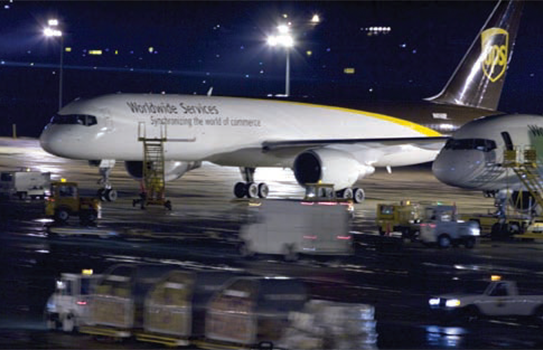
In the 55 years that have elapsed since Smith made this statement, UPS operations have become significantly more complex and distributed. In 1954, UPS ran a U.S.-only operation that delivered and picked up non-committed volume. In 2009, every UPS driver worldwide services delivery volume with different committed times throughout the day. In 1954, our network was limited to the United States and was fed by over-the-road tractor/trailer movements or movements on trains. In 2009, UPS’ worldwide network includes an airline, built from scratch, which includes 208 aircraft in service each day. With 263 total aircraft in our inventory, UPS has the ninth largest airline in the world.
UPS Structure
UPS small package operations are divided into:
- Package delivery/pickup (the Brown trucks you see in your neighborhood).
- Hub — sorting packages.
- Feeder — over-the-road package transport, hub to hub or hub to delivery center. It’s called “feeder” because this operation “feeds” packages to hubs and delivery centers.
- Airline — package transport via our air network.
UPS has developed and actively utilizes operations research models and applications in all four of these operating areas.
O.R. In UPS Package Delivery/Pickup Operations
UPS continues to use O.R. to enhance its award-winning Package Flow Technology (PFT), a technology suite UPS utilizes to optimize sortation, dispatch planning and delivery in its small package operation. By leveraging address and map data, customer data and real-time GPS and by integrating O.R. algorithms into PFT, UPS is testing O.R. algorithms that will provide real-time guidance to drivers in order to service customers in the most cost-effective manner.
UPS is testing this new on-road integrated optimization and navigation system in several locations around the United States. The O.R. algorithm balances optimality and consistency to provide a solution that should drive cost efficiencies while meeting service and customer commitments.
O.R. In UPS Hub Operations
UPS has three optimization tools to assist with planning UPS hub operations. They can be classified as long-term planning, medium-term planning and short-term planning.
Hub and Feeder Network Optimization (HFNO) is the long-range planning optimization tool. HFNO is used to determine how to best utilize our UPS’ capacity while maintaining service commitments and minimizing transportation costs.
HFNO is used for facility capacity needs for at least 10 years into the future. HFNO is also used to set strategy and provide policy decisions. For example, HFNO has been used to model what the UPS network would look like prior to acquiring new companies. It gives UPS analysts insight into how the added capacity will fit into the UPS network and provides analysts a high-level estimate on impact to operating cost.
Network Planners’ Toolkit (NPT) is the medium-term optimization tool. NPT provides decision support to assist planners in answering the following questions:
- What are service feasible alternate flows for packages?
- How can packages be re-routed to bypass a sort or facility?
- Can volume be taken out of one load to create a direct load?
- Can service be enhanced by flowing packages a different way?
Load Planning Assistant (LPA) is the short-term planning tool. LPA is used to plan what loads will need to be moved two weeks prior to execution. The scope of LPA is to optimize a single day for a single building up to four buildings simultaneously. This optimization is deployed to all of our major hubs in the US.
LPA was developed in conjunction with Castle Lab (Princeton University). UPS developed the interface and Castle Lab (Warren Powell and Belgacem Bouzaiene-Ayari) developed the optimization. UPS also has a multi-day, multi-building load planning optimization running at Castle Lab. The next step will be to move this multi-day, multi-building model out of the lab and into UPS operations.
O.R. In UPS Feeder Operations
Feeder Scheduling and Optimization System (FSOS) is an optimization system used by UPS’ local feeder operations to generate feasible, efficient feeder driver schedules which meet all UPS and labor work rules, including minimum and maximum driver hours and driver domicile restrictions. FSOS starts by evaluating all individual feeder movements, and then determines alternative ways for combining these movements into individual driver schedules. FSOS repeatedly improves the solution until improvement stops. FSOS is typically run quarterly in each of our operating districts.
In addition to the brown feeder fleet, UPS needs to hire third-party drivers and driver teams (called Expediters in UPS lingo) to help move the additional package volume the company handles during the busy peak time-frame leading up to the holiday season. The planners use the Expedited Feeder Scheduling (EFS) system to develop the routes these drivers run. UPS planners develop a list of the loads that will need to be moved by these third-party carriers, and EFS strings these loads together into a system of round-trip routes that moves all the loads within their specified time window at minimal cost. The planners have estimated that it would take about 20-plus people three to four months to develop a similar set of routes using traditional manual processes.
O.R. in UPS Airline Operations
While UPS created its airline in 1988, the company has been using O.R. to help plan and manage its air operation since UPS began acquiring its own aircraft in 1981. Over the years O.R. tools have been used in a variety of ways to support the air operation including developing simulator training schedules for UPS pilots to meet currency and training requirements, helping determine how many air containers need to be in position at all UPS locations to support the peak operations time between Thanksgiving and Christmas, and developing operational plans for using leased, small jet aircraft to ensure that packages still meet their service commitments in the event of delays in the UPS air system.
The system determines the least-cost air network needed to move all packages given the available aircraft, their operating restrictions, and constraints on airport and hub capacities.
Currently, the airline is using the Volume, Location, Aircraft Network Optimizer (VOLCANO) to help plan the domestic U.S. next-day operation. The initial VOLCANO model was the systeM DeterMines the least-cost air networK neeDeD to Move all pacKages given the availaBle aircraFt, their operating restrictions, anD constraints on airport anD huB capacities.
Developed in conjunction with Cindy Barnhart at MIT. VOLCANO allows air planners to examine changing as much, or as little, of the air network as is needed to solve aircraft and air hub capacity problems. The system will determine the least-cost air network needed to move all packages given the available aircraft, their operating restrictions, and constraints on airport and air hub capacities. Recently the air planners have been using VOLCANO to reduce the number of aircraft that UPS needs to fly to deliver all air packages, resulting in lower costs to both UPS and its customers.
This model assumed that the package flow was fixed. Since the initial model, the O.R. group has added the capability to change the package flow while simultaneously generating aircraft routes and schedules.
Operations Research will continue to be an important factor in the success of UPS. As the company’s network and business become more and more complex, UPS will rely on operations research tools and techniques to assist it in maintaining an efficient, reliable and cost effective service.
Jeff Winters, director, Small Package Operations Research, United Parcel Service, is a past president of the Roundtable and current vice president of meetings for the organization. The INFORMS Roundtable promotes OR/MS excellence in practice, provides practitioner-inspired leadership to the profession and promotes the personal professional growth of Roundtable representatives. Doug Mohr manages a UPS Operations Research group based in Louisville, Ky., that specializes in algorithm and application development for UPS hub and airline operations and planning.
([email protected])