

June 7, 2010 in The PuzzlOR
Patient No. 21
SHARE: PRINT ARTICLE: https://doi.org/10.1287/LYTX.2010.03.11
Making a correct diagnosis on a patient is a very challenging task for a doctor. A complex disease can manifest through any number of symptoms that often leave “trial and error” as the only method for arriving at the correct diagnosis. To aid doctors in this daunting task, mathematical modeling can be used to help guide a diagnosis.
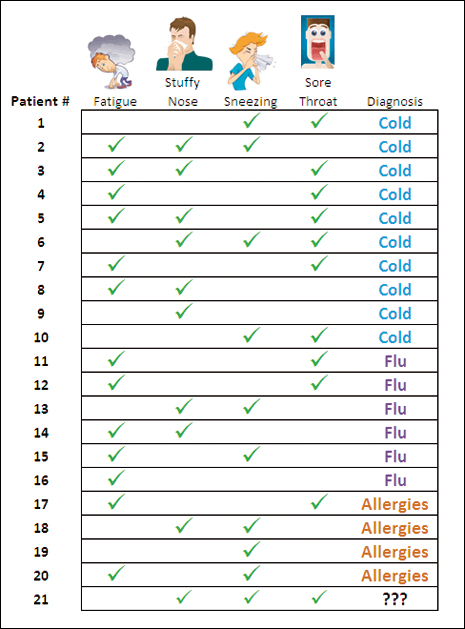
Table 1 shows 20 patients with varying symptoms and corresponding diagnoses. For example, Patient No. 1 reported symptoms of sneezing and a sore throat and was found to have a cold. Patient No. 20 exhibited symptoms of fatigue and sneezing that was found to be allergies. All diagnoses were confirmed through lab tests.
Question: Patient No. 21 has not been diagnosed yet is exhibiting symptoms of stuffy nose, sneezing and sore throat. Using only the data in Table 1, rank the three diagnoses (cold, flu and allergies) in order of how likely Patient No. 21 has each.
Send your answer to [email protected] by June 15. The winner, chosen randomly from correct answers, will receive an “O.R. The Science of Better” T-shirt. Past questions can be found at puzzlor.com.
John Toczek is the AVP Predictive Modeling at Chubb in the Decision Analytics and Predictive Modeling department. He earned his BSc. in Chemical Engineering at Drexel University (1996) and his MSc. in Operations Research from Virginia Commonwealth University (2005).