

August 2, 2010 in Corporate Profile
It’s all about the math at Wagner Associates
SHARE: PRINT ARTICLE: https://doi.org/10.1287/LYTX.2010.04.11
Headquarters: Malvern, PA.
Business: Consulting and software development firm that applies mathematics (operations research) and computer science to a wide range of operational problems.
Web site: www.wagner.com
Company Name: Daniel H. Wagner Associates, Inc.
Daniel H. Wagner Associates is a consulting firm that develops mathematical models and software implementations of those models to aid a wide range of clients in solving challenging operational problems. The Department of Defense is at the top of the firm’s client list. Other important client sectors include the financial industry, the health industry, the transportation industry and the oil and gas industry.
Headquartered in Malvern, Pa., the firm has branch offices in Hampton and Vienna, Va. Wagner Associates is an employee-owned company. Approximately half of the technical staff holds Ph.D.s in the mathematical sciences. The employees are the single greatest asset of Wagner Associates, and the company is structured to provide maximum benefits to the staff. Technical and career growth is encouraged and supported both conceptually and financially. In addition to tuition assistance, the company provides professional leave of up to seven days a year to encourage professional activities, such as writing journal articles, participating in professional societies, refereeing papers and attending conferences.
The firm was founded by Daniel H. Wagner in 1963 with the corporate goal of combining the power of mathematical theory with operational experience to address the increasingly complex problems encountered in naval operational analysis. Dan Wagner was a pioneer in naval operational analysis and brought an innovative philosophy to his fledgling company: hire the best mathematical talent possible and let them learn the applied side on the job. The company continues this tradition to this day, with proven success. In honor of his significant accomplishments and contributions to the field of operations research, CPMS: The Practice Section of the Institute for Operations Research and the Management Sciences (INFORMS), offers the Wagner Prize for Excellence in Operations Research Practice.
Search Theory
A major strength of the company is in the area of search theory, the optimal allocation of search effort/resources when attempting to locate or detect an object. Throughout the years, Wagner Associates has advanced this field in both the theoretical and the applied realm. Famous examples of the application of search theory involving Wagner Associates participation include: the 1966 search for an H-bomb lost by the U.S. Air Force near Palomares, Spain; the 1968 search for the sunken nuclear attack submarine USS Scorpion (SSN-589); the search and recovery operation after the space shuttle Challenger accident; and the search for the SS Central America, an 1857 treasure ship that sunk off the Carolinas in a hurricane, whose discovery returned more than $400 million in gold.
Of course there are other important applications of search theory. For example, Wagner Associates used search theory to develop the first computer-assisted search planning tool (CASP), which was used by the U.S. Coast Guard in planning and conducting search and rescue (SAR) efforts. One interesting feature of SAR is that in some search-and-rescue operations, the goal becomes to minimize the time to locate the object (e.g. man overboard in frigid waters) rather than to maximize the probability of finding the desired object.
In the military arena, search theory comes into play when attempting to determine, or maintain knowledge of, enemy location and status. This applies whether one is trying to optimally schedule the use of radar energy to detect incoming ballistic missiles as early as possible or placing sonobuoys in the water to assure that an enemy submarine cannot get within torpedo range of a carrier battle group undetected. When the object under search is actively seeking to avoid detection, a game-theoretic approach may provide the best solution. Wagner Associates developed a genetic algorithm based tool, the Operational Route Planner (ORP), that is used in the U.S. Navy Undersea Warfare-Decision Support System (USW-DSS) to plan search routes for anti-submarine warfare (ASW) and takes target-reaction-to-search operations into account.
Data Fusion and Target Tracking
Data fusion is another area of research related to search theory. Humans are easily able to integrate their own organic sensory information in order to obtain an accurate picture of the world around them. Automatically fusing the data from operational sensing systems (radar, passive and active sonar, cameras, seismic sensors, etc.) to achieve situational or tactical awareness of the surroundings poses a difficult challenge even with today’s powerful computers. Wagner Associates has been involved in the tracking of military targets since its inception. Even the simple problem of tracking a target with radar falls under the heading of data fusion. One must correlate the radar detections from one scan of data to the next, and then extract from the set of correlated detections as much information about the target state as possible. The Kalman Filter is the classic method for estimating the kinematic state from sensor data. Additional knowledge can be inferred from the observed trajectory over time (e.g., civilian airliners don’t make 3-G turns).
When multiple heterogeneous sensors need to be fused, and when the goal is to infer from the data a higher level of knowledge (relationships, intent), data fusion begins to intersect with a wealth of mathematical fields. Probability and stochastic processes play a fundamental role in the basic kinematic estimation. For example, Bayesian statistics, often implemented as Bayesian Networks, can be used to estimate target classification/identity, and graph theory can be used for associating data across multiple sensor frames. In addition, a variety of new analytical tools can also come into play: neural networks, fuzzy logic, evidential reasoning, support vector machines, etc.
From R&D to Deployment
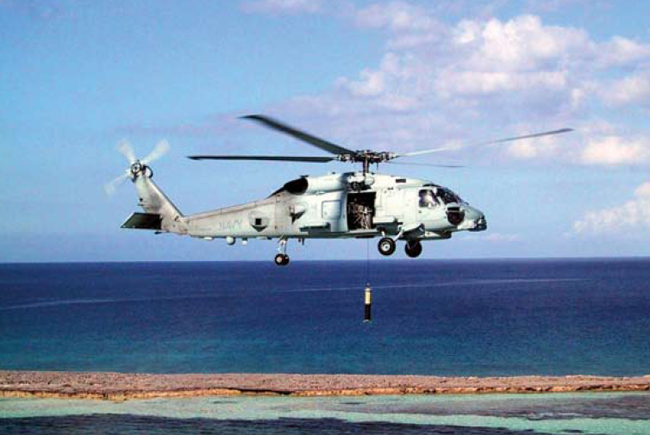
Although much of the work performed at Wagner Associates is basic research, many of our projects lead to operational systems that prove successful in the field. Oftentimes, theoretical advances made in a number of projects over a period of years combine to produce a single, highly advanced software product or module. A perfect example of this process is the acoustic mission planner (AMP), developed for the Navy’s MH-60R Seahawk Multi-Mission Helicopter under a multimillion dollar subcontract to Lockheed Martin Systems Integration-Owego.
One of the primary missions for the MH-60R is to locate submarines, and it uses both passive and active sonobuoys and a dipping airborne low frequency sonar (ALFS) to accomplish this task. AMP assists the MH-60R crew in planning its anti-submarine missions, recommending ALFS dipping sonar times and locations and optimal passive and active sonobuoy patterns. AMP is embedded in the MH-60R avionics software and also in the shipboard mission planning station (MPS).
There are two keys to AMP’s high level of performance. The first is the use of Wagner’s non-Gaussian tracking engine (NGTE) to provide the best possible probabilistic estimate of the submarine’s location. The NGTE is a non-Gaussian tracker that uses Monte Carlo target motion models and Bayesian statistical models to generate a space-time target probability distribution that is updated in real-time for both “positive” contact reports and “negative” search information from non-detection of the submarine. NGTE also uses estimates of target tactics and the presence of obstacles (such as land in the case of locating a submarine) to accurately project target location into the future based on the fusion of all available data. The second key is a search optimization algorithm that takes the target location information generated by NGTE, combines this data with insitu sensor performance estimates, and then optimizes the employment of the dipping sonar and passive and active sonobuoys using a global optimization scheme based on Brown’s algorithm, along with a local heuristic for flight path selection.
In operational use, the AMP optimizer computes a complete route with sensor locations, depths and operating modes for the helicopter at the beginning of the mission. Each deployment of the dipping sonar, or of an expendable bathythermograph (XBT), returns environmental data that is used to improve the accuracy of the sensor performance estimate. Based on this new data, the embedded system reruns the optimization algorithm, improving overall mission performance in the latter portion of the search.
Mathematical Finance
One of the recurring surprises of mathematics is how seemingly unrelated problems have mathematically related solutions. For example, the same class of stochastic differential equations used to model the physical motion of vehicles for the DoD can be used to model the “motion” of prices of various financial instruments. Wagner Associates uses these and other mathematical finance methods to develop trading systems that exploit statistical arbitrage opportunities for the benefit of our client investment firms.
Out of our long history of finance consulting experiences, Wagner Associates has developed numerous computer models for quantifying financial risk as well as stand-alone mathematical finance software products. The Retirement Spending Planner (RSP) tool uses Monte Carlo techniques (similar to those used in NGTE) to analyze and recommend retirement planning strategies for individuals. A classic example of Sam Savage’s “Flaw of Averages” is the retirement plan that on average results in a comfortable lifestyle until one’s presumed demise at age 95, but that has a 25 percent chance of going broke before age 85. RSP, used by both individuals and certified financial planners, permits a probabilistic analysis that can accurately take into account future uncertainties. Another product, M-V Optimizer, uses mean-variance optimization methods to construct investment portfolios that maximize expected return subject to a user specified constraint on risk.
In summary, the Wagner Associates company handbook states, “Our staff is decidedly our most important asset. Therefore, a primary corporate goal of the firm is to build and maintain a highly talented and motivated staff and to provide them opportunities to grow professionally.” We accomplish this goal by choosing to work on the most challenging problems, by seeking partnerships with universities and government labs, by encouraging innovative thinking and academically oriented activities, and by maintaining the high standards of research excellence set by our founder, Daniel H. Wagner.
Allen Butler is president of Daniel H. Wagner Associates.
([email protected])