

December 6, 2010 in OODA Loop
Agility wins
Military strategy studies indicate huge importance of rapidly adaptive decision-making.
SHARE: PRINT ARTICLE: https://doi.org/10.1287/LYTX.2010.06.05
Recent news reports indicate that Barnes and Noble, once giant of the bookstores, is putting itself up for sale, while GM prepares to issue new stock to emerge from bankruptcy. Meanwhile, Circuit City is gone, and Rite-Aid is reportedly teetering on the edge. Urban newspapers are becoming a vanishing species. The recession has played a part, but all these companies have competitors who are doing better. Such stories keep appearing, and alleged experts repeatedly proclaim, “They couldn’t adapt to the changing market.”
This diagnosis is almost a truism: If the company were doing well, neither the company nor its changing market would be in the news, right? “Stay close to your customers” was one of the big recommendations of the 1980s management classic text, “In Search of Excellence.” W. Edwards Deming, near the end of his long and illustrious career, liked to point out that all his principles of quality control and quality improvement had not sufficed to save the vacuum tube manufacturers when transistors entered the market. Still, there is a serious scientific question here. Adaptation to changing conditions is clearly good, but how important is it relative to other core values, and how can management know how much is enough?
A cogent answer to this question comes from a source unfamiliar to most business managers – indeed, even to most analytic professionals. He was, in addition, one of the most influential military strategists in history, and perhaps the most undervalued. His name is John Boyd.

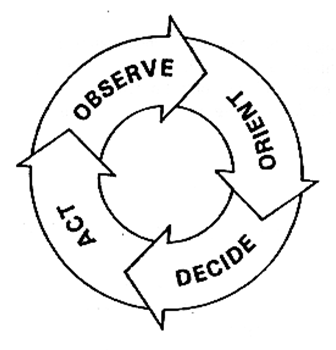
John Boyd (1920-1997) was a U. S. Air Force pilot, later a professor at the U. S. Military Academy (West Point), who developed and articulated a new theory of warfare. Among other innovations, he can claim much of the credit for post-1950s aerial combat doctrine, maneuver warfare, net-centric warfare (a key to the success of Operation Desert Storm in 1991 and the swift Coalition victory in the conventional phase of the Iraqi conflict in 2003), the development of the F-15, F-16 and F-18 fighters and the transformation of U. S. force structure following the Vietnam conflict. He is best known, however, for the idea that every decision-maker repeatedly executes a cyclic process: observation, orientation, decision, action. This cycle is usually called the OODA loop, and Boyd’s work is often over-simplified to the conclusion, “the shorter OODA loop always wins.”
The first step to understanding Boyd’s thinking is the emphatic statement that he abhorred over-simplifications. One of the reasons he is not well known is that he never published his extensive findings and theorizing. The definitive source material is a collection of overhead slides he used in his lectures at West Point and elsewhere. This volume, often referred to by Boyd fans as “the green book,” contains his major presentations: “Destruction and Creation” (1975), “Patterns of Conflict” (1977), “Design for Command and Control” (1982, revised through 1987), “The Strategic Game of ? and ?” (1987) and “A Discourse on Winning and Losing” (1987, repeatedly revised for several years thereafter). In final form, the “Discourse” comprises the other presentations, as revised, plus an additional summation piece, “Revelation.” He continually tinkered with his work and, according to book reviews on Amazon.com by a couple of his former students, refused to release even the slides to a group until they had heard the lecture.
Fortunately, much of his work is assembled, assessed, chewed over, connected to and compared with other sources, and perhaps made more understandable in an excellent recent book, “Science, Strategy and War: The Strategic Theory of John Boyd,” by a Royal Netherlands Air Force pilot, Col. Frans P. B. Osinga, Ph.D. With considerable help from this book, and at the risk of over-simplification, here are some of Boyd’s main ideas:
Life is full of complex adaptive systems. Such systems require understanding at the system level and are perpetually changing. Therefore, our methods of gaining understanding must be perpetually adapting, as well.
Recognizing changing conditions quickly is a critical component of good decision-making. Boyd’s OODA concept originated in his study of why U.S./ South Korean F-86s did so consistently well against North Korean MiG-15s in the Korean Conflict. Differences in armament, speed, maneuverability and pilot training were insufficient to account for the results. He concluded that the F-86 had a critical advantage in the wide field of view its cockpit afforded, as contrasted with the much more closed-in design of the MiG-15 cockpit. The F-86 pilot therefore had a big edge in seeing where the opponent was and where he might be going next – the “orientation” portion of the decision cycle.
Doing the unexpected usually works better than a seemingly stronger but predictable action. In this, Boyd cited and built on the ideas of Sun Tzu, J. F. C. Fuller and B. H. Liddell Hart.
Attack the opponent’s center of gravity, the critical resource, which may not be – indeed, usually is not – the physically strongest component of his forces. In many cases, the point to attack is not physical at all, but the opponent’s mind. Overwhelming the opponent with confusing and debilitating information may be the most effective tactic.
The central strategic idea can be summarized – over-simplifying, of course – as “Variety, Rapidity, Harmony and Initiative.” This is the wrap-up of a 177- page review of military history that will repay careful study, which in turn is necessary to a deep understanding of the wrap-up.
Systems gain entropy (become less ordered) unless energy is added from outside. The only way to effect change toward some ordered behavior we want is to inject energy into the system. This insight formed the basis for his theories on aerial combat, now known as “energy-maneuver warfare” or “EM.” The short OODA loop, the ability to adapt so quickly that the opponent is overwhelmed, comes from having the information and operational resources to generate actions he cannot match or counter.
No system can be understood from within itself. In citing the Second Law of Thermodynamics as the scientific underpinning of the EM concept, Boyd also cited the Godel Incompleteness Theorem to support this point. Just as energy to maintain a system’s order must come from outside it, perspective to understand its behavior must also come from outside it. In short, pay attention to context, and …
Continually seek diverse points of view, paying particular attention to indications that you have missed something. This is a common theme of many recent articles in Analytics and OR/MS Today, drawing on research in agent-based modeling, wargaming and hypergame theory, and on Thomas Ricks’ account of how the U. S. military developed its new Iraq strategy in late 2006. The widely discussed recommendations early this year for transforming U. S. intelligence processes, by Maj. Gen. Michael Flynn, who commanded U. S. military intelligence efforts in Afghanistan and is now on the staff of the Director of National Intelligence, emphasize the same idea.
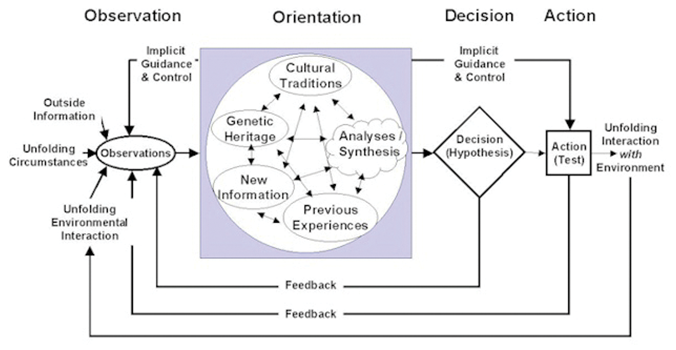
Cultivate not only the specific decision-making process but also the way of thinking that enables us to recognize changing circumstances and adapt to them faster than our opponents. This is the “short OODA loop” recommendation, but in a broader and deeper form; Boyd knew perfectly well that making bad decisions quickly was not an advantage. His point was that making decisions consistently well is impossible, given the way in which the situation keeps evolving, so the key need is to evolve along with it.
Growth is a repetitive cycle of creation and destruction. In particular, the key to finding an improved way of doing things usually is the readiness to discard the current approach, even though it has been successful.
Recognize the critical importance of interactions. The question marks in Boyd’s “Strategic Game of ? and ?” turn out to refer to “interaction” and “isolation.” (In typical fashion, he wanted people to work through his whole discussion before learning what the question marks meant.) Interaction with cooperative parties and isolating the opponent from similar interactions is the key to winning. This leads to …
Develop and increase moral leverage. Boyd asserted that, “With respect to ourselves we must:
- “Surface as well as find ways to overcome or eliminate those blemishes, flaws or contradictions that generate mistrust and discord so that these negative qualities neither alienate us from one another nor set us against one another, thereby destroy our internal harmony, paralyze us and make it difficult to cope with an uncertain, ever-changing world at large.
- “In opposite fashion we must emphasize those cultural traditions, previous experiences and unfolding events that build up harmony and trust, thereby create those implicit bonds that permit us as individuals and as a society, or as an organic whole, to shape as well as adapt to the course of events in the world.”
He continued, “With respect to our adversaries we must:
- “Reveal those harsh statements that adversaries make about us – particularly those that denigrate our culture, our achievements, our fitness to exist, etc. – as basis to show that our survival and place in the scheme of things is not necessarily a birthright, but is always at risk.
- “Reveal those mismatches in terms of what adversaries profess to be, what they are and the world they have to deal with in order to surface to the world, to their citizens, and to ourselves the ineptness and corruption as well as the sub-rosa designs that they have upon their citizens, ourselves, and the world at large.
- “Acquaint adversaries with our philosophy and way of life to show them that such destructive behavior works against, and is not in accord with, our (or any) social values based upon the dignity and needs of the individual as well as the security and well-being of society as a whole.”
As for the uncommitted and the potential adversaries, Boyd said, “We should:
- “Respect their culture and achievements, show them we bear them no harm, and help them adjust to an unfolding world, as well as provide additional benefits and more favorable treatment for those who support our philosophy and way of doing things; yet
- “Demonstrate that we neither tolerate not support those ideas and interactions that undermine or work against our culture and our philosophy, hence our interests and fitness to cope with a changing world.”
Boyd therefore defined strategy as “a mental scheme or design for harmonizing and focusing our efforts on a basis for realizing some aim or purpose in an unfolding and often unforeseen world of many bewildering events and many contending interests.” Hence the purpose of strategy is “to improve our ability to shape and adapt to unfolding circumstances, so that we (as individuals or as groups or as a culture or as a nation-state) can survive on our own terms.” He elaborated, “The central theme is one of interaction/ isolation while the key ideas are the moral-mental-physical means toward realizing this interaction/isolation.” Thus, he concluded, “We play to this theme and activate these ideas by an instinctive see-saw of analysis and synthesis across a variety of domains, or across competing/independent channels of information, in order to spontaneously generate new mental images or impressions that match up with an unfolding world of uncertainty and change.”
As Boyd summarized in his introductory abstract, “The theme that weaves its way through this ‘discourse on winning and losing’ is not so much contained within each of the five sections, per se, that make up the ‘discourse’; rather, it is the kind of thinking that both lies behind and makes up its very essence. For the interested, a careful examination will reveal that the increasingly abstract discussion surfaces a process of reaching across many perspectives; pulling each and every one apart (analysis), all the while intuitively looking for those parts of the disassembled perspectives which naturally interconnect with one another to form a higher order, more general elaboration (synthesis) of what is taking place. As a result, the process not only creates the ‘discourse’ but it also represents the key to evolve the tactics, strategies, goals, unifying themes, etc., that permit us to actively shape and adapt to the unfolding world we are a part of, live in, and feed upon.”
References
- John Boyd, “A Discourse on Winning and Losing,” unpublished collection of lecture slides. A few copies are available via Interlibrary Loan from such sources as the Marine Corps University Library, the depository for Colonel Boyd’s papers.
- Maj. Gen. Michael T. Flynn, Captain Matt Pottinger, Paul D. Batchelor, January 2010, “Fixing Intel: A Blueprint for Making Intelligence Relevant in Afghanistan,” Center for a New American Security, www.cnas.org.
- John Nagl, 2002, “Learning to Eat Soup with a Knife: Counterinsurgency Lessons from Malaya and Vietnam,” Praeger.
- Frans P. B. Osinga, 2007, “Science, Strategy and War: The Strategic Theory of John Boyd,” Routledge.
- Thomas Ricks, 2009, “The Gamble: General David Petraeus and the American Military Adventure in Iraq, 2006-2008,” Penguin.
- Douglas A. Samuelson, June 2003, “The ‘Netwar’ in Iraq,” OR/MS Today.
- Douglas A. Samuelson, August 2008, “Understanding Organizational Anarchy: Agent-Based Models Help Explain Well-Known Dysfunctions,” OR/MS Today.
- Douglas A. Samuelson, Summer 2009, “The Turnaround in Iraq,” Analytics.
- Douglas A. Samuelson, December 2009, “Playing for High Stakes: Wargamers and Cognitive Scientists Seek to Avoid ‘Strategic Surprise’,” OR/ MS Today.
- Douglas A. Samuelson, June 2010, “Changing the War with Analytics,” OR/MS Today.
Douglas A. Samuelson is president of InfoLogix, Inc., a consulting company in Annandale, Va. Samuelson worked as a paid campaign staffer in a U.S. Senate campaign in Nevada in 1970, as a county coordinator in a gubernatorial campaign and targeting analyst for a local campaign in California in 1974, and as a Federal Civil Service policy analyst from 1975 to 1982. He has been a longtime contributor of columns and articles to OR/MS Today and Analytics magazines.
([email protected])