

February 7, 2011 in Analytics
HP’s world-class e-marketing business
How Hewlett-Packard uses advanced analytics to drive its digital marketing strategies.
SHARE: PRINT ARTICLE: https://doi.org/10.1287/LYTX.2011.01.04
The growing effectiveness of digital media has changed the way marketers interact with customers. New age customers are informed and empowered. The challenge for organizations is to be a part of the customers’ conversations involving their product and to influence their choices. Hence, the adoption of digital channels such as social media, e-mail marketing and online search and display ads is growing steadily. What helps marketers get the most out of their digital marketing strategies is the ability to capture and mine data exhaustively and cost effectively through advanced analytics techniques. These techniques shed light on the effectiveness of all marketing activities, thus helping marketers fine-tune their strategy. In the long run, this enhances customer engagement, optimizes digital “marketing spend” [1] and has a direct impact on revenues.
Hewlett-Packard uses advanced analytics and operations research (O.R.) applications to drive its digital marketing strategies and overcome business challenges. HP’s in-house analytics team, Global Business Services Analytics (GBS Analytics), directs this enterprise-wide analytics effort and plays a critical role in developing various advanced analytics solutions. These solutions leverage structured and unstructured data across billions of customers worldwide to improve the effectiveness of the e-marketing model across HP [2].
The Era of Digital Marketing
Compelling benefits encourage organizations to move their marketing dollars from traditional to digital channels. For starters, digital channels assure better and cheaper access to a broader customer base. Additionally, these channels offer the ability to mass-customize marketing messages and speed up the capture and analysis of customer responses. All this knowledge can be used to quickly refine marketing and sales tactics.
According to Forrester Research Inc., less than 20 percent of organizations are expected to increase marketing spend in traditional media, such as newspapers, magazines, television and direct mail [3]. In contrast, more than 60 percent of them are expected to increase spend in digital media, such as e-mail marketing, paid search and social media.
E-Marketing at HP
HP is at the center stage of this digital revolution and has been making significant investments on digital channels to generate demand, engage customers and provide technical support. E-marketing at HP can be summarized into three broad themes – the three “Cs” of the e-marketing ecosystem:
- Community deals with the aspect of engaging customers and creating awareness about HP products and services, leading to effective lead generation.
- Content deals with the aspect of providing customized relevant content to customers and improving user experience.
- Commerce deals with aspects of generating revenue through online commerce.
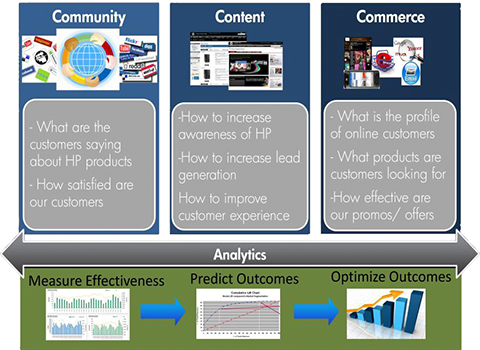
Multiple levers are available to grow the online business. These levers include:
- driving traffic by guiding customers to the right content;
- increasing conversion by offering relevant products at appropriate price points;
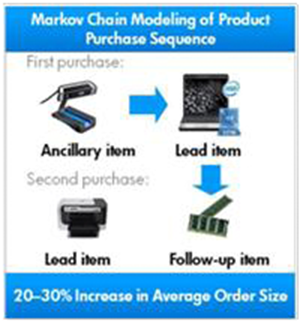
- cross-sell and up-sell to increase basket size and improve margins; and
- increasing customer engagement to increase loyalty and repeat purchase.
HP deploys various analytical solutions to drive online commerce. This has proven valuable in three broad areas:
- Enhanced online store effectiveness by driving quality traffic, analysis of marketing effectiveness and inventory planning
- Proactive customer engagement to identify opportunity and target customers with right products
- Increased profitability of digital media investment by intelligent allocation of budget across marketing vehicles
Analytics Solutions
Online stores with high volumes of customer transactions and behavioral data create the perfect environment to apply advanced analytical solutions. This helps elevate performance of key store functions, such as:
- Demand generation – driving quality traffic to the store. Data analysis helps understand the key marketing activities driving traffic to the Web store and accurately forecast Web traffic.
- Web store experience – online customization for enhanced user experience. Analytics helps in areas such as click-stream analysis, cart abandonment analysis and experimental design to help increase click-through.
- Supply chain operations – order fulfillment and inventory optimization. Analytics solutions could include standard performance measurement framework and managerial dashboards to manage daily store operations.
- Customer support – customer tech and warranty support center. Customer surveys and call-center analytics can help identify problem areas, drive down costs and build customer relations.
Proactive Customer Engagement
In the digital age, customers no longer just experience the brand; they have also started impacting brand perception. Marketers who can proactively engage customers can expect to increase the circle of influence many times over by making these “engaged customers” their brand advocates.
An organization needs to keep its customers engaged to achieve long-term profitability and sustainability. It is critical that customers not only continue to use a specific product/service but also try out other offerings from the same brand. That can only be achieved if customers are satisfied with their previous experiences. Studies have proven that word-of-mouth is a highly effective way of attracting new customers. Satisfied customers act as a company’s covert sales force and significantly reduce the cost of acquiring new customers. However, influencing customers enough for them to champion a product or service requires deep behavioral insights.
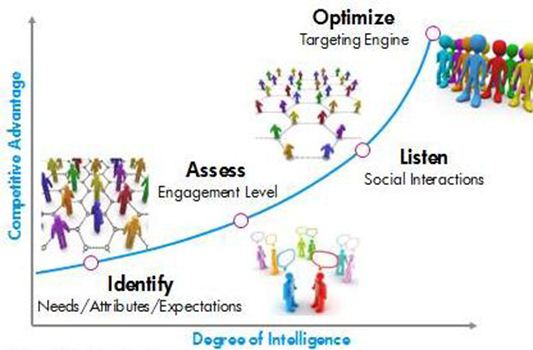
Analytical techniques can be deployed to tap these insights at various stages of customer engagement:
- Customer need identification: Marketers can understand differences in media consumption behavior by capturing the unique needs and expectations of customers and then creating a logical segmentation the existing customer base.
- Engagement-level assessment: Marketers can reach out to their customers through various touch points to review the level of engagement and determine the drivers of loyalty – rational, emotional or brand-image related. Organizations can use their internal data (length of relationship, recent activity and frequency of purchase) to assess customer loyalty.
- Active listening – Social media is a great platform to assess customer sentiments and the level of engagement. Conversations are un-bounded and customers can express their true feelings. Understanding these conversations will enable marketers to take positive actions. Analytical tools (e.g., text mining) help provide a structure to this unstructured, conversational data and aid in the discovery of key take away.
- Engagement optimization – Knowledge gained in the first three stages are brought together in this stage to optimize customer value by creating an intelligent cube that helps marketers answer the “who, what, when and how” questions. The intelligent cube helps create an effective targeting engine to offer the most relevant products to customers and increase conversion several folds.
HP’s relevant “digital” presence on popular social networks provides an opportunity to actively listen to customers’ likes and dislikes. Consumer buzz is captured and fed into the enterprise data warehouse, and then analyzed along with other relevant data by skilled analytics professionals to gauge consumer sentiments and satisfaction level, new product ideas and selling opportunities.
Boosting Profitability of Digital Media Investment
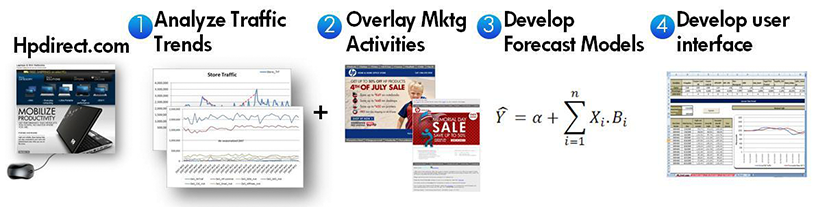
To reach different customer segments with different communication and buying preference, marketers use a mix of marketing vehicles. Optimizing spend on various marketing vehicles is critical to enhancing demand generation efforts. However, determining which marketing mix is most beneficial to the business requires not only a scientific approach to analyzing spend and revenue, but also a test-learn-optimize culture.
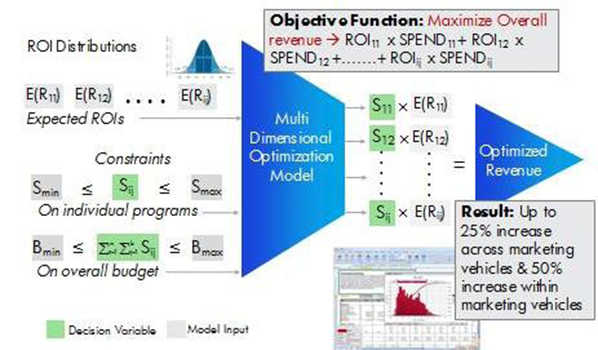
The GBS Analytics team has developed an optimization framework that helps HP decide how best to allocate marketing spend based on historical performance. The framework …
- provides a mathematical framework to a business decision of selecting a specific marketing vehicle for a campaign;
- helps determine the business justification for appropriate allocation of spend on different marketing vehicles; and
- provides the user with the ability to tweak the marketing spend across vehicles and evaluate the resulting ROI of the campaign.
The first phase of the project used a linear programming approach to determine the budget allocation across different marketing channel and product category combinations, with the objective of maximizing the overall revenue.
The team developed a user-friendly optimization tool that allows HP to maximize revenue (or ROI) subject to channel specific constraints (e.g., an upper and lower bound on the number of e-mails per campaign) and product-specific constraints (e.g., Notebooks have to be marketed on affiliate sites and the HP Web site and search engine). The solution, when tested on some historical campaign scenario and compared with the actual spend allocation results, was found to provide an overall ROI increase of up to 25 percent.
In the second phase of the project, the impact of interaction effects on ROI and the non-linear nature of ROI by online channel will be evaluated through non-linear programming. The tool will also provide the ability to perform simulations using a Monte-Carlo simulation approach to allow the business to test multiple marketing spend allocation scenarios and pick the one that suits them the best. The traffic generated by marketing activities, the conversion rate and order size are the drivers of revenue in the next phase of model formulation. Traffic generated by each vehicle, conversion rate and average order size are variable. Given a particular budget allocation, the tool allows the user to simulating web-store traffic and predicts the total revenue.
Conclusion
As digital marketing and social media grow as influencers, it becomes imperative that the insights gained and actions taken based on the measurement of marketing effectiveness are disseminated across the enterprise in an integrated manner. While digital channels enhance an organization’s ability to reach its target customer in the most effective and efficient manner, analytics helps companies measure the previously immeasurable and provides the means to evaluate data and turn it into actionable insights.
References
- “Marketing spend” refers to the marketing budget allocated to such activities as search marketing, e-mail marketing, affiliate marketing and comparative shopping.
- http://viewer.zmags.com/publication/07afc96c#/07afc96c/29.
- “U.S. Interactive Marketing Forecast, 2009 to 2014,” Forrester Research Inc.
Arnab Chakraborty is a managing director at Accenture Analytics, part of Accenture Digital, with responsibility for the ASG (Austria-Switzerland-Germany) region. Prithvijit Roy is a senior director, at HP Global Business Services. Copyright Hewlett-Packard Development Company, L.P. All rights reserved. Pritam Kanti Paul a director at HP Global Business Services. Copyright Hewlett-Packard Development Company, L.P. All rights reserved. Girish Srinivasan is a senior manager at HP Global Business Services. Copyright Hewlett-Packard Development Company, L.P. All rights reserved.
([email protected])

([email protected])

([email protected])