

October 3, 2011 in Five-Minute Analyst
Budgets and brinksmanship
SHARE: PRINT ARTICLE: https://doi.org/10.1287/LYTX.2011.05.13
Like most Americans and many others around the world, I anxiously watched the debt ceiling negotiations this summer with an ever-increasing sense of concern. Although assigning blame and quoting politicians out of context made for some very entertaining blog and television, we can safely assume – with the stakes this high and the professional staffs of both parties hard at work – that the reason for the impasse was not simply “madness.” Although the stakes were extremely high, we can think of the politicians as having played a “game” that I will call “Budget Chicken” [1].
Many of us are familiar with the setup of the car version game of “Chicken”– two drivers head toward each other on a single stretch of road, and the player who “flinches” first loses. Of course, if neither player flinches, the cars collide at full speed and there is no “winner.” A possible payoff matrix for Chicken is shown in Table 1.
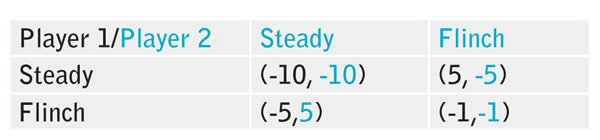
is listed first each cell. This instance is symmetric – each player’s preference is for the other player to “flinch.”
Chicken is fundamentally different than the DUI-App game of May/June’s column because Chicken is best thought of as a family of decisions. Suppose we are playing the car version and each car starts 200 meters from the “middle” and moves at 20 meters per second [2]. Also, imagine that this is reality TV, so at each second, we pull the drivers into the “confession booth” to reveal what they are thinking. If the drivers decide to play “steady,” the clock is advanced and each driver moves 20 meters closer to disaster. Here’s the rub: obviously, somebody should flinch since nobody wants to crash at 90 MPH closure. However, neither player wants to be the first one who has to “give” – particularly if they are concerned about reputations.
Previously, we had only considered a single play of the game so we had a simple rule. Here, life is more complicated. We need a family of rules or a strategy. Here’s one possible strategy:
1. Figure out how close you are willing to get before you flinch.
2. Play “steady” until the moment right before you think you should flinch.
This strategy works but has a problem. For example, if I am playing the car game against you and I learn that you are willing to get no closer than two seconds from disaster, I will adjust my “flinching time” to 1.9 seconds before impact, and I’ll win without having to “give” – or risk – anything.
The way out for a rational player is to mask how close he’s willing to get to disaster. This means he must appear to be willing to go all the way to the edge – hence the term “brinksmanship.” In the car version, actions that would tend to show how close you are willing to get might include wearing a helmet and, for lack of a better phrase, appearing to be insane. In the budget version, it may include walking out of meetings and exchanging threats.
If you are playing Chicken with cars, two dangers exist. First, suppose that Player 1’s threshold is .1 seconds before impact. Player 2 knows this and adjusts his threshold to .09 seconds before impact. In the car version, there is some point beyond which the brakes are ineffective even if they are applied. Determining this point would be a difficult exercise in physics as it would involve precise estimates of speed, braking power, friction and so on. In the budget version, the danger is that if the fighting goes on too long the markets will have adverse reactions and bond ratings may be downgraded anyway. This is a real concern for cars, budgets and nuclear weapons [3].
The second danger in playing Chicken for real is that you can never fully dismiss the possibility that your opponent really is insane. They may be playing optimally, or they might really be crazy. You would never know for certain until after the game is over.
Notes
- If you object to likening the budget to the game of “Chicken” it will be of no comfort whatsoever that nuclear war has also been likened to Chicken.
- 45 MPH if you prefer.
- With the credit-rating downgrade, it would appear this has happened.
Harrison Schramm, CAP, PStat, is a senior lecturer at Naval Postgraduate School, splitting his time between Defense Management and Operations Research where, in addition to teaching, he runs the Contested At-Sea Logistics Lab (CASLL). He served as the inaugural chair of the INFORMS Security Conference and is a past president of the INFORMS Analytics Society.
([email protected])