

December 5, 2011 in Profit Center
A winning analytics team
SHARE: PRINT ARTICLE: https://doi.org/10.1287/LYTX.2011.06.09
I met Erin Blatzer for lunch near Houston’s museum of natural science, where she works as director of online media. But it was the work she’d done with the Houston Symphony that I wanted to discuss.
Blatzer led a team of MBA students at the University of Houston that won first place in the fourth annual Google Online Marketing Challenge – the first American team to win. The challenge is open to students from universities throughout the world, and in 2011 attracted 4,429 teams from 68 countries.
The competition focuses on the use of AdWords, a Web product offered by Google for small businesses to help them set up and manage online ad campaigns. Loosely speaking, an online ad campaign consists of money set aside for text ads that are displayed when a Web search is performed with Google. These are paid ads, not the organic (unpaid) search results that Google also delivers. A typical paid ad might appear as follows:
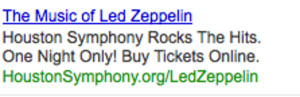
The primary means of payment is based on clicks. If Google displays an ad for a business and a viewer clicks on that ad, Google receives payment. There’s no set price. Businesses choose a maximum amount they’re willing to pay which is treated as a bid. This means a click will result in payment to Google that may be less than the amount a business is willing to pay, but never more.
Of course, Google is motivated to give all relevant ads good placement because it improves the viewer experience and because only an actual click will result in a payment. But Google also has many competing bidders for the same ad space, and performs sophisticated, proprietary ad placement algorithms designed to maximize Google’s long-term revenues.
Yet, while businesses ultimately depend on Google for ad placement, AdWords provides many opportunities for businesses to provide control or assistance to Google on where to place ads. In the control category are items like geographic region. Should a business want to limit views to selected English-speaking cities in Europe, that can be set up. In the assistance category are items such as keywords. When someone uses Google to search for one or more of the keywords a business has chosen, the business’s ad may or may not appear, depending on how many other businesses are using the same keywords (and how much those other businesses are willing to pay per click.) In the end, ad placement and, ultimately, the number of clicks a business receives are a complex mix of what the business tells Google, what the business bids for clicks, and how Google evaluates the many different competing ads.
Needless to say, not even Google can explain the placement of any particular ad other than to describe its ad placement algorithms – which, of course, it doesn’t do since businesses could take advantage of this information. Google does, however, provide a variety of tools – some quite sophisticated – for businesses to track how their ad campaign is performing.
That’s how Blatzer and her team won their award. The first step was to find a good business partner, a requirement for the competition. The Houston Symphony was a fortunate find since it was in the early stages of pursuing online marketing initiatives. As part of that process it was using Google Analytics, another Web product by Google, that could aid the team in designing their ad campaign.
The team was given a $200 credit with AdWords and three weeks to complete their campaign. The decision was made to focus on individual ticket sales since management at the symphony felt this was the best way to reach new customers – customers with the potential to become long-term patrons. After a variety of calculations incorporating items such as expected immediate revenue, customer lifetime value and cannibalization from other channels, a goal of three sales was established since at that point the return would exceed $200.
The team’s strategy was to start with fairly tight limits on controls such as customer location and then adjust accordingly. With a limited budget, the idea was to focus attention on individuals with a high perceived likelihood of making a purchase. However, after the first week, the ad had been displayed only 91 times. With only two weeks remaining, it was clear more impressions were needed to generate sales. Changes were made, and by the end of the three-week period the team had generated more than 13,000 impressions and 10 sales – impressive for a budget of only $200.
The team had to tightly control how it spent its money. They couldn’t, for example, bid $10 per click unless they were willing to live with the possibility that the entire budget could be wiped out with as few as 20 clicks. Still, if the bid was too low, the team surmised Google’s ad placement algorithms would choose other, more profitable ads to display. What to do?
AdWords requires a business to supply a bid per click that it’s willing to pay, but it also allows businesses to place a limit on the total amount of money they’re willing to spend. If not, a business might get so many clicks that, unless those clicks generated sufficient sales, it could go broke.
A key insight came when the team reasoned that Google’s ad placement algorithms might make decisions not only on the amount bid per click, but on the total amount of money a business was willing to spend. A business willing to pay $10 per click looks good compared to one willing to pay only $1 per click, but the story changes when the first business has a budget of $100 and the second a budget of $100,000. Even though the team had a budget of only $200, they entered a much higher budget – then carefully watched to make certain they didn’t overspend their actual budget, thus risking disqualification. If clicks occurred too frequently without generating sales, they could stop the process and reevaluate other aspects of their campaign.
First-place honors included a trip to Google’s Googleplex, the company’s corporate headquarters in Silicon Valley. There, the winners were treated with the respect due any group that had demonstrated unequaled mastery of the online tools offered by an intellectual and market powerhouse. At a presentation to Google employees, the team probed about the judging criteria. The response was admittedly vague: The team had learned and made adjustments throughout the campaign and the judges were impressed. That was it. Had the judges gone into detail, they were at risk of divulging proprietary information. Understandable for Google, but not much help for future teams entering the competition.
But perhaps the judging criteria weren’t really that important. The competition gave students around the world hands-on experience with running an online marketing campaign. Until recently, that’s something marketing professors could only dream about. For its part, Google managed to get AdWords into the hands of tens of thousands of students; students who will take their AdWords skills into the workplace and in turn generate ad revenues for Google. And since the student teams were required to partner, the partner organizations were also introduced to AdWords.
For its part, the Houston Symphony earned a $5,000 donation from Google as a result of its involvement in the competition. The symphony also applied for, and received, a credit of $10,000 per month on AdWords as part of the Google Grants program for non-profit organizations. As for Blatzer and her team members, only time will tell. But they’re certainly off to a great start.
The team consisted of Erin Blatzer, Lauren Davis, Carolina Thomas and Jeffrei Clifton of the University of Houston under the sponsorship of Professor Steven Koch.
Andrew Boyd, INFORMS Fellow, past INFORMS VP of Marketing, Communications and Outreach, was an executive and chief scientist at an analytics firm for many years.
([email protected])