

December 5, 2011 in Five-Minute Analyst
Picking airline seats
SHARE: PRINT ARTICLE: https://doi.org/10.1287/LYTX.2011.06.11
This is the November/December edition of Analytics Magazine, and that means that many of us will be travelling with families – either our own for visiting distant relatives or traveling alone for business sprinkled amongst the family gatherings [1]. On many air carriers you get a ticket and go to your assigned seat, and you know when you buy your ticket what seat you will have and you have no way to influence who your neighbors are. This is different than other carriers, such as Southwest, where you line up in ticket rank order and sit wherever you like.
If you had a “special” ticket that you could trade for the boarding pass of your choice, what number would you want to have? We’ll assume a full flight with 90 seats, arranged in 15 rows of six (three on each side of the aisle). Two factors determine the quality of a flight if you are flying alone: the seat you have and who you sit next to. Let’s assume that I’m someone who likes to have conversations with fellow passengers about what they are reading. If I saw a passenger carrying a copy of OR/MS Today [2], I’d want to sit next to them. Likewise, if I saw another passenger carrying the newest selection from the “Teen Paranormal Romance” shelf [3], I would not want to sit with them.
Now, if you don’t care about what the other passengers are reading because you don’t talk on flights, then your only concern is seat choice; the ticket that gives you the most choice in your seat is the first one (and you can stop reading the rest of this article).
If, however, you are concerned both with your seat and who you sit with, then you may want a different approach. Let’s think about boundary cases:
- If you have the first ticket, then you will get your first choice in seats, but are at the mercy of the other passengers for who sits next to you. You have a 1/89 ? 1 percent chance (assuming you pick an aisle or window seat) of sitting next to the passenger reading OR/MS Today.
- If you have the last ticket, you have no choice in seats and also no choice in who you sit next to. You have a 2/89 ? 2 percent (assuming that the last seat on the plane is a middle seat) chance of sitting next to the passenger reading OR/MS Today.
It is immediately counterintuitive that the last ticket may have a better chance of sitting next to the “best” passenger than the first ticket.
Now, this is the five-minute analyst, not the five-year dissertation. The problem posed here could lead to a mountain of applied probability. To avoid this, I’m going to make an enormous simplifying assumption [4]:
When passengers board the plane, they do not take a middle seat if others are available.
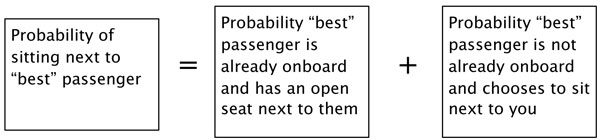
We have also (implicitly) assumed that all of the other passengers are traveling alone. If we can live with these assumptions, we can compute probabilities of sitting next to the best passenger by breaking the problem up as shown in Figure 1.
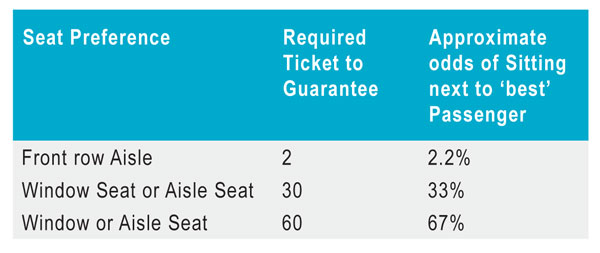
We can now think about “mixed” requirements – a person who wants to have a certain type of seat and also wants to sit next to the most desirable passenger, as depicted in Table 1.
A graph as shown in Figure 2 may also be useful.
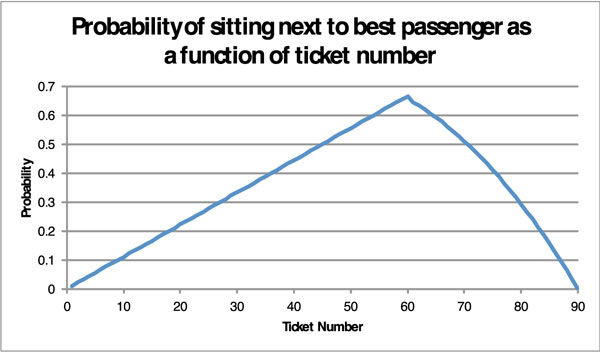
increases near-linearly until the 60th ticket, at which time middle seats begin to be filled and it sharply decreases.
I’ve made a bunch of assumptions, and some of them are clearly unrealistic. So what was the point? The takeaway from this discussion is to see that there are circumstances where it is best NOT to be the first person on the plane. In particular, it would seem that (depending on assumptions) the best ticket to maximize both your seat choice and neighbor choice is probably somewhere between 30 and 60, or the middle boarding group.
NOTES
- In the interest of full disclosure I expect to do both.
- OR/MS Today (www.orms-today.org/) is the membership magazine of the Institute for Operations Research and the Management Sciences (INFORMS), the publisher of Analytics Magazine.
- Sadly, I didn’t make this up.
- If we didn’t make this assumption, this would be a messy complication to the “Best Prize Problem” from applied probability.
Harrison Schramm, CAP, PStat, is a senior lecturer at Naval Postgraduate School, splitting his time between Defense Management and Operations Research where, in addition to teaching, he runs the Contested At-Sea Logistics Lab (CASLL). He served as the inaugural chair of the INFORMS Security Conference and is a past president of the INFORMS Analytics Society.
([email protected])