

June 4, 2012 in Viewpoint
What is ‘wellness’?
New study highlights need for systems approach to veterans’ post-service reintegration.
SHARE: PRINT ARTICLE: https://doi.org/10.1287/LYTX.2012.03.10
Veterans returning from America’s operations in Iraq and Afghanistan face some issues different than their counterparts from previous conflicts. The institutions – public and private, local and national – that deal with these issues typically do so piecemeal, each focusing only on one aspect. According to a study just released by the Center for a New American Security (CNAS), this means that the support veterans receive is fragmented and less effective than it could and should be.
The study’s authors, an experienced strategist for the independent and non-profit sector and a social scifentist who specializes in military manpower and quality of life, assert that a fundamental problem – perhaps the root of all the difficulties they describe – is the lack of an agreed definition of “wellness” in this context. They explained, “Unlike prominent civilian interpretations that emphasize the absence of illness or infirmity as a prerequisite for being well, we propose that the new paradigm for veteran wellness must emphasize the possibility of wellness despite physical and mental injuries caused by war.”
They noted a number of community-based reintegration efforts that seem to be working well and could serve as models of best practice for other communities. They were less complimentary about national, especially federal government, programs: “Gaps in both leadership and services negatively affect many of those who have served the country and thus also affect the communities to which they return. The current governmental framework for veteran care does not and cannot accommodate the service-related needs of today’s all-volunteer force. Federal agencies have insufficient reach into the communities from which veterans come and to which they return. In order to finally address the veteran reintegration challenge, federal agencies must re-strategize, refocus and recalibrate their programs, engaging pubic and private partners to deliver at the local level what large bureaucracies in Washington cannot and embrace a comprehensive understanding of veteran wellness as their guiding goal.”
Specifically, they discussed the effects of longer tours of duty, frequent exposure to explosions and higher rates of survival with grievous injuries. They stated, “Traumatic brain injury, post-traumatic stress, pain management and extensive dependence on prescription medications are some of the major health-related problems facing this generation of veterans, yet only half of these veterans seek and receive the health care benefits for which they are eligible.” In particular, no formal mechanism exists to guide veterans through the transition from Department of Defense (DoD) healthcare for active duty military to Veterans Administration (VA) care, as the VA requires the veteran to decide to enroll in order to receive benefits. The quality and availability of VA benefits depend in turn on where the veteran resides and the convenience and cost of transportation there. Affordable and desirable housing, accomplishing modifications in housing where disabilities require them and employment opportunities all have effects as well, but each of these areas of need is typically addressed by one or more different entities. All these matters, in turn, are embedded in how well the returning veteran can establish – or reestablish – and maintain social and family relationships, a sense of comfort and enjoyment in the community and a redefined sense of purpose. Clearly this aspect of quality of life can be addressed – indeed, is even meaningful – only at the community level.
Opportunity for Systems Analyses
OR/MS analysts readily recognize this sort of situation as a classic case for systems thinking: doing very well, even (arguably) optimally in each of several separate areas of effort, can still result in an overall course of action that is not good at all. As the study’s authors put it, “Inevitably – but too often at a point when the veteran has fallen through society’s cracks – the burden of care is placed on under-resourced community-based providers that are neither familiar with service-related needs nor knowledgeable about how to address them effectively.”
An OR/MS analyst might also point out here that integrated care, well reported, is the only basis to feed back suggestions for more effective acute care in the field for wounds, such as traumatic brain injury or spinal cord injury, that produce long-term effects. Such feedback can also help guide efforts to design better protective measures, such as body armor and vehicle design. While considerations such as these were outside the scope of the study, they follow clearly and are worth noting as additional justification for following the study’s recommendations.
The study’s recommendations included:
- The president should charge the secretaries of Defense and Veterans Affairs with swiftly developing an actionable interagency plan that directs and ensures accountability for the transition between service members’ separation from the military and their return to civilian society and that supports and provides guidance for the longer-term process of successful reintegration.
- The secretaries of Defense and Veterans Affairs should commit to a comprehensive reintegration strategy based on an understanding of wellness that is unique to veterans.
- Civic, community and nonprofit leaders (including conveners of community-based reintegration efforts) should access or develop data on the veterans and military families in their catchment areas, develop the attendant needs analyses, inventory community resources available to address these needs and convene stakeholders in the design and implementation of a community reintegration model.
- Grant-makers should help community leaders to address the needs of veterans effectively by properly vetting, and then supporting, organizations that serve veterans at the local level.
A New Overview of Veteran Wellness
To illustrate how redefining wellness would motivate a comprehensive, systematic approach to assisting veterans, the study’s authors offered the conceptual model illustrated in Figure 1.
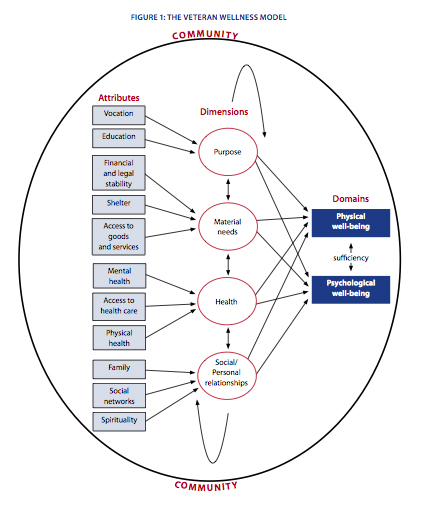
They explained that all the factors depicted interact, to produce – when matters go well – not only health indicators, but also material, social and psychological well-being.
Long-time readers of Analytics and OR/MS Today (the magazine of membership of INFORMS) may recognize CNAS for, among other projects, the publication, in 2010, of then-Maj. Gen. Michael Flynn’s critique of intelligence functions in Afghanistan. (He is now a lieutenant general and assistant director of National Intelligence.) CNAS has become one of the most influential “think tanks” on national security issues in Washington, D.C. Several of its senior staff took high-level positions in the Obama Administration, and many of its current Board and advisors previously served in high-level civilian Government and military posts.
The study cited in this article, authored by Nancy Berglass (senior non-resident fellow at CNAS and director of the Iraq Afghanistan Deployment Impact Fund) and Margaret Harrell (senior fellow and director of the Military, Veterans and Society Program at CNAS), is one of a number of efforts directly sponsored or indirectly promoted by CNAS concerning veterans’ needs. The report was informed by the CNAS Joining Forces Wellness Working Group and the CNAS Joining Forces Community Models Working Group. The report represents solely the views of its two authors.
REFERENCES
- Nancy Berglass and Margaret C. Harrell, April 2012, “Well After Service: Veteran Reintegration and American Communities,” Center for a New American Security, http://www.cnas.org.
- U.S. Army Maj. Gen. Michael T. Flynn, U.S. Marine Capt. Matt Pottinger and Paul D. Batchelor, 2010, “Fixing Intel: A Blueprint for Making Intelligence Relevant in Afghanistan,” Center for a New American Security, http://www.cnas.org.
- Douglas A. Samuelson, 2010, “Intel Under Fire: Changing the War with Analytics,” OR/MS Today, Vol. 37, No. 3.
SHARE: