

February 4, 2013 in Five-Minute Analyst
Black Friday
SHARE: PRINT ARTICLE: https://doi.org/10.1287/LYTX.2013.01.14
Each year, the beginning of the Christmas shopping season, “Black Friday,” seems to start earlier. Black Friday is currently the day immediately following “Mobile Thursday” [1], although this year some businesses stated their holiday sales at 8 p.m. on Mobile Thursday. I am interested in the so-called “Christmas Creep,” where lights and sales begin earlier. Consider the following from Google Trends for searches on “Black Friday” and various retailers who are known for Black Friday sales (see Figure 1).
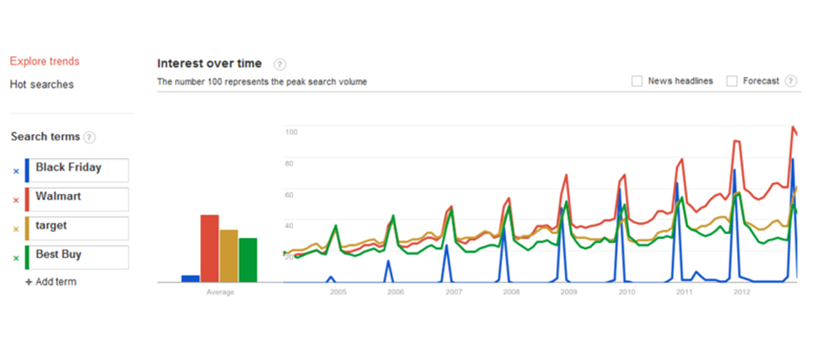
Clearly, search volumes for these retailers are strongly correlated with the Black Friday searches, which themselves are strongly correlated with Black Friday itself. For a comparison of Black Friday sales against other holiday shopping dates, see Figure 2.
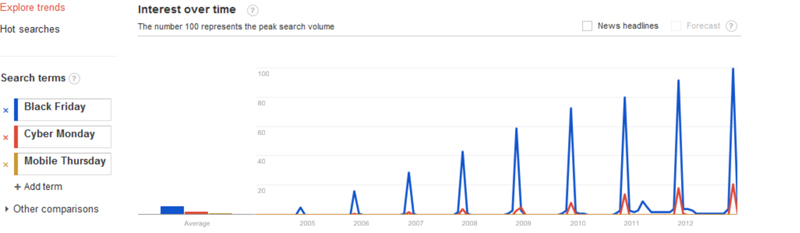
Black Friday has been joined recently by other shopping dates such as “Cyber Monday” and “Mobile Thursday,” although the results in Trends for these two items are completely dwarfed by the Black Friday results. There are most likely two reasons for this:
- There’s no reason to search for “Cyber Monday” shopping – you simply go and do it directly from your favorite Web site.
- Because of overhead, the stakes are much higher for retailers with a physical presence. Bringing in your employees after dinner on Mobile Thursday represents a risk.
There’s an interesting dynamic to opening times and “Christmas Creep.” Holiday season sales are estimated to represent 20 percent to 40 percent of annual sales for many retailers. If the holiday season begins on “Black Friday,” this is because retailers (at least implicitly) agree to begin it then. As soon as one retailer decides to begin his sales “a little early,” then all of the other retailers in that particular sector need to move their sales up as well. Like an arms race, this problem is unstable. Consider the payoffs in Table 1.
| Store 1 / Store 2 | Open Early | Open at Last Year’s Time |
| Open Early | (0,0) | (+1, -1) |
| Open at Last Year’s Time | (-1, +1) | (0,0) |
Table 1: Payoffs for a hypothetical game between two retailers. From the starting position of “open at last year’s time,” “open at last year’s time,” either side can unilaterally increase his payoff by deciding to open early by moving in the direction of the arrows. With the knowledge that your competitor may do better by opening early, the best strategy is to open early.
Table 1 does not include any “limits” on the beginning of the holiday shopping season; for example, it would be strange for Santa to arrive before, say, the Fourth of July, but there is nothing to prevent this solution. The limits are sometimes set by law, such as working hours on holidays, as well as what customers are willing to consider as the “Christmas Season.” It would seem that there is a disincentive for being the “leader” of making the shopping season start sooner; however, once one retailer decides that they should open earlier (and thereby begin the holiday season earlier), it is optimal for other retailers to follow suit.
REFERENCES
- Some of the older readers of this column may ask, “But isn’t Thanksgiving on a Thursday?” It is. Thanksgiving is celebrated between tweets on Mobile Thursday.
- Forbes Magazine, April 10, 2012.
Harrison Schramm, CAP, PStat, is a senior lecturer at Naval Postgraduate School, splitting his time between Defense Management and Operations Research where, in addition to teaching, he runs the Contested At-Sea Logistics Lab (CASLL). He served as the inaugural chair of the INFORMS Security Conference and is a past president of the INFORMS Analytics Society.
([email protected])