

August 5, 2013 in Inside Story
Big bang theory of analytics
SHARE: PRINT ARTICLE: https://doi.org/10.1287/LYTX.2013.04.07
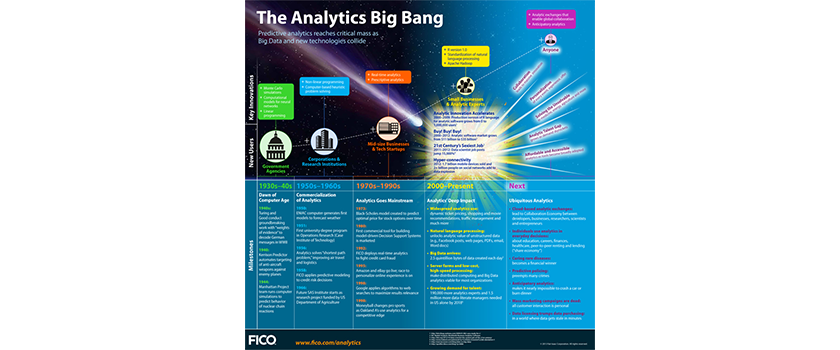
FICO recently published an eye-popping infographic called “The Analytics Big Bang” that, according to an accompanying press release, “traces predictive analytics from the dawn of the computer age in the 1940s through the present day, and cites compelling evidence indicating that the analytics industry is at an inflection point.”
The compelling evidence includes these nuggets:
- Sales of analytics software grew from $11 billion to $35 billion between 2000 and 2012.
- The number of data scientist job posts jumped 15,000 percent from 2011 to 2012.
- 2.5 quintillion bytes of big data are created each day, enabling analytics to become more insightful, precise and predictive than at any point in history.
“Predictive analytics is becoming the defining technology of the early 21st century,” says Andrew Jennings, FICO’s chief analytics officer and head of FICO Labs, which produced the infographic. “You can trace the evolution over the past few decades, but we’ve now reached a tipping point where the convergence of big data, cloud computing and analytic technology is leading to massive innovation and market disruption. We foresee predictive analytics being used to solve previously unsolvable problems, and bringing enormous value to businesses, governments and people.”
The explosive growth in the demand for analytics and data scientists has created an interesting problem for managers like Jennings: What makes a good data scientist and how do you find one? Jennings addresses the question in his Executive Edge column in this issue of Analytics magazine. Jennings details four key skills and traits to look for when building an analytics team and notes that, “It’s a great time to be a data scientist, but a tricky time to hire one.”
Peter Horner is the editor of Analytics magazine.
([email protected])