

October 7, 2013 in Five-Minute Analyst
Modeling zombies
SHARE: PRINT ARTICLE: https://doi.org/10.1287/LYTX.2013.05.14
On general principle, I do my best to avoid zombies. However, the increasing number of zombie games, movies, and even an academic paper [1] have convinced me that zombies are worth five minutes of effort.
Zombies are presumably difficult to combat for two reasons: First, they are already dead, so killing them takes a little more “umph.” Secondly, if you are in a group of people fighting zombies some of your unfortunate comrades will become dead-dead, but others may become un-dead, making more zombies to fight. Zombies can also be difficult to model. First, there are no historical zombie scenarios (and hopefully there never will be [2]). Second, everyone has his or her own opinions about what zombies would do in a fight. These differences don’t mean that we can’t think about it analytically.
Our analysis proceeds as follows: Consider a group of zombies, who at any time may infect a human, kill a human or spontaneously die – most zombies don’t look too healthy and we assume that they die of (un)natural causes. Zombies may use weapons to kill humans, so they don’t necessarily need to be in direct contact with them [3], but they do require contact to infect [4]. Similarly, humans may be infected or killed by zombies. We assume that humans die from non-zombie causes at a rate that is negligible for the timeframes we consider.
Let Z be the number of Zombies, B be the number of Humans. Let  be the rate at which humans kill zombies. Let
  be the rate at which zombies convert humans to zombies (make un-dead) and let
  be the rate at which zombies kill humans (make dead-dead). Let
  be the rate at which zombies die due to being, well, zombies.
This yields:
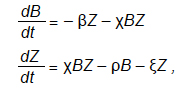
as a deterministic model for fighting zombies.
Analyzing a model like this is more about gaining insights than any particular solution. In most analytic settings, a detailed discussion of numerical results or integration techniques may lead your clients to spontaneously become zombies. Analysis is not about the “eaches” of mathematics, but it’s about insights that decision-makers can use.
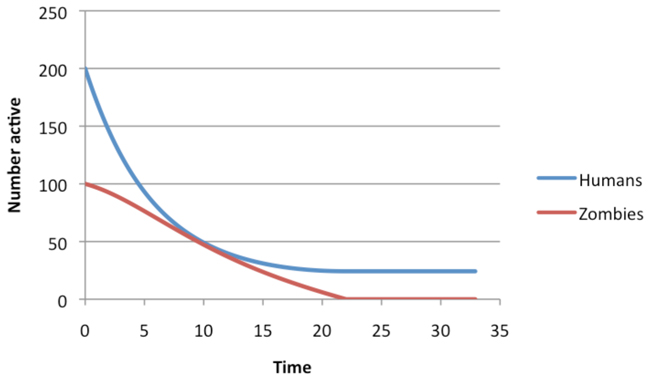
 = .05,
  rel = .2,
  = .12,
  = .055.
It is fairly obvious that if zombies do not naturally die off in ( = 0), the zombie population will be constant if zombies convert humans at the same rate that humans kill zombies (Z – = 0), and the more zombies there are, the easier it is for zombies to convert humans. The human population is always decreasing so long as zombies are present.
Writing differential equation models and exploring them parametrically can help tease out the insights from the problem. We note that the zombie-conversion factor, , does not have the same scaling as the others model parameter; it is in units of “zombies per zombies times humans,” while all the other parameters are in terms such as “zombies per human.” This kind of dimensional mismatch can cause grave errors. In order make the units work out, we create a new parameter, rel = / .5 (B0 + Z0), which is more natural to work with for comparisons. A little exploratory analysis also shows that the rate that zombies convert humans drives the result more than any other parameter. Sensitivity analysis of rel is shown in Figure 2.
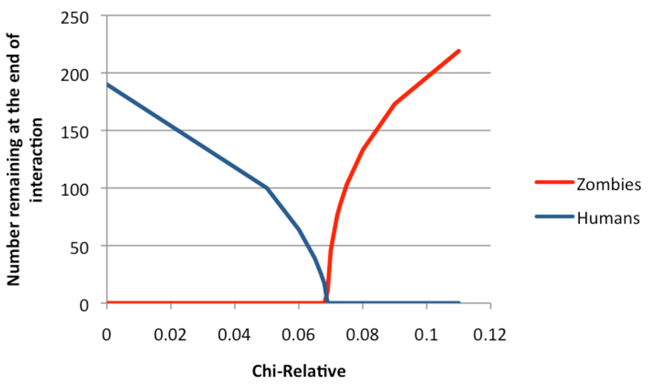 rel. In this scenario, humans are 10-times effective at killing zombies than zombies are at killing humans. Parametric exploration shows that the critical infection value is approximately .067, above which the zombies are victorious. Although each side begins with 200 active, the zombie population may finish above its initial number due to recruitment.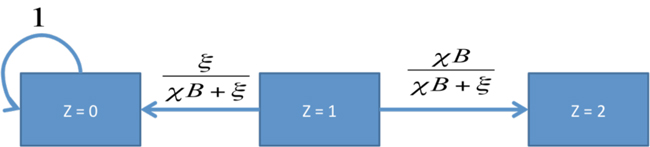
Stochastic Zombies [5]
The equations above don’t really tell the whole story if the number of initial zombies is small (it usually is), and the initial zombie begins in a far-away place (the frequently do). Now, we might assume away the possibility that a human would kill zombie-Prometheus, since nobody was expecting to meet a zombie on the street after a movie in a city in broad daylight. Still, the first zombie needs to find a human to infect before he dies of (un)natural causes. A full treatment of this model will take more than five minutes; however, we can condition on the first transition out of the state Z = 1 by using a continuous time Markov chain (CTMC).
To conclude, while it seems that looking at zombies is a (hopefully entertaining) diversion, there is a real point to this piece. Proposing and analyzing simple deterministic models can be useful in teasing out insights which may be broadly true. I have heard that zombies are afraid of green engineer’s paper – this is why I always carry some!
REFERENCES & NOTES
- P. Munz, I. Hudea, J. Imad, R. Smith, 2009, “When zombies attack: mathematical modeling of an outbreak of zombie infection,” in “Infectious Disease Modeling Research Progress,” Nova Science Publishers.
- My mental references for this work are “Zombieland,” “Resident Evil” and Poe’s “Masque of the Red Death.”
- For those familiar, we use Lanchester aimed-fire as a model.
- Hence the appeal to infectious disease models.
- This is both an effect seen when I used to lecture on applied probability or a fantastic name for a mathcore group.
Harrison Schramm, CAP, PStat, is a senior lecturer at Naval Postgraduate School, splitting his time between Defense Management and Operations Research where, in addition to teaching, he runs the Contested At-Sea Logistics Lab (CASLL). He served as the inaugural chair of the INFORMS Security Conference and is a past president of the INFORMS Analytics Society.
([email protected])