

October 7, 2013 in Thinking Analytically
Urban planning
SHARE: PRINT ARTICLE: https://doi.org/10.1287/LYTX.2013.05.15
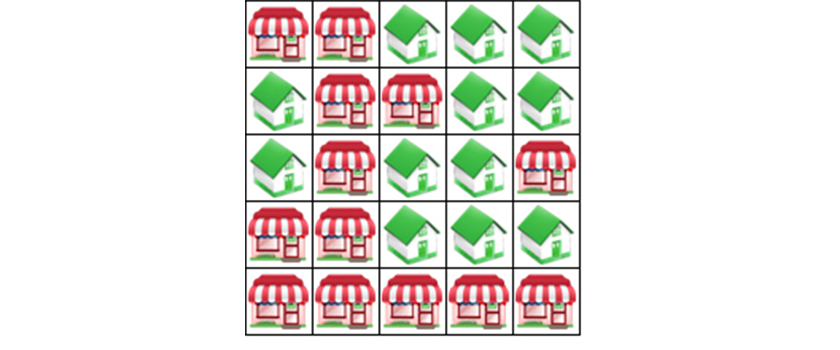
Urban planning requires careful placement and distribution of commercial and residential lots. Too many commercial lots in one area leave no room for residential shoppers. Conversely, too many residential lots in one area leave no room for shops or restaurants.
The 5×5 grid in Figure 1 shows a sample configuration of residential and commercial lots. Your job is to reorder the 12 residential green lots and 13 commercial red lots to maximize the quality of the layout.
The quality of the layout is determined by a points system. Points are awarded as follows:
Any column or row that has five residential lots = +5 points
Any column or row that has four residential lots = +4 points
Any column or row that has three residential lots = +3 points
Any column or row that has five commercial lots = -5 points
Any column or row that has four commercial lots = -4 points
Any column or row that has three commercial lots = -3 points
For example, the layout displayed in Figure 1 has a total of 9 points:
Points for each column, from left to right = -3, -5, +3, +4, +3
Points for each row, from top to bottom = +3, +3, +3, +3, -5
Question: What is the maximum number of points you can achieve for the layout?
Send your answer to [email protected] by Nov. 15. The winner, chosen randomly from correct answers, will receive a Magic 8 Ball. Past questions can be found at puzzlor.com.
John Toczek is the AVP Predictive Modeling at Chubb in the Decision Analytics and Predictive Modeling department. He earned his BSc. in Chemical Engineering at Drexel University (1996) and his MSc. in Operations Research from Virginia Commonwealth University (2005).