

June 2, 2014 in Executive Edge
Greater than the sum of its parts
SHARE: PRINT ARTICLE: https://doi.org/10.1287/LYTX.2014.03.06
Over the past decade, corporations across industry verticals have invested significant capital to upgrade their infrastructure to analyze customer data collected within a multichannel environment. And so the obvious next question is – what now?
The answer can be derived from the combination of capabilities, created by the investment in these newer technologies – specifically, the digital engagement of the customer, where customer represets both external consumers and internal stakeholders. Whether to create a network of external customers to drive the creation of a dynamically optimized yet evolving set of products or to drive efficiency in internal operations, digital presents corporations with both challenges and opportunities.
Going digital, in simple terms, means transitioning from an “inside-out” to an “outside-in” approach to business. With the exception of a handful of super-enterprises, most corporations are focused on “What can I offer to customers?” and “What can I deliver to customers?” That focus is important but traditional “inside-out” thinking. On the other hand, corporations with an “outside-in” orientation ask questions such as: “What do customers consciously – and subconsciously – want?” “How can I affirm, if not expand, my control over the value chain with new ideas and products?” “How do I redefine business processes with an operating model that informs key answers to the aforementioned questions?”
The Digital Customer
Technological advances have created the digital customer – one who is empowered by technology, distracted with technology and social through technology. As we move forward, communication with customers will be continual and bidirectional, capturing cusomers’ sentiments and built upon self-service as well as co-creation of products and services. Supported by an efficient operating model, digitally enhanced technology effectively enables value creation for the business.
At the highest level, a company would have to engage its audiences more frequently, more personally and across multiple channels. Digital engagement should mimic the personalization of face-to-face interactions, offering a collaborative environment in which customers can participate in idea generation and product development, and the organization is better able to understand and predict customers’ wants and needs.
But keep in mind, a more holistic view of digital encompasses both external expansion that is customer-centric and internal optimization that improves efficiency within the organization. Linking the two is important for a seamless, effective operating model.
The Four Quadrants of Digital
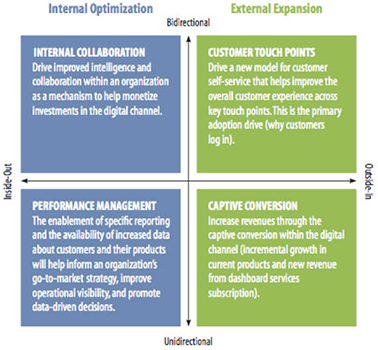
At the highest level, the impact of digital can be segregated into four quadrants, defined by interaction vectors (unidirectional or bidirectional) and the strategic input vectors (outside-in or inside-out). Bidirectional interaction refers to a duplex interaction model between the customer and the corporation, effectively providing a means by which true information exchange, not just information transfer, can occur. Outside-in refers to the ability to extract input from outside the corporation to drive decision-making and broader strategic direction. Inside-out, on the other hand, refers to strategic decision-making based on a model driven by perspectives within the corporation (primarily a supply-constrained view).
As described in the four-quadrant view shown in Figure 1, both outside-in and inside-out input models are relevant consideration factors depending on the objectives (external expansion or internal optimization) of the corporation pursuing a digital transformation. The highlighted examples (customer touch points, captive conversion, internal collaboration, performance management) provide high-level examples of key opportunities for corporations looking to capitalize on digital.
Where to Begin
On a practical level, executing a digital engagement strategy should be gradual but still involve all key facets of the company’s infrastructure. Although a digital platform is heavily supported by technology and is rooted in IT, it should be a priority for the entire business. Paramount for digital success is a broad top-down mandate that spans marketing, sales, service, operations, finance and IT.
In terms of implementation, inertial elements can slow the internal adoption of digital with business-as-usual perspectives within the company, and externally through an untrained customer base. To manage those constraints, companies should adopt and institute a gradual but focused program, concentrating initially on the interactions most intuitively handled through a digital interface. Such early interactions are best exploited in a service and support (e-service) model that provides a natural problem-resolution incentive for customers to engage. As a result of a digital-service-first model, corporations can obtain insightful data from a large set of interaction types to help identify those easiest to migrate to digital. Payment of bills is one the most common interaction types for this purpose.
The challenges of the present, however, don’t change the fact that digital engagement is the blueprint for future corporate operating models. To that end, organizations that embrace, implement, and refine their thinking around this imminent paradigm will be the likely standouts in the capital markets in the years ahead.
Dr. Henna A. Karna is president of Verisk Digital Services, the digital business unit of Verisk Analytics.