

June 2, 2014 in INFORMS News
CDC wins INFORMS Edelman Award
SHARE: PRINT ARTICLE: https://doi.org/10.1287/LYTX.2014.03.10
The U.S. Centers for Disease Control and Prevention (CDC), which collaborated with Kid Risk, Inc. to use analytics and operations research to combat the remaining pockets of polio around the world, won the 2014 Franz Edelman Award for Achievement in Operations Research and the Management Sciences.
Following a series of judged presentations, the award was presented at the Edelman Awards Gala held in conjunction with the INFORMS Conference on Analytics & O.R. in Boston. INFORMS is the premier organization for advanced analytics professionals.

the CDC and Kid Risk, Inc.
Dr. Bruce Aylward, World Health Organization, assistant director-general of Polio, Emergencies and Country Collaboration, said, “This work has been fundamental to so much of what’s happened in the polio eradication program over the last few years, and it has helped to support many of our decisions over the last decade and to bring the world much, much closer to one where future generations will never know the terror of this disease.”
“Through collaborations with Kid Risk, Inc. and other partners, CDC is helping to identify the best strategies to further polio eradication and achieve the endgame,” added Dr. Mark Pallansch, director of the Division of Viral Diseases in the National Center for Immunization and Respiratory Diseases at CDC.
The Franz Edelman competition attests to the contributions of analytics and operations research in the profit and non-profit sectors. Since its inception in 1972, cumulative dollar benefits from Edelman finalist projects have reached over $213 billion.
As a spearheading partner of the Global Polio Eradication Initiative (GPEI), the CDC annually contributes over $100 million of its budget and significant human resources to polio eradication activities for which it maintains high standards for developing evidence-based policies and expectations of cost-effective use of its resources. In 2001, the CDC launched a collaboration with Kid Risk, Inc. to use a range of operations research and management science tools combined with the best available scientific evidence and field knowledge to develop integrated analytical models for the evaluation of the global risks, benefits, and costs of polio eradication policy choices.
The analytical results from the collaboration significantly furthered polio eradication in many ways, including more rapid response to outbreaks and reaffirmation that pursuing eradication instead of control is the “best buy” to prevent cases of paralysis and to save lives and money.
Recognition of polio eradication as a major program in need of stable financing helped support a fundraising effort in 2013 that raised over $4 billion from donors to finish the job. The team foresees increased integration of operations research and management science tools to perform simultaneous probabilistic and dynamic modeling for other complex global health challenges, including other vaccine-preventable diseases like measles and rubella.
Along with the CDC, the other finalists competing in the 2014 Franz Edelman Award Competition included teams from Alliance for Paired Donation, The Energy Authority, Grady Health System, Australia’s NBN and Twitter.
Mayo Clinic earns INFORMS Prize
Mayo Clinic, the innovative healthcare organization that has used analytics throughout its organization to provide economical, quality services in an era of ballooning medical costs, was named the 2014 winner of the INFORMS Prize. The prize was presented at an awards gala held in conjunction with the 2014 INFORMS Conference on Business Analytics and Operations Research in Boston.
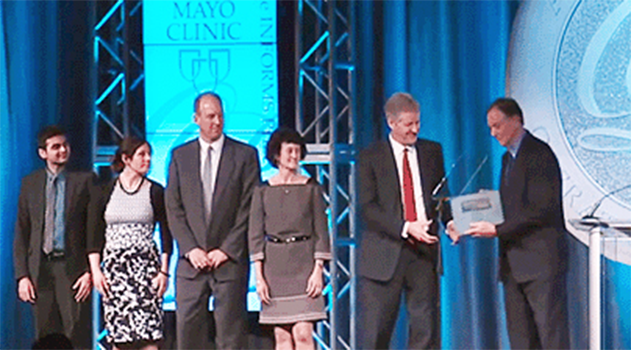
“Operations research is deeply rooted in Mayo Clinic’s culture,” says Mayo Clinic President & CEO John Noseworthy, M.D. “These disciplines help us improve patient outcomes and experience while controlling rising health care costs, one of the biggest financial challenges facing our country today.”
The INFORMS Prize recognizes effective integration of operations research into organizational decision-making. The award is given to an organization that has repeatedly applied the principles of O.R. in pioneering, varied, novel and lasting ways.
Mayo Clinic’s century-long history of using systems thinking, analytics and operations research (O.R.) traces its roots back to Dr. Henry Plummer, who developed the first integrated, paper medical record as a platform to organize and share patient information within a group practice of medicine. This served as the foundation of Mayo Clinic’s culture of applying engineering and O.R. principles.
Mayo Clinic continues to make significant investments to ensure a sophisticated advanced analytics and O.R. infrastructure. With more than 500 practitioners of O.R. and analytics, Mayo Clinic is able to continually leverage analytical methods to enhance strategic planning, care process redesign, patient experience, inventory management and project management – leading to important patient benefits as well as financial savings.
Examples include optimization models for patient scheduling, queuing theory for effectively transporting patient, systems dynamics for strategic capital allocation planning, simulation modeling to redesign pharmacies that reduce patient waiting and discrete event simulation models for blood management.
In addition to applying advanced analytics and O.R. to its business, Mayo Clinic has made significant strides to educate staff and disseminate what they’ve learned.
Mayo Clinic’s leadership recognizes analytics and engineering as key contributors to the organization’s sustained excellence, market differentiation, and superior customer experience. Looking to the future, senior leaders consider these disciplines to be vital in addressing the formidable challenges in healthcare today and tomorrow.
Past recipients of the award include Intel, UPS, HP, IBM, Ford, Procter & Gamble and GE Research.
SHARE: