

June 2, 2014 in Five-Minute Analyst
Buffet’s billion-dollar basketball bracket bet
SHARE: PRINT ARTICLE: https://doi.org/10.1287/LYTX.2014.03.13
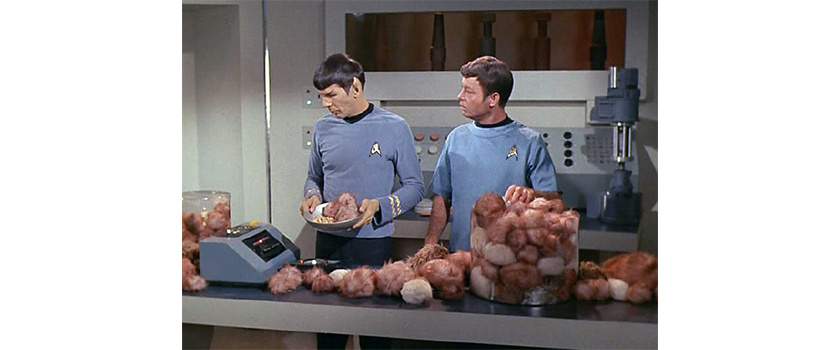
Warning: Factorials and powers are ubiquitous in this article. Like Tribbles from Star Trek, expressions like “64” look cute and innocent, but they are some of the most deadly mathematical beasts known to man.
I was bemused to read this article [1] in Slate magazine detailing the odds of Warren Buffet’s basketball challenge, which may be found here [2]. [Buffet offered a billion dollars to anyone who submitted a perfect bracket (i.e., correctly predicting the winner of all 63 games) of “March Madness,” otherwise known as the NCAA Men’s Basketball Championship Tournament.] A billion dollars – even with taxes – is a lot of money. How hard is it to come up with a perfect bracket? There is only one perfect bracket in a world with many potential brackets, so we first need to find out how many possible brackets there are.
The NCAA is a single elimination tournament, which means that each team plays until they lose. In a single elimination tournament, each round is made up of n teams, with n/2 games played. Therefore, there are 2n/2possible outcomes in the first round. Knowing that the tournament starts with 64 teams, there are 232 ? 4.3 • 109possible outcomes for the first round. Using similar calculations at each round, there are  possible outcomes, only one of which is correct.

2014 NCAA Championship game.
PHOTO BY STEPHEN SLADE. COURTESY OF UNIVERSITY OF CONNECTICUT
For comparison’s sake, 1 billion is a thousand million, or 109 so the odds of winning the basketball challenge are around 1:(109)2 or one in a billion billion3. So, it appears your odds of winning are not very good at all.
Frequently, one can get a feel for the value of a gambling game by the “fair price” that one would be willing to pay to play the game; specifically, the value that would make one indifferent between playing the game and just keeping their money. For this game, a “fair” price would be nine million attempts per penny!
Some Excursions
Suppose I could have one piece of information. A likely choice would be: “How much better off would we be if we knew the eventual winner?” In this case, we would reduce the number of possibilities in each round by 1; and the number of combinations would “only” be  , which is 64 times better than the original estimate. Sixty-four is generally reckoned to be a small number when compared to 1018. If you knew the Final Four, you would be considerably better off, at
  , or 520,000 times better than the original bet, which is to say that in the scheme of things, you are no better off at all.
Now suppose that you had to pay $1 to play this game instead of it being free, but you think you are pretty good at predicting basketball games. You would need to have 72 percent accuracy in your ability to pick basketball games to be risk neutral for a dollar (i.e., 72 percent accuracy increases your odds of winning to 1 in 1 billion).
As bad as these odds are, here’s a game that is even worse, which I will call the Georgetown Wager (after my colleague who challenged me to come up with a tougher game). Suppose that you are given the 64 teams that will play, but the games are randomized and you have no information about their parings; you know that there are 64 teams in the first round, of which 32 will win, and so on, but you don’t know who will play who. In this version, you have to figure out for the number of possibilities,
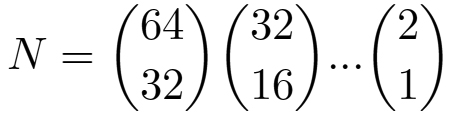 (1)
(1)
where the “choose” function,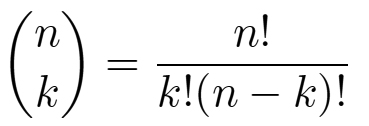
if you expand (1) out by hand and cancel terms4, you will find that it is: 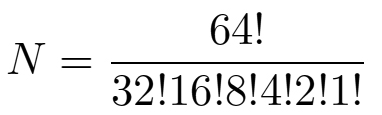 . If the odds of Buffet’s Billion Bracket are bad, the Georgetown Wager is patently absurd; the odds of winning are ? 1.2 • 104, which are roughly on the order of winning Buffet’s game twice in a row!
You may be asking: “So, if this is such a good bet for the house, why don’t I run a similar lottery?” Because I don’t have a billion dollars, and I’m not willing to lose. Remember that the “house” has to be willing to pay out the fee in the extraordinarily rare event that someone won. Events that are “statistically impossible” are still “possible.” and while it is extraordinarily unlikely that someone will win, there is no law of physics that prevents someone from winning.
The perfect first round buyout: Suppose you had a perfect first round, in that you guessed the first 32 games correct. Congratulations. Strictly speaking, the risk-neutral buyout price from the bank’s perspective (i.e., Mr. Buffet) is approximately $2. Now, this figure presumes that you got to this point by dumb luck, and you will certainly claim – and the house may believe – that you got to this point because you are very good at predicting basketball games. After all, to have a 50 percent probability of predicting the first round correctly, you would need to have ~98 percent per-game prediction accuracy.
So, should you play? Sure, go ahead. Expected value calculations presume that you are going to do something else with the money; this is true for large amounts but typically not for small. So it depends on what else you would do with the money. In this particular example, you won’t pay anything, except some advertising e-mails, so if that works for you, go ahead.
If a similar wager cost $1 to play, it would depend on what else you would do with the money. Foregoing a late afternoon soda to buy a ticket for this game, if you enjoy talking about it, would be OK. Dumping out your life savings in order to play games is a terrible idea (we’ve written about this before, see July 2013 [5]). The point is that we all do lots of things where the odds of winning are practically zero. This is not necessarily a bad thing. If you derive “pleasure” out of daydreaming about winning a billion dollars or have fun arguing basketball scores with your friends, go for it! Just do so with eyes open, knowing that it is incredibly unlikely that you will win.
And don’t forget, there are also 20 first-prize winners, regardless of whether the grand prize is given or not, valued at $100,000. While no billion, this is no small amount of money, and most importantly, does not require you to be perfect, simply better than the other players who enter. If you think you are good at filling out your bracket, then perhaps you should enter with the hopes that you win the first prize. Here, the odds are no worse than 1:750,000, which is a number that you can start to comprehend!
A note on calculation. I used R to do the large calculations in this article. Professionals always need to be concerned about numerical stability and floating point precision, which may be the subject of a subsequent article. If I did not have a good computational platform or was doing this 50 years ago, I would resort to Sterling’s Approximation, 
It’s amazing to think about all of the computation that we simply take for granted.
Finally, knowing that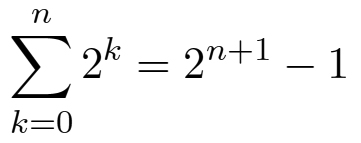
is very handy. (If you need a proof, start writing out numbers in binary)
Notes and References
- http://www.slate.com/articles/sports/sports_nut/2014/03/billion_dollar_bracket_challenge_why_it_s_a_bad_idea_to_enter_warren_buffett.html
- https://tournament.fantasysports.yahoo.com/quickenloansbracket/challenge/?qls=BDB_B14qlb03.qlredirect
- When your exponents have exponents, the numbers are really huge!
- Comment: If you want real understanding in mathematics, there is no substitute for expanding by hand. This is how the mathematicians of 50 years ago did things, and there is goodness in it, even today.
- http://www.analytics-magazine.org/july-august-2013/838-five-minute-analyst-carnival-game
A collection of Tribbles, which despite their harmless appearance, quickly grow to fill the space. Much like Factorials.
Harrison Schramm, CAP, PStat, is a senior lecturer at Naval Postgraduate School, splitting his time between Defense Management and Operations Research where, in addition to teaching, he runs the Contested At-Sea Logistics Lab (CASLL). He served as the inaugural chair of the INFORMS Security Conference and is a past president of the INFORMS Analytics Society.
([email protected])