

March 2, 2015 in Five-Minute Analyst
Travel documents
SHARE: PRINT ARTICLE: https://doi.org/10.1287/LYTX.2015.02.13
I was recently asked the following question: Is it better for a couple traveling together to pool their valuables and documents, or should they carry them separately? This is a great Five-Minute Analyst topic not only because it is about relationships – mathematical and interpersonal – in equal measure, but also because it’s a practical problem. For example, Albert Einstein was well known for being forgetful during his life [1].
There are two competing objectives in this problem and one missing piece of data. The competing objectives are the desire to make sure that you have some minimum amount of documents, which would suggest that the partners should cross-carry the documents, versus the problem of identity theft, which would suggest that the partners should have the more responsible party carry their documents. We’ll analyze this here. The missing piece of data is: How do you determine who the more “responsible” person is? We won’t solve that here, but will comment on some difficulties.
We could consider the following strategies: First, that each member of the couple could carry their own documents (we will call this the default strategy). Second, one member of the family, say, Judy, could insist on carrying all of the documents. A third strategy is that each member of the family could carry most of their own documents and a minimum set of the others; for example, the spouses trade driver’s licenses, so that if either one loses their wallet, the other will have enough to get them at least started with the embassy.
Let’s call the family members 1 and 2, and the random variable representing the loss of documents is represented by X1,X2respectively. If the couple mixes their identity papers, so that each carry “enough” to prove who they are, say each carries their own passport and their partner carries their drivers’ license and school ID card, then the time to catastrophic loss is max(X1,X2). However, even if you have enough documents to get you home, losing your papers is no minor matter, and opens you up to crime and worry. Under a scheme like this, the time to first loss is min(X1,X2).
Since losing things involves lack of memory, we should use a distribution that has this property, and exponential distributions and expectations will be ubiquitous in what follows. Other distributions and approaches are of course possible, but require much more work. The expected time to the first loss in the minimum case is given by  ; it turns out that the minimum of two exponential random variables is also exponentially distributed, and this is a result that is covered in most applied probability texts.
Alternatively, the expected time to total loss in the mixed case has a surprisingly clean form; it is given by  . I was taken by surprise by the second result, and had simulated first, thinking that analysis would be extremely messy [2]. There’s an important lesson here: Even if you think that the math is going to be ugly and lead nowhere, you should try anyway!
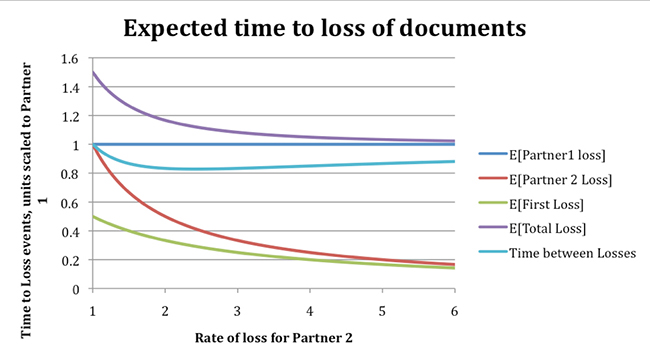
Let’s do some experimentation. Because the parameterization is not dependent on any given choice of units, let’s presume that Partner 1 is the more responsible partner, by which I mean he has a lower loss rate that we fix to 1. Partner 2 is “less responsible” and has a loss rate that is scaled relative to Partner 1. If it turned out that Partner 2 was more responsible, we would simply re-name them.
This implies two interesting things:
- If both partners are about equal in terms of losing things, then they can have a reasonable (20 percent or greater) improvement in time to losing all of their papers if they carry each other’s. This is true so long as the “less responsible” partner loses things less than two times as often as the more responsible. If they were exactly equal, mixing papers doubles the (expected) time to total loss, but halves the time to first loss.
- Conversely, if one partner is more responsible, that partner should always carry the passports if you are concerned about first loss. If you are worried about losing all of your passports, then you should share documents, unless the other partner is totally untrustworthy. This problem is only interesting if the less trustworthy partner is between “as forgetful” and “twice as forgetful.” If your partner is more than twice as forgetful, they probably shouldn’t carry any documents at all.
This of course all sidesteps the real issue of: How do you know which partner is more trustworthy to carry the documents in the first place? Parameter estimation is difficult, particularly with couples in domestic situations, where blame can be as important if not more than keeping the documents safe. Suppose, hypothetically, that one of the partners always drives and the other comments on how bad their driving is. There is substantial sample bias because the non-driving partner’s ability to drive is never observed. Put simply, if one partner always carries the passports, then they will be the only one who can ever lose the passports!
Finally, the U.S. State Department [3] has the following advice: “If your passport has been lost or stolen, it should be reported immediately to help protect yourself against identity theft and to prevent someone else from using the passport.”
Thank you to Ned Dimitrov for recommending this problem.
Bonus: Suppose that two processes follow a Poisson Process with known rates. The probability that event X1happens before X2 is given by:  . This is commonly known as the “race of the exponentials” and is extremely handy in all manner of applications.
REFERENCES
- http://www.biographybase.com/biography/einstein_albert.html “He was also the prototypical ‘absent-minded professor’; he was often forgetful of everyday items, such as keys, and would focus so intently on solving physics problems that he would often become oblivious to his surroundings.”
- You can easily derive it yourself; the key insights are that the CDF of the maximum is
 , and the “alternate” formula for expectation,
  .
. - http://travel.state.gov/content/passports/english/passports/lost-stolen.html
Harrison Schramm, CAP, PStat, is a senior lecturer at Naval Postgraduate School, splitting his time between Defense Management and Operations Research where, in addition to teaching, he runs the Contested At-Sea Logistics Lab (CASLL). He served as the inaugural chair of the INFORMS Security Conference and is a past president of the INFORMS Analytics Society.
([email protected])