

May 4, 2015 in Newsmakers
INFORMS honors & salary survey
SHARE: PRINT ARTICLE: https://doi.org/10.1287/LYTX.2015.03.09
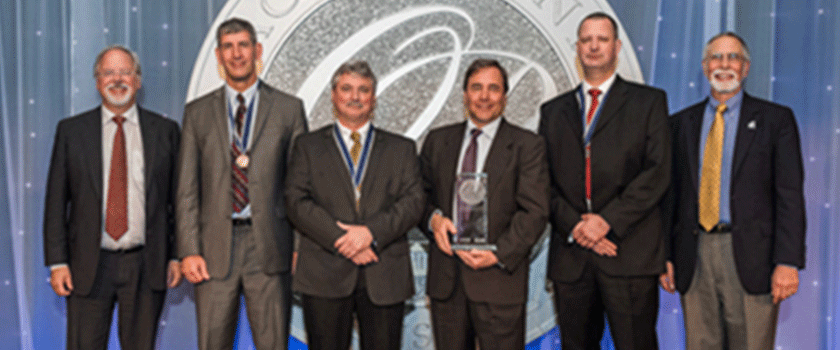
Syngenta earns 2015 Edelman Award from INFORMS
Syngenta, which uses high-end analytics to improve food supplies for an increasingly crowded planet, won the 2015 Franz Edelman Award for “distinction in applications of analytics, operations research and management science.” Sponsored by the Institute for Operations Research and the Management Sciences (INFORMS), the leading association for analytics professionals, the Edelman Award is considered the “Super Bowl of O.R.”
Following presentations by six finalists from around the world, the Edelman Award was presented at an Oscar-like Edelman Gala held in conjunction with the 2015 INFORMS Conference on Business Analytics & Operations Research in Huntington Beach, Calif., in April.
“Winning the Franz Edelman Award demonstrates the scientific excellence and leadership science is bringing to the farmer in the field,” says Joe Byrum, Syngenta Global Head Soybean R&D. “It’s a level of leadership that has hasn’t been demonstrated in agriculture until now. We’re honored to win the Franz Edelman Award. … It further demonstrates the impact our Good Growth Plan is having on the world, and we’re proud to share that message with the masses.”
With current breeding methodologies, the rate of increase in crop production is not sufficient to meet today’s food needs. Syngenta changed that by applying O.R. methods to make better breeding decisions, reducing the time and cost required to develop crops with high productivity. This data-based transformation helps Syngenta achieve its commitment to meeting the world’s growing food needs in an economically and environmentally sustainable way.
Each of four O.R. tools used by the prize-winning work supports one or more key “pipeline” phases: variety design, variety development and variety evaluation.
Syngenta’s trait introgression (TI) tool and the breeding project lead (BPL) tool make processes within the pipeline more efficient. Syngenta is using the TI tool to transfer favorable traits from one soybean variety to another. It uses the BPL tool to develop varieties with higher productivity. With each tool, the project lead compares alternative TI and breeding strategies until a strategy is identified with a high probability of success, as well as minimal cost and time.
Yield trial design (YTD) optimizer and data quality cart (DQC) tools support decisions that impact the quality of variety selection and advancement toward commercialization.
The new analytical tools dramatically improve project lead training, decision-making and planning, resulting in cost avoidance for soybean R&D of more than $287 million from 2012-2016 and substantially improving the probability of successfully delivering a portfolio value exceeding $1.5 billion. Syngenta recognizes the positive impact these tools have on soybean R&D and is initiating a multi-year effort to customize and launch similar tools across all major crops.
Since its inception in 1972, cumulative dollar benefits from Edelman finalist projects have reached nearly $225 billion.
Along with Syngenta, this year’s Franz Edelman Award competition finalists included:
- IBM for “Predictive Cloud Computing with Big Data: Professional Golf and Tennis Forecasting”
- Ingram Micro for “End-to-End Business Analytics and Optimization in Ingram Micro’s Two-Tier Distribution Business”
- LMI/Defense Logistics Agency for “Peak and Next Gen: Effective Inventory Control for Items with Infrequent or Frequent, Highly Variable Demand”
- Saudi Arabia Ministry of Municipal and Rural Affairs for “A Decision Support System for Hajj Crowd Management”
- U.S. Army and Sandia National Laboratories for “Maximizing the Army’s Future Contribution to Global Security Using the Capability Portfolio Analysis Tool (CPAT)”
Chevron wins INFORMS Prize for analytics excellence
The Institute for Operations Research and the Management Sciences (INFORMS) presented its 2015 INFORMS Prize for excellence in analytics and operations research to Chevron Corporation for its long and innovative history of applying analytics and operations research across the breadth of the worldwide energy company.
The ceremony took place at the 2015 INFORMS Conference on Business Analytics & Operations Research, held at the Hyatt Regency Huntington Beach Resort and Spa in California.
Unlike the Edelman Award, which honors an impactful project, the INFORMS Prize salutes successful and sustained integration of O.R. and analytics throughout an organization.
“At Chevron, operations research and advanced analytics are not an exception; they are important pieces of the fabric upon which we differentiate our performance,” says Louie Ehrlich, Chevron’s chief information officer and president of Chevron Information Technology Company.
For decades, Chevron has leveraged a variety of operations research and advanced analytics techniques in its business, creating significant value. The company pioneered applying operations research to refinery planning in the 1970s, it adopted decision analysis in 1991, and it has been employing artificial intelligence techniques to improve asset performance for more than 10 years. From building and running reservoir models with seismic data to managing its crude-to-customer value chain to forecasting resources that fuel its major capital projects, Chevron utilizes operations research and advanced analytics technologies to make data-driven decisions. The results enable Chevron to operate more safely, reliably and efficiently; reduce material costs; deliver higher value products; effectively recover resources; and better understand and manage risks and uncertainties.
Chevron has more than 700 operations research and advanced analytics practitioners around the world, both in centralized groups and in business units. The company offers extensive training programs and frequent opportunities for practitioners to share lessons learned. Career paths support operations research and advanced analytics from entry-level positions to experienced professionals. Leadership at Chevron recognizes that the strategic decision to employ advanced analytics across the enterprise has delivered significant returns along its value chain.
Past recipients of the INFORMS Prize include Mayo Clinic, Intel, UPS, HP, IBM, Ford, Procter & Gamble and GE Research.
Analytics Section salutes award winners
The Analytics Section of INFORMS hosted a recognition breakfast for those who won awards and competitions sponsored by the Section at the recent INFORMS Business Analytics & Operations Research Conference in Huntington Beach, Calif.
The honorees included:
- The Mayo Clinic for winning the Innovative Applications in Analytics Award for their work on intelligent surgical scheduling. The award recognizes creative and unique applications of a combination of analytic techniques in a new area. Teams from American Airlines and the MIT Operations Research Center, along with Rue La La, were finalists.
- Jodie Lam, who is pursuing a master’s degree in management in operations research at the University of British Columbia, for winning the 2015 Student Analytical Scholar Competition, which aims to provide a positive learning experience for students by developing a statement of work for an analytics project and is supported by SAS. Lam’s application earned her free registration, lodging and travel to the conference, as well as participation in the Professional Colloquium held on Sunday at the conference.
Qinlu (Louisa) Chen, from the same program at the University of British Columbia and also president of the school’s INFORMS Student Chapter, received honorable mention. Both presented posters of their work at the conference. - Lianna Gerrish of Advanced Energy Industries for winning the Spreadsheet Guru competition, a test of head-to-head spreadsheet skills in data analysis and presentation. Gerrish solved the final problem statement in 13 minutes. In second place, at 21 minutes, was Jason Acimovic, a professor at Pennsylvania State University’s Smeal School of Business.
Data scientists: salary survey shows pay, demand continue to rise

Elite data scientists, increasingly in demand from U.S. leading corporations, are riding high on the big data movement, with top-level managers seeing an 8 percent increase in base salary over last year and median bonuses topping $56,000. Data scientists can score 16 percent increases in their median base salary when changing jobs.
The second annual “Burtch Works Study: Salaries of Data Scientists,” the only U.S. study looking at salaries, education levels, gender and geographical location of this breakout profession, confirmed that the elusive kingpins in the big data movement can earn base salaries of well over $250,000 when managing a team of 10 or more. The study also found that the vast majority of data scientists have at least a master’s degree and probably a Ph.D., and one in three are foreign born. Over a third of all data scientists remain on the West Coast working for technology and gaming companies.
Data scientists are becoming more mainstream as corporate America embraces the data movement and pursues data-driven growth opportunities. So many more large, established companies have hired data scientists that the proportion of data scientists employed by startups – the firms that were the first to use big data – declined from 29 percent in 2014 to 14 percent in 2015.
“Originally embraced by tech startups whose business models relied on analytics, data scientists are increasingly being hired by major corporations to get their arms around and benefit from the massive amounts of data that can improve the business’s performance and business model,” says Linda Burtch, managing partner of Burtch Works, the executive search firm that conducted the study. “This influx of opportunities at more traditional firms is being met with excitement from many data scientists who are turning to more stable options after witnessing the risk and uncertainty of the startup world.”
The profession of data science has emerged to solve the peculiar computing and analysis problems of data that are not only big but also unstructured and messy. Unlike other analysts, data scientists know how to use tools invented specifically to store and retrieve massive amounts of data efficiently. They are proficient at distinguishing the useful from the useless in messy data through the use of sophisticated statistical models and machine learning techniques. It is only in recent years that data storage has become sufficiently inexpensive that many businesses have the capacity to save enormous sets of unstructured data, and are establishing data science teams.
“We’re seeing more high-profile appointments, such as Dr. DJ Patil, the U.S. government’s first chief data scientist, and Paul Ballew, global chief data and analytic officer at Ford, confirming commitment to data use in government and corporations,” Burtch adds. “Data scientists want to see top-level buy-in behind enterprise-wide, data-driven decisions and know that their work influences those decisions.”
The study found that the median years of experience of data scientists in the sample was only six, down from nine in 2014’s study, suggesting that millennials are starting to flood the hot field and as a result, many academic programs are forming to produce these specially trained graduates. The study also found median junior level salaries of $91,000 on data science teams, and up to $110,000 on the West Coast where competition for entry-level talent is fierce.
Study Highlights
The 2015 Burtch Works study found data scientists are:
- Generally young (with a median of only six years of experience), highly educated (92 percent have at least a master’s degree, 48 percent have a Ph.D.), overwhelmingly male (89 percent), and a disproportionately large number are foreign-born (36 percent).
- Nearly one-third (29 percent) hold a degree in mathematics or statistics while one fifth (18 percent) hold a degree in computer science.
- Over one-third are employed on the West Coast (36 percent) and almost half work for firms in the technology and gaming industries (43 percent).
- The median compensation of data scientists varies primarily with years of experience, depth of expertise and management responsibility, but can range from $91,000 with one to three years of experience up to $250,000 for managers leading teams of 10 or more.
- Data scientists earn more than other predictive analytics professionals that strictly work with structured data. When entering the job market, for instance, a data scientist with one to three years of experience can earn 24 percent more than a predictive analytics professional with the same level of experience.
The study of 371 data scientists was conducted by Burtch Works, an Evanston, Ill.-based executive recruiting firm which specializes in the placement of quantitative business professionals, now one of America’s hottest job segments due to demand for big data professionals. A full copy of the study can be found at www.burtchworks.com.
SHARE: