

September 7, 2015 in Five-Minute Analyst
Battle of Hoth
SHARE: PRINT ARTICLE: https://doi.org/10.1287/LYTX.2015.05.15
This time, we take a military historical [1] look at the Battle of Hoth from “Star Wars Episode V: The Empire Strikes Back.” There are several reasons to choose this among the Star Wars battles to analyze. First, Empire is considered by many to be the best Star Wars movie, and the battle of Hoth is the only major “force on force [2]” engagement in it. Most importantly, it is good for analysis – the pace is slow enough to track, but there is enough action to be interesting.
Surprisingly, I was unable to find a time trace of the battle on the Internet. We analyzed the battle and the relative value of the units by watching the film repeatedly and pausing to write down major events.
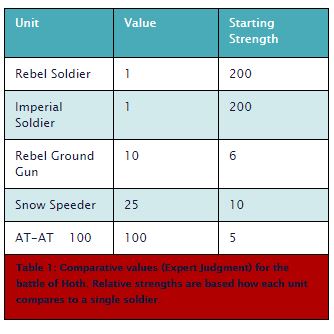
We mark the beginning of the battle of Hoth as Han Solo’s destruction of the Probe Droid 19:11 in the film, and its ending when Luke departs for Dagobah at 36:18. We ignore the space battle and focus on the ground battle. In order to get a good “apples to apples” comparison of forces, we weight them as shown in Table 1.
We use Lanchester aimed fire equations to fit the Hoth battle data, which assume that the attrition to each side is a function of the elapsed time, amount of force on their side remaining and a fixed effectiveness multiplier. Lanchester’s equations have been a focus of practical and academic study since their introduction in 1916 [3] by a large number of operations researchers [4]. The equations are:
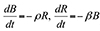
We’ll follow the convention of describing forces as “Red” and “Blue,” which still works because we can think of it as lightsaber color: Red for Empire, Blue/Green for Rebels. When describing a set of ODE’s like this to non-technical audiences, the best approach is to say something like: “The Empire forces are drawn down at a rate proportional to the number of active Rebel forces.”
Having the equations, we are left with determining the “best value” for  , which is our main task. One method is to find parameters to make the model agree with the losses at the end of the battle. This is somewhat unsatisfying because it throws away the time-dependent battle trace, which we took time to record. It is also trivial (why?).
We choose instead to minimize the standard deviance. Herein, we turn a data analysis problem into a nonlinear optimization. In Excel, we measure the deviance of each trace (Rebel and Empire) by using the =SUMXMY2() function. Next, we minimize this quantity, but we need to do it in a way that does not unfairly favor either side. The resulting “formulette” is MIN(MAX(R_error, B_error)), encouraging solver to make both of the errors – which happen to be correlated – equal by “pushing down” the greater error.
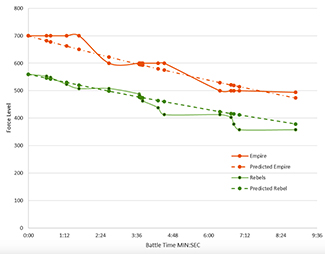
Technique is important in solving a problem like this. Before invoking any solver, we manipulate the parameters by hand until a reasonable incumbent solution appears. Human beings are very good at this. We then place the problem “in a box” by providing solver with upper bounds on effectiveness. It appeared that the Evolutionary Solver outperformed GRG non-linear.
We determine that the effectiveness coefficients for the Rebels and Empire are 1.2 and .8, respectively. This means that the Rebels are approximately 1.5 times more effective than the Empire.
Are the Rebels a good fighting force? Not really. Historically (all the way back to Sun Tzu), defenders should have a 3:1 advantage because they are dug in. If the two forces were equal, we would expect the Rebels to have a 3:1 apparent advantage.
A few “loose ends”:
- We do not count Admiral Ozzel as a casualty, even though he had “failed for the last time” and was Force-choked during the battle.
- The rebels lose their base, and it is unclear whether the Empire lost a star destroyer hit by Ion Cannon, with a complement of 46,785 on board [5]. Counting either or both losses would have hopelessly skewed the results.
- There was action in the Battle of Hoth that we did not see in the movie. This is a problem that military historians have as well!
Notes & References
- After all, it did happen long, long ago in a galaxy far, far away!
- By “force” we mean military force involving combat arms, not “The Force” involving midiclorians.
- F. W. Lanchester, 1916, “Aircraft in Warfare: Dawn of the Fourth Arm.”
- Including me! Schramm, H. and Gaver, D., 2014, “Lanchester for Cyber – the Mixed-Epidemic Combat Model.”
- Numbers from Wookiepedia.
Harrison Schramm, CAP, PStat, is a senior lecturer at Naval Postgraduate School, splitting his time between Defense Management and Operations Research where, in addition to teaching, he runs the Contested At-Sea Logistics Lab (CASLL). He served as the inaugural chair of the INFORMS Security Conference and is a past president of the INFORMS Analytics Society.
([email protected])