

November 2, 2015 in Five-Minute Analyst
Star Wars analytics II: Predicting the new movie’s sales
SHARE: PRINT ARTICLE: https://doi.org/10.1287/LYTX.2015.06.14
I’m doing something that I have never done before, which is to write about the same topic twice in a row. The new Star Wars movie is that big of a deal. The previous installment considered the Battle of Hoth.
I remember the first movie I ever went to: “Star Wars: A New Hope.” We knew it back then as just “Star Wars.” Last month, I focused backward, on events in “Empire Strikes Back” (another in the Star War series). This month, I focus forward, thinking about sales of the next Star Wars movie.
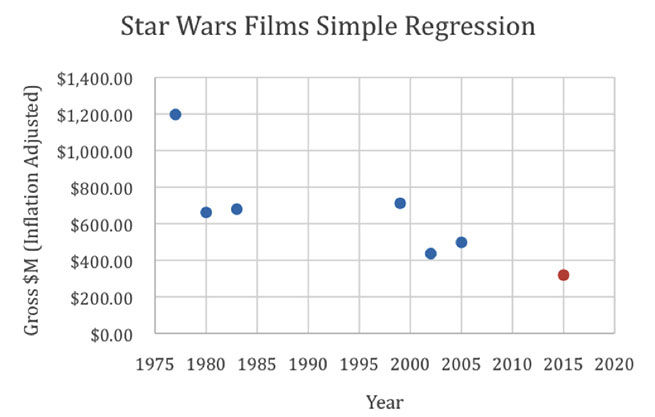
Analytically, the first thing to try is prediction based on regression. The data we have at this time is six Star Wars movies with which to compare [1]. Given the data, we are tempted to simply perform a linear regression to predict the box office of the new Star Wars movie as shown in Figure 1.
The F-statistic associated with this regression has a significance p = .102, which is probably OK for this application. So, we’re like, done, right?
Wrong!
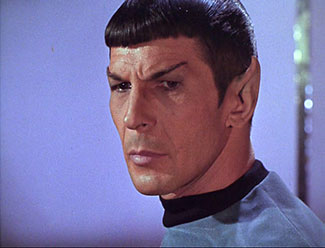
With apologies to famed Star Trek character Mr. Spock, I find the application of analytic methods without consideration of the underlying problem highly illogical.
Market forces can be complex, and I do not believe without proof that the new Star Wars movie will perform simply as an extension (on trend) from the previous six. It is also worth noting that the original Star Wars movie was the No. 2 grossing film of all time (behind “Gone with the Wind”), and that all six films are in the top 50 grossing of all time.
I recommend at this point a comparison, and this might be controversial and surprising. There is a science fiction franchise with astonishingly similar history to include multiple restarts: “Star Trek” (see Figure 2).
I’m going to argue that the new Star Wars movie has more in common with the rebooted Star Trek than laser-pistols. First, they both have similar spacing between films. Second, both the original and rebooted series will feature actors from the first: Leonard Nimoy (who sadly passed away this year) in Star Trek and at least Harrison Ford in Star Wars. Finally, the films have multi-generational appeal; first with kids, who are experiencing the series for the first time and will drag their parents, and parents who grew up with the original films and will drag their children. Finally, both the Star Wars and Star Trek reboots are directed by J.J. Abrams.
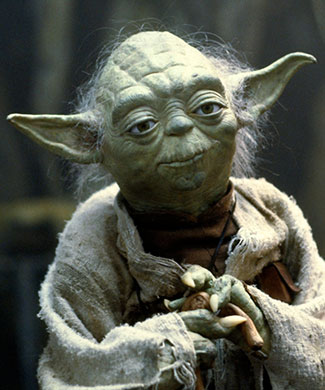
Channeling my inner Yoda of Star Wars fame, consider this: Data is all around you. Operations researchers feed on it. Statisticians breathe it. Strengthens them it does.
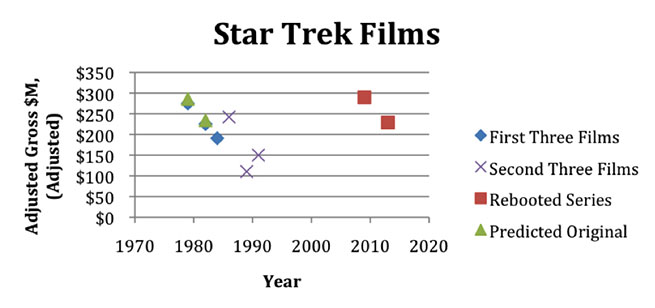
Using this comparison, we would inflate the (original) Star Wars by 4 percent and then compensate for inflation, and come up with $1.55 billion. This puts our estimate of the new Star Wars movie squarely between the original Star Wars and the No. 1 grossing movie of all time, “Gone With The Wind.” Did I really just predict that “The Force Awakens” will be the new No. 2 movie of all time, out-grossing the original after compensating for inflation?
Yes, I did.
Open issue: the sophomore slump. It is noteworthy that for all four sets of movies considered (Star Wars IV-VI, Star Wars I-III, Star Trek I-III, Star Trek IV-VI) that the middle movie of the trilogy performed worse than the first and last. I don’t have an explanation for this. Also, it seems (and I have predicted) that the middle trilogy performs worse than the first and last.
Reference
- All data from www.boxofficemojo.com, accessed early October 2015.
Harrison Schramm, CAP, PStat, is a senior lecturer at Naval Postgraduate School, splitting his time between Defense Management and Operations Research where, in addition to teaching, he runs the Contested At-Sea Logistics Lab (CASLL). He served as the inaugural chair of the INFORMS Security Conference and is a past president of the INFORMS Analytics Society.
([email protected])