

January 4, 2016 in Executive Edge
Data analytics’ better half
Why investing in the human element of analytics pays off.
SHARE: PRINT ARTICLE: https://doi.org/10.1287/LYTX.2016.01.07
Despite massive spending on technology to produce analytics, companies have spent relatively little on their ability to consume analytics – what we call the “human element of analytics.”
For years, companies have spent millions of dollars on data analytics, but many have not seen a breakthrough return on this investment. The problem? Despite massive spending on technology to produce analytics, these companies have spent relatively little on their ability to consume analytics – what we call the “human element of analytics.”
Business executives acknowledge that this disconnect is at the heart of the data analytics’ conundrum. The latest EY/Forbes Insight study, “Analytics: Don’t Forget The Human Element” [1], highlights many of the obstacles to making analytics more actionable, and emphasizes what leaders are doing most effectively to achieve analytics excellence.
The study surveyed 564 senior leaders and found that a majority of respondents do not have an effective business strategy for competing in a digital, analytics-enabled world. However, there is a segment of executives, the top 10 percent of survey participants, that is achieving a higher level of maturity and seeing competitive advantage.
The top 10 percent of participants identified in the survey typically meet two criteria:
- They use data analytics in their decision-making “all of the time” or “most of the time.”
- They report a “significant” shift in their company’s ability to meet competitive challenges.
The Human Face of Analytics
Investing in new technology and tools, data quality and advanced analytics skill sets is common to many companies. After all, these elements are critical for the “production” of analytics.
But it is only half of the equation. What is often missing is the behavioral alignment required to move from insights to action to value. This includes key components such as culture, organizational processes, skills of the business “users” and individual employees’ incentives. These are the capabilities required to “consume” analytics throughout the organization.
Finding ways to embed analytics into business processes at the point where decisions are made is essential to driving true value in analytics. It is also where organizations find the biggest challenge.
The Organizational Level
Success with analytics requires an organizational commitment to make productive use of data that is integral to the business strategy. Companies demonstrate this organizational alignment in three ways:
- Strategy: Analytics is central to the business strategy of leading enterprises, but that does not mean executives should be asking, “What is my analytics strategy?” They should be asking, “What is my business strategy to compete in a digital, analytics-enabled world?” A slight majority (54 percent) of executives with leading analytics organizations report that analytics is central to their overall business strategy, versus approximately 1 in 10 of respondents in the remaining 46 percent of enterprises who are “lagging” or “learning.”
- Leadership and culture: Excellence in big data and analytics requires strong leadership. Close to two-thirds (64 percent) of executives in the top 10 percent of enterprises indicate they “have a dedicated C-level executive – a chief analytics officer (CAO) – overseeing their data and analytics programs and engagements.” In contrast, only two in five (40 percent) of the lagging organizations have a designated CAO.However, it must be noted that effective analytics leaders are a rare breed. In many ways, they need to be a renaissance professional, with in-depth knowledge of the business, analytics and statistics, while also being an innovator, a network builder and a leader of teams.In addition to the analytics leadership role, there are five challenges that the CEO and C-suite executives must address to build an analytics-enabled culture:• Delegate an influential executive to lead the enterprise-wide analytics program.
• Use analytics to challenge existing mental models in the leadership team.
• Be clear on the critical business objectives and quantifiable measures for success.
• Navigate the inevitable conflicts between established institutions or executives that analytics creates.
• Foster collaboration within the C-suite to set an example for the rest of the organization.
• Tolerate failure as part of using analytics to learn and innovate.
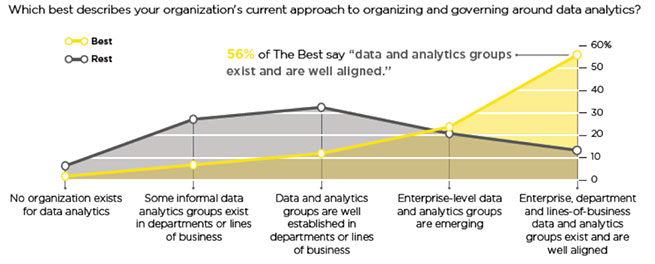
3. Organization and processes: Aligning analytics delivery and business requirements is crucial to enabling an organization to consume analytics. The survey found that the top 10 percent of organizations had processes in place to connect people and analytics within their organizations. More than half (56 percent) of these top companies have already aligned enterprise, department and lines-of-business data and analytics groups, compared with just 13 percent of the rest of the organizations.
The Individual Level
Strong leadership and the right organizational and business processes increase the likelihood that a company will successfully be able to leverage analytics. But to achieve a positive impact, analytics must be used at the point where decisions are made – by individuals. There are three factors to this:
- Decision bias: Companies need to provide the training to help individuals recognize decision biases – the psychological assumptions that often lead to poor decision-making. By being more aware of this subconscious thinking, employees can better interpret and act on the insights from analytics.
- Capabilities: For analytics to create value, individuals within an organization must be able to understand and use the data and insights. First and foremost, this comes down to training. In the survey, we found that the top 10 percent of firms are more likely than their peers to conduct on-site seminars or workshops, enroll employees in off-site education programs or coaching, and provide mentoring by data and analytics professionals or leaders. But this kind of education is about more than what an individual knows; it also establishes an analytics mindset within the organization. As a result, everyone becomes more comfortable with analytics, which removes the fear factor when switching from judgment-based to analytics-based decision-making.
- Incentives: Incentives, rewards and measurement need to be aligned with the actions suggested from the analytics-based insights. According to the survey, the top 10 percent understand the importance of motivation, with 40 percent of them having aligned incentives to desired change from analytics, compared with 23 percent of their peers. More than two-fifths (42 percent) of the top 10 percent also offer greater opportunities for promotion and advancement to individuals.
Conclusion
All companies will need to have analytics as a core competency in order for business decisions to be informed by data. End users of the analytics, whether they are doctors, marketing professionals, factory workers, customer service representatives or financial professionals, will enhance their decision-making with the help of analytics. But this cannot happen without recognizing that the consumption of analytics is as important as the production.
Now is the time to ask if your investment in producing data-driven insights is delivering a competitive advantage. If not, ask yourself if your organization is effectively consuming analytics. And as you look forward to what analytics will deliver for your organization in 2016, do not forget the human element.
References
- http://www.forbes.com/forbesinsights/ey_data_analytics_2015/index.html
- Figure 1 was taken from the EY/Forbes Insight study, “Analytics: Don’t Forget The Human Element.”
As EY’s (Ernst & Young) global chief analytics officer, Chris Mazzei leads the Global Analytics Center of Excellence that serves as a catalyst for transformation both internally, within EY, to embed analytics into its service offerings across all business lines, as well as externally for EY’s clients by delivering analytics offerings that help organizations grow, optimize and protect value.