

January 4, 2016 in News & Notes
Edelman, queues, STEM & survey
The Edelman finalists were chosen after a rigorous review by verifiers, all of whom have led successful analytics projects. INFORMS announces 2016 Edelman Award finalists
SHARE: PRINT ARTICLE: https://doi.org/10.1287/LYTX.2016.01.11

INFORMS announces 2016 Edelman Award finalists
INFORMS has named six organizations representing applications of real-world operations research and advanced analytics for the 2016 Franz Edelman Award competition. The winner will be announced at the INFORMS Conference on Business Analytics & Operations Research in Orlando, Fla., in April following a daylong series of presentations before a panel of judges.
The finalists include:
- 360i for “360i’s Digital Nervous System”
- BNY Mellon for “Transition State and End State Optimization Used in the BNY Mellon U.S. Tri-Party Repo Infrastructure Reform Program”
- Chilean Professional Soccer Association (ANFP) for “Operations Research Transforms Scheduling of Chilean Soccer Leagues and South American World Cup Qualifiers”
- The New York City Police Department (NYPD) for “Domain Awareness System (DAS)”
- UPS for “UPS On Road Integrated Optimization and Navigation (Orion) Project”
- US Army Communications Electronics Command (CECOM) for “Bayesian Networks for US Army Electronics Equipment Diagnostic Applications: CECOM Equipment Diagnostic Analysis Tool, Virtual Logistics Assistance Representative”
The finalists were chosen after a rigorous review by verifiers, all of whom have led successful analytics projects. The verifiers come from organizations such as Verizon Wireless, HP, Turner Broadcasting, Carnegie Mellon University, PriceWaterhouseCooper, SAITECH, Princeton Consultants, University of Chicago and University of Maryland.
Now in its 45th year, the Franz Edelman Award is the world’s most prestigious recognition for excellence in developing and applying advanced analytical methods to help organizations solve complex problems or create new opportunities that result in highly impactful outcomes for the economy and society.
Art, science and psychology of managing long queues
As a world-renown expert in queueing theory, MIT professor Richard Larson, aka “Dr. Queue,” knows all about waiting in lines. So it’s no surprise that when the Washington Post’s Wonkblog reporter Ana Swanson needed an expert source for her story on the art and science of managing long queues, she called on Dr. Queue.
According to Larson, people can expect to spend one to two years of their lives waiting in line, most of it stuck in traffic. But those five-minute waits in the checkout line at the supermarket, stuck behind someone talking on their smartphonewhile fumbling with a pile of coupons and dollar bills to give to the checker, can be just as annoying.

As Swanson notes in the article, waiting in line not only irritates the customer, it’s bad for business. “A long and unpleasant wait can damage a customer’s view of a brand, cause people to leave a line or not enter it in the first place (what researchers respectively call ‘reneging’ and ‘balking’), or discourage them from coming back to the store entirely,” she writes.
Businesses, of course, realize this and come up with various ways to solve the problem, starting with good, old-fashioned distraction such as magazines in the doctor’s waiting room and near the supermarket checkout lines. Larson, a past president of INFORMS, considers Disney the “undisputed master” of designing queues that are entertaining and that create anticipation for the ride. “In my book, [Disney is] number one in the psychology and in the physics of queues,” Larson tells the Post.
Writes Swanson: “The design is so successful that parents with young children can happily stand in line for an hour for a four-minute ride – a pretty remarkable feat, [Larson] points out. And of course, the capacity of the line and the ride are carefully calculated to balance customer satisfaction with profits.”
To read the complete article “What really drives you crazy about waiting in line (it actually isn’t the wait at all),” click here.
STEM majors with the best value

Not surprisingly, WorldWideLearn.com’s updated list of the “STEM Majors With the Best Value for 2015” is loaded with majors common among members of the analytics community. The list includes information technology (No. 1), computer programming (No. 3), computer and information science (No. 5), engineering (No. 7), data modeling (No. 9), computer systems analysis (No. 11), mathematics (No. 18), management science (No. 21), informatics (No. 22), petroleum engineering (No. 23) and physics (No. 25).
WorldWideLearn.com analyzed 122 majors belonging to the STEM disciplines. To be included in the rankings, each major had to meet at least one of the following criteria:
- Be on the 2012 STEM-Designated Degree Program List from the Department of Homeland Security
- Be matched by the National Center for Education Statistics to a job on the Bureau of Labor Statistics’ list of STEM occupations
Ranking criteria including educational availability, educational affordability, earnings and employment opportunity.
Gaps between teaching, practice of advanced analytics
Students of advanced analytics who aspire to leave academia and succeed quickly in business and government arenas should assess their approaches and tools in the classroom and their research, according to an informal Princeton Consultants survey conducted at the 2015 INFORMS Annual Meeting in Philadelphia. The survey revealed notable gaps between what students learn, what professors teach and what practitioners need.
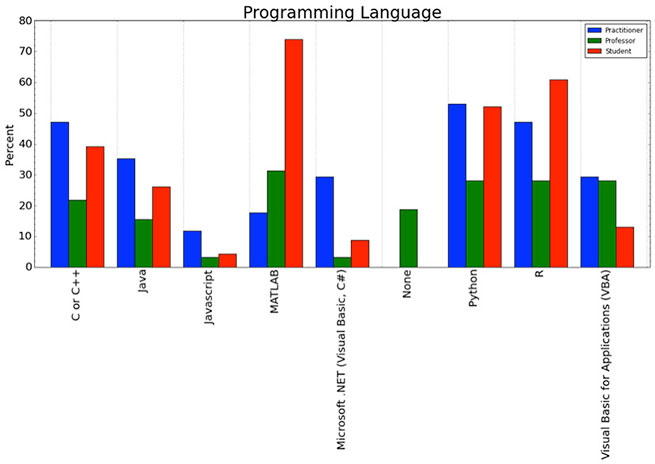
Irv Lustig of Princeton Consultants, a longtime INFORMS member and a former employee of CPLEX, ILOG and IBM, reported the following findings:
- Students must learn more about building applications with modern technologies so they have the skills needed by the practice community.
- Professors are, for the most part, not teaching the programming languages used by students or in practice. Students and practitioners are using both Python and R, both of which are used heavily in the data science community, but faculty members are not adapting their courses to teach these new languages.
- With few exceptions, there seems to be misalignment between the use of modeling languages in academia and the use of modeling languages in practice.
The survey of 72 self-selected participants, all of whom were onsite at the INFORMS Annual Meeting, was comprised of college professors (44 percent), students (32 percent) and practitioners (24 percent). The non-scientific “snapshot” survey was designed to compare the responses of these three groups about solvers, programming languages, modeling languages and software development based on the participants’ last two years of experience.
SHARE: