

May 2, 2016 in Newsmakers
Edelman gala and awards galore
SHARE: PRINT ARTICLE: https://doi.org/10.1287/LYTX.2016.03.09
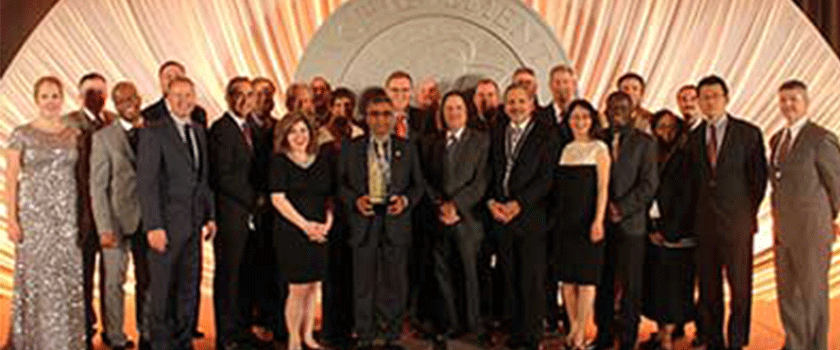
UPS wins 2016 Edelman Award for O.R. achievement
The Institute for Operations Research and the Management Sciences (INFORMS) named UPS as the winner of the 2016 Franz Edelman Award for Achievement in Operations Research and the Management Science at an Oscar-like gala held in Orlando, Fla., in conjunction with the INFORMS Conference on Analytics & Operations Research. The award, considered the “Super Bowl of Operations Research,” honored UPS’s On-Road Integrated Optimization and Navigation (ORION) project that demonstrated how operations research (O.R.) can be used to realize hundreds of millions of dollars in cost savings.
“We are very proud to have won the Franz Edelman Award, which represents the highest levels of performance and sophistication in operations research,” says Mark Wallace, UPS senior vice president of global engineering and sustainability. “This honor recognizes many years, countless resources and teams of people dedicated to deployment of one of the largest operations research projects in the world. ORION will lead to hundreds of millions of dollars in cost savings, reduced fuel usage, and it supports our efforts to strive towards improved sustainability.”
UPS, the leading logistics provider in the world, and long known for its focus on efficiency improvement, in 2003 first instituted an ambitious effort to modernize its pickup and delivery operations. This commitment evolved into a suite of systems that are collectively known as package flow technologies (PFT) and an advanced optimization system known as ORION.
ORION uses the data foundation of PFT to provide an optimized manifest to its drivers to help them meet the complex demands of providing service with greater efficiency. This is accomplished by building more efficient routes, reducing the miles driven and reducing vehicle fuel consumption.
More specifically, when fully deployed at the end of 2016 to 55,000 drivers, UPS estimates a reduction of 100 million miles driven annually and a savings of 10 million gallons of fuel per year. That amounts to eliminating more than 4,000 trips around the world per year.
ORION also contributes to UPS’s sustainability efforts by reducing the CO2 emissions by 100,000 metric tons each year. The company expects ORION to save it $300 million to $400 million annually when fully implemented.
The key for ORION is its use of analytics and operations research to identify and capitalize on the small efficiencies on the front lines, and to use the power of data and heuristics to constantly improve performance. In day-to-day implementation, ORION takes the guesswork out of finding the most efficient and effective routes and schedules for delivery. Drivers face less pressure to make routing decisions and can instead focus on safety and serving customers. Customers also have greater control, since ORION allows them to use their own computers or smart phones to postpone or redirect packages with UPS My Choice to designated UPS Access Point locations, offering them greater convenience and security options.
The company considers ORION its foundation for a new generation of advanced planning systems. Because of its sheer size and scope, it has come to be regarded as one of the largest operations research projects in the world.
Other finalists and projects included:
360i for “360is Digital Nervous System”
BNY Mellon for “Transition State and End State Optimization Used in the BNY Mellon U.S. Tri-Party Repo Infrastructure Reform Program”
Chilean Professional Soccer Association (ANFP) for “Operations Research Transforms Scheduling of Chilean Soccer Leagues and South American World Cup Qualifiers”
New York City Police Department (NYPD) for “Domain Awareness System (DAS)”
U.S. Army Communications-Electronics Command (CECOM) for “Bayesian Networks for U.S. Army Electronics Equipment Diagnostic Applications: CECOM Equipment Diagnostic Analysis Tool, Virtual Logistics Assistance Representative”
General Motors awarded INFORMS Prize

General Motors, which is using big data and advanced analytics to predict failure of certain automotive components and systems before customers are affected, was named the winner of the 2016 INFORMS Prize for operations research and the management sciences. This year’s INFORMS Prize was presented at the 2016 INFORMS Conference on Analytics & Operations Research in Orlando, Fla.
Industry-first proactive alert messages sent to customers through GM’s OnStar system covering potential issues with a vehicle’s battery, fuel pump or starter can transform an emergency repair into planned maintenance. A recent example of applying operations research and management science to the most complex issues the company faces led to the INFORMS Prize.
“Over the last seven decades, OR/MS techniques have been used to improve our understanding of everything from prognostics to traffic science and supply chain logistics to manufacturing productivity, product development and vehicles telematics and prognostics,” says Gary Smyth, executive director of GM Global R&D Laboratories. “These approaches to problem-solving permeate almost everything we do.”
GM has hundreds of OR/MS practitioners worldwide who play a vital role in everything from designing, building, selling and servicing vehicles to purchasing, logistics and quality. The team is constantly developing new business models and vetting emerging opportunities.
Another example of management science positively impacting the business is helping to understand what products and features customers most want to create, as well as price features and option packages that would sell best. That work extends to determine the ideal number of vehicles and what vehicle variants Chevrolet, Buick, GMC and Cadillac dealers in the United States should stock. In addition, advanced analytics help dealers achieve GM’s goal of creating customers for life. The company recently received the 2015 overall manufacturer loyalty award from IHS.
The impact OR/MS is now having to the business can be traced to 2007, when GM created a center of expertise for operations research to promote best practices and transfer new technologies. GM has since expanded to include partner teams in product development, supply chain, finance, information technology and other teams.
The INFORMS Prize honors effective integration of operations research in organizational decision-making. The award is given to an organization such as GM that has repeatedly applied the principles of O.R. in pioneering, varied, novel and lasting ways.
Carnegie Mellon schools receive UPS George D. Smith Prize
The School of Information Systems & Management and the School of Public Policy and Management at the H. John Heinz III College, Carnegie Mellon University, received the 2016 UPS George D. Smith Prize from INFORMS. The award recognizes excellence in preparing students to become practitioners of analytics and operations research.
The award was presented at the 2016 INFORMS Conference on Business Analytics & Operations Research held April 10-12 in Orlando, Fla.
The other finalists included the Institute for Advanced Analytics, North Carolina State University, and the Operations Research Program, United States Air Force Academy.
The UPS George D. Smith Prize is awarded to an academic department or program for effective and innovative preparation of students to be good practitioners of operations research, management science or analytics. Established in 2011, the award is named in memory of the late UPS chief executive officer who was a patron of operations researchers at the Fortune 500 company.
Stanford team wins Syngenta Crop Challenge
Syngenta Crop Challenge.
The team was awarded a $5,000 prize for their entry, “Hierarchy modeling of soybean variety yield and decision making for future planting plan,” which modeled a system for predicting soybean seed variety selection.
“It has been a wonderful experience working with Syngenta on this project, and we are excited about the impact our work can have on improving crop yields and addressing food security challenges,” says Xiaocheng Li. The Challenge tasked participants to develop a model that predicts the seed varieties farmers should plant next season to maximize yield. The inaugural competition aimed to address the challenge of global food security by fueling innovation among experts applying advanced analytics in biochemistry and agriculture.
“Global food security is one of the greatest challenges facing the next generation, and there is a significant need to engage a broader talent base into agriculture,” says Joseph Byrum, Syngenta head of soybean seeds product development and lead for the Syngenta Crop Challenge in Analytics committee. “This competition clearly demonstrated that people outside and adjacent to the industry can make noteworthy contributions.”
The finalists made their presentations at the INFORMS Conference on Business Analytics & Operations Research in Orlando, Fla. Programs were evaluated based on the rigor and validity of the process used to determine seed varieties, the quality of the proposed solution and the finalists’ ability to clearly articulate the solution and its methodology.
The runner up, “Decision assist tool for seed variety selection to provide best yield in known soil and uncertain future weather conditions” (authored by Nataraju Vusirikala, Mehul Bansal, Prathap Siva Kishore Kommi) received a $2,500 prize. The third place entry, “Balancing weather risk and crop yield for soybean variety selection” (authored by Bhupesh Shetty, Ling Tong and Samuel Burer), received a $1,000 prize.
“The submissions from the Syngenta Crop Challenge in Analytics represent best in class science,” Byrum adds. “What is striking is the overall professionalism, quality and effort that the finalists put into the presentations. The teams were clearly committed and had a deep connection to the challenge.”
Syngenta, a global agribusiness headquartered in Switzerland, donated the prize money from its 2015 Franz Edelman Award win in support of a commitment to run the Syngenta Crop Challenge for the next four years.
“Syngenta is a great example of a company using operations research to better both its own performance as well as to help better society,” says Melissa Moore, executive director of INFORMS.
Next year’s Crop Challenge will be announced this May with submissions due in January 2017. For more details about the Syngenta Crop Challenge and to register for the upcoming Challenge, visit www.ideaconnection.com/syngenta-crop-challenge.
SHARE: