

May 2, 2016 in Five-Minute Analyst
Border walls
SHARE: PRINT ARTICLE: https://doi.org/10.1287/LYTX.2016.03.11
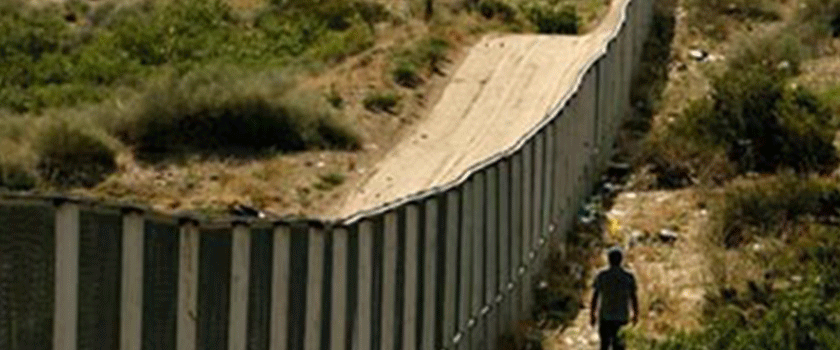
This time, I’m going to take a look at a subject in current events – the proposed construction of an anti-immigration wall along the U.S. border with Mexico. If you have read this column a few times, you know that it’s all about analysis, and seamlessly moves from the frivolous, such as popular television and movies, to the very serious, such as vaccinations and welfare policy. While analysis is the focus, the requirements on both data and rigor are much higher when you are working on current events.
This article turned out to be a lot more complicated than I initially expected it to be.
For those who haven’t been following, the “Border Wall” is a proposed barrier running the length of the U.S. southern border with Mexico. This is one of the key elements of Donald Trump’s platform running for the Republican nomination for president. At the time of this writing (April 1, 2016), Mr. Trump is the frontrunner for the Republican nomination. For the remainder of this article, we will assume that the goal is to prevent illegal immigration into the United States, although even that is contested [1].
Before we can talk about the merits of a wall, we should try to understand the size of the problem. The difficulty with estimating immigration – and illegal activity in general – is that we have data on those who were apprehended, but we do not have a true estimate of those who successfully crossed. We know how many unsuccessful attempts were made. There are some very interesting techniques to attempt to discern the true size of the problem using partial data [2], but such an attempt is beyond the scope of the current effort. For southern border apprehensions by year, see Figure 1.
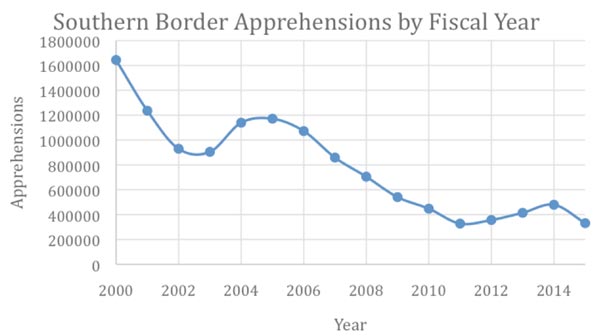
When I sat down to write this, my plan was to compare the cost of the wall with the cost of current Customs and Border Protection budgets to determine which was more effective. However, after seeing Figure 1, I got derailed; my analytic voice was screaming: Wait a minute – why are apprehensions decreasing?
There are at least three reasons why apprehensions at the border might be decreasing. They are:
- Enforcement efforts have decreased; if you aren’t trying to catch border crossers, you will catch fewer.
- Border crossers have gotten better; if the people running the border have gotten better at it, you will catch fewer.
- Enforcement has increased and fewer attempts have been made; if you try harder to catch border crossers and this is known, people will assess their probability of successfully crossing as low and not attempt it.
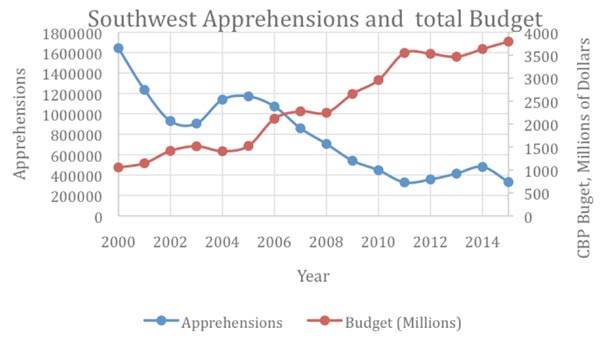
Evaluating (2) or (3) is beyond the scope of this article, but there is readily available data to help us think about (1). Let’s add the annual CBP budget to our existing graph.
Figure 2 does not support the hypothesis that the U.S. government gave up enforcing the border. Another way to look at this problem is to consider unemployment rates in both Mexico and the United States. See Figure 3.
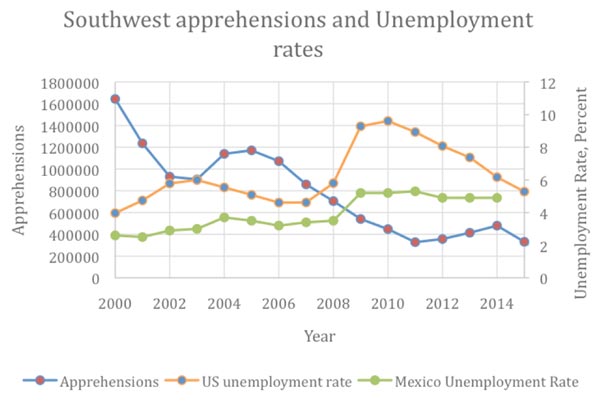
Source: United States (Bureau of Labor Statistics [5]) and Mexico (World Bank [6]).
Earlier, in Figure 1, we regressed year vs. apprehensions and concluded that immigration was decreasing, but we did not consider any of the underlying causes. Now, we perform a regression of unemployment rates vs. apprehensions, and the results are interesting. The p-value suggests significance at .003, and the R-square is .49.
Why would I prefer a model with a lower R-square? Because it is tied to a variable of interest. Recall that immigration is a complicated process and what we have performed here is a very rudimentary look.
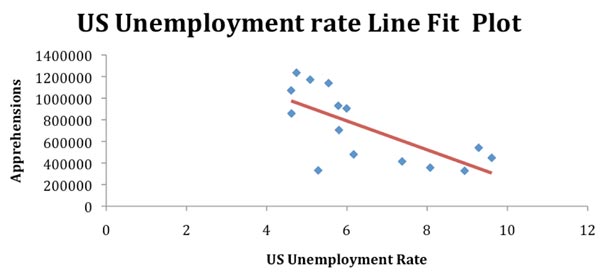
While I typically do not like to present diagnostic charts in a “polished” setting, the predicted vs. fitted chart for this data is informative:
I was planning to end this column by considering the historical and proposed costs of the “Border Wall,” but I spent our five minutes together on these charts instead. The historical and proposed costs may be the topic of a future column if it is still part of the national discussion.
References
- For example, see: http://www.rand.org/pubs/periodicals/rand-review/issues/2012/fall/leadership/immigration-reform.html
and http://thehill.com/blogs/congress-blog/foreign-policy/203984-illegal-immigrants-benefit-the-us-economy - Shearer, Robert, “Operations Analysis in Iraq: Sifting through the Fog of War,” Military Operations Research, Vol. 16 No. 2, see p. 68.
- https://www.cbp.gov/sites/default/files/documents/BP Total Apps%2C%20Mexico%2C%20OTM%20FY2000-FY2015.pdf “Southwest Border” Retrieved March 25, 2016.
- https://www.cbp.gov/sites/default/files/documents/BP Budget History 1990-2015.pdf
- http://data.bls.gov/timeseries/LNS14000000
- http://data.worldbank.org/country/mexico
Harrison Schramm, CAP, PStat, is a senior lecturer at Naval Postgraduate School, splitting his time between Defense Management and Operations Research where, in addition to teaching, he runs the Contested At-Sea Logistics Lab (CASLL). He served as the inaugural chair of the INFORMS Security Conference and is a past president of the INFORMS Analytics Society.
([email protected])