

July 4, 2016 in Healthcare Analytics
Technologies converging but hurdles remain
SHARE: PRINT ARTICLE: https://doi.org/10.1287/LYTX.2016.04.10in
With 2016 half over, we have seen many developments in the political and business world during the first six months, including the most recent Microsoft acquisition of LinkedIn. Meanwhile, the healthcare analytics space has stayed quite vibrant. According to a report published by Rock Health, a start-up accelerator turned venture fund, investment in healthcare analytics and digital health during the first quarter alone grew to nearly a billion dollars, of which $307 million was invested in big data analytics and population health management technology companies. However, deployment and adoption of technology solutions, especially digital health solutions, is still struggling to pick up momentum. In this article I will share my thoughts about the hurdles faced by healthcare organizations despite advancements and convergence of various technologies.
Five Technology Forces Model
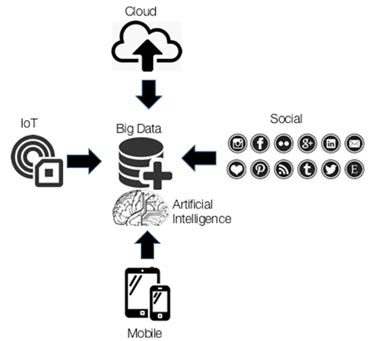
Five technology forces are now shaping our experience of the real world: the Internet of Things (IoT), social networks, mobile and big data, along with artificial intelligence. These technologies interact with each other and will eventually converge. We are seeing the advent of more sensors and cloud-enabled intelligence within devices from thermostats on the wall to smart clothing we wear. The promise of the IoT is every human-created object would be capable of interacting with each other.
Cloud computing powered by massive server farms of Google, Amazon, Microsoft, Rackspace and many others are delivering intelligence to the mobile devices we use every day: phones, smart watches, tablets, lights at home or work, sprinkler systems, smoke detectors and appliances. The Google Fit app on an Android phone or watch can now measure steps as we take them and the types of exercise as we do them, as long as we keep the phone in our pocket or the smart watches on our wrist. Data captured through the built-in sensors are analyzed in the cloud, and glance-able dashboards present feedback seamlessly and instantaneously. Apple iPhone and Apple Watch can do similar things as well. Our phones and smart watches have become the points of convergence for mobility, IoT, cloud and analytics to measure our personal health condition and fitness activity.
Big data with analytics is now everywhere. Market research firm IDC predicts that revenues from the sale of big data and analytics hardware, software and services will increase by 50 percent between 2015 and 2019. By 2019, IDC forecasts sales will reach $187 billion globally. While big data is poised for a rapid growth in retail, banking and finance, uptake in healthcare is still questionable.
Artificial Intelligence
The emergence of artificial intelligence (AI) is a more recent phenomenon in the consumer technology space. AI, however, is not a new technology. The first “expert system” named MYCIN that used a rule-based technology was developed in the early 1970s at Stanford University, albeit it was never used for real-life diagnosis. Advancement in computing power and focused efforts by global technology giants such as IBM, Google, Microsoft and Facebook have now started to move AI to the consumer world.
Google and Microsoft recently open sourced their AI technology stack for the global developer community. IBM made the first big splash with Watson, its super computer-powered AI software, which they now offer as a cloud-based service. Watson is at the center of IBM’s analytics platform strategy (branded as “Platform for Cognitive Business”), which includes healthcare analytics. Google and Microsoft’s AI strategy do not include healthcare yet, but hopefully they will include it in the future. AI-based automation is a key development. McKinsey & Company estimates that as much as 45 percent of the tasks currently performed by people can be automated using existing technologies. This includes tasks within healthcare as well.
Healthcare a Hard Nut to Crack
Despite many advancements and the convergence of technology forces, entrepreneurs and big companies alike are finding healthcare and biology domains difficult for disruption. We have seen many failures for digital health technologies already. Some worked initially or received media hype but then faded or adoption died. The saga of Theranos is a sobering reminder that healthcare is different from other industry verticals. It is structurally complicated, highly regulated and layered with emotions. A nurse or a physician is not just a service provider; patients make emotional ties with them. Patients like to interact with a good doctor or a compassionate nurse rather than interacting with a computer with built-in intelligence. Even when we get our care through virtual care technologies like email, we expect the human compassionate touch of a care provider.
Interestingly, the healthcare industry in the United States has always embraced cutting-edge technologies in the form of medical devices. That’s not true for information technologies. Digitization is a recent phenomenon. The true value of data has only recently been understood. Physicians now agree that data and analytics are crucial for delivering appropriate care to the right patients in a timely fashion. Demands for data are very different across departments within a healthcare delivery organization.
Physicians want to have meaningful analytics delivered to them at the point of care. However, they have productivity requirements to meet, which makes most encounters only 15 minutes long. During this limited timeframe a physician has to engage in a conversation with the patient, document relevant information in an electronic health record (EHR) system using a poorly designed interface, prescribe medications or order a lab test. Where is the time to check an analytics dashboard during that process? Even if they could, what analytics would be required? What if an analytics tool is not integrated seamlessly with the legacy EHR?
Quality improvement groups, on the other hand, need to examine process analytics across the organization or clinical quality measures by site and by physician. Case management groups need risk profiles of all high-risk patients and their recent healthcare utilization trends. With bigger health systems it is possible to fulfill such demands, but for smaller institutions and clinics this is an enormous challenge. Off-the-shelf solutions do not meet all requirements, and they cannot find or afford data scientists to develop analytics in house. Who will create and maintain the enterprise data warehouse? Without strong support from data scientists and data stewards, adoption fizzles out after the initial euphoria. With the change in payment models, organizations are also struggling to adequately combine cost with clinical data to generate actionable insights. This is a huge undertaking for many.
The healthcare industry is in the midst of experiencing big tectonic shifts. This will surely bring a lot of upheavals in the form of mergers, acquisitions and consolidation. The dust hasn’t settled yet; in fact, the dust storm has just begun. It is unclear when this behemoth of a 2.8 trillion-dollar industry will settle down with a new model of care, payment and organizational structure, and where the five technology forces will eventually converge just like they have in other industry verticals.
Rajib Ghosh is the founder and CEO of Health Roads, LLC, a consulting company for enabling digital transformation in healthcare organizations. He has 25 years of technology experience in various industry verticals where he had management roles in software engineering, data analytics, program management, product management, business operations and strategy development. Ghosh spent a decade and half in the U.S. healthcare industry as part of a global ecosystem of medical device manufacturers, medical software vendors, telemedicine and telehealth solution providers. He’s held senior positions at Hill-Rom, Solta Medical and Bosch Healthcare. His recent work includes leading data-driven digital transformation in the public health space, including county-level healthcare agencies and organizations focused on underserved populations.
([email protected])