

September 5, 2016 in Analyze This!
Midlife Makeover: Remodeling House, Health & Tech Skills
SHARE: PRINT ARTICLE: https://doi.org/10.1287/LYTX.2016.05.08in
My normal late August routine: scrambling to start my fall MBA classes, helping my daughter organize for her first day of school (always the first week as mine!), trying to finish off this column, and madly getting ready to go to Burning Man [1].
But this year is different.
This year, I have a sabbatical from teaching, my first since joining the University of San Francisco faculty. And this sabbatical is only the latest in a series of major personal transitions all taking place this year. It is certainly not a “crisis,” so let’s instead refer to it herein as my “midlife makeover.”
It all started with the decision to remodel our kitchen, a project that quickly evolved into a major home renovation. Because I am not good with design, details or major capital expenditures, everything about a project like this scared me. The barrage of horror stories about cagey contractors, endless schedule delays and massive cost overruns did little to assuage my anxiety.
But I am pleased to report that our project is now complete, nearly on time and within the budget contingency that we had planned for. For this I must give much of the credit to our contractors, Berkeley Craftsmen. They did an excellent job of developing and managing the project plan and making sure that we made the necessary decisions (about materials, finishes, colors, etc.) in time to prevent expensive bottlenecks. The subcontractors that they selected were skilled, timely and professional. There was clear and regular communication between us throughout the nine-month project (even through the final “punch list” phase), including weekly “show and tell” on-site walkthroughs.
While these are all standard concepts from my project management courses, such disciplined execution is far less common on residential projects like ours. For me, this long journey resulted in not only a beautiful “new” old house but also an enduring positive relationship with Berkeley Craftsmen, as well as an appreciation for the volume and variety of problems that get solved by skilled craftsman during projects of this magnitude and complexity. Much respect and gratitude.
Meanwhile, another “remodeling” project has required me to be a lot more hands-on. In January, I began working with Dr. Cyrus Khambatta, a nutritional biochemist and personal trainer, to restructure my diet and enhance my exercise routine. Since being diagnosed as a Type 2 diabetic [2] years ago, I had not done a great job in making the dietary shift toward the low carbohydrate diet recommended by my doctor. Over time, I found myself taking more medications in larger doses, and I felt like I was on a path toward insulin injections and increased risk for heart disease, nerve damage, vision issues and a whole bunch of other serious and negative health outcomes. Yet I feared that I lacked the knowledge, skills and discipline needed to make such major changes on my own.
I was lucky to find Cyrus, for both his scientific research and his professional practice focus on blood sugar issues. In particular, he quickly offered me a broader “systems thinking” view of my own physiology. Rather than focusing on the carbs that produced the sugars that were trapped in my blood stream, he instead presented an alternative model, supported by contemporary research, of cells and tissues holding fats, thus making insulin far less effective in moving sugars out of the blood stream, a phenomenon known as “insulin resistance” [3].
Thus, I shifted my objective from a low-carb diet to one that is low in fats and high in fresh carbohydrates such as fruits and vegetables. This was somewhat counterintuitive, as I had spent the better part of the last decade thinking that all carbs were “bad” and that all proteins were “good.” Under Cyrus’ guidance, I also added a couple of weekly gym workouts.
The results have been dramatic. Over the first eight months of this year, I have lost more than 30 pounds, added a modicum of muscle, and (most importantly) have been controlling my blood sugar levels while weaning myself off of all diabetic medications. These are huge steps, and I am now working hard to keep these good habits in place for the months and years to come.
Which brings me, finally, to the third leg of my midlife makeover. I will be spending my sabbatical visiting the Human Rights Data Analysis Group (hrdag.org), a non-profit, non-partisan organization that applies rigorous science to the analysis of human rights violations around the world. My university’s mission to “Change the World from Here” and my background with statistical modeling seem to be well aligned with HRDAG’s high-level goals of applying scientific methods to help support the protections established in the Universal Declaration of Human Rights [4], the International Covenant on Civil and Political Rights [5] and other international human rights treaties and instruments.
The reality is that I’m mostly at HRDAG to learn by doing. My primary personal goal is to try to shake off a lingering case of the imposter syndrome [6] by developing more of the technical skills that analytics professionals in today’s world are expected to have. While most of my students (and perhaps some readers of this column) already assume that I have a solid understanding of a modern analytics tech stack, much of what I know is secondhand and somewhat shallow. There is no substitute for meaningful direct experience.
Reflecting back on my home and dietary remodeling projects, two keys to success have been: (a) personal persistence rooted in some intrinsic desire, and (b) collaboration with (and support from) experienced, well-trained professionals. Together, these have helped me overcome my own fear and anxiety about taking on significant challenges such as these.
This realization also gives me a little bit of confidence as I anxiously start the process of remodeling my technical skills. As anxious as I am about immersing myself in new technical challenges, I’m even more afraid about falling further out of touch with contemporary analytics tools and practices. Moreover, I feel incredibly fortunate to have a great team to learn from at HRDAG, and am very grateful to Dr. Megan Price (executive director) and Dr. Patrick Ball (founder and chief scientist) for giving me a chance, and a place, to be a beginner again.
Wish me luck. I’ll report back from time to time.
Vijay Mehrotra is a professor in the Department of Business Analytics and Information Systems at the University of San Francisco’s School of Management and a longtime member of INFORMS.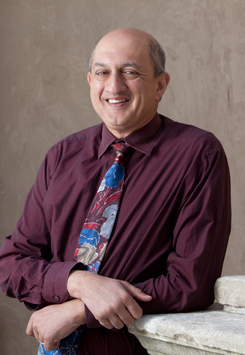
([email protected])