

September 5, 2016 in Five-Minute Analyst
Presidential acceptance speeches
SHARE: PRINT ARTICLE: https://doi.org/10.1287/LYTX.2016.05.12in
It’s U.S. presidential election season, which means there’s a once-every-four-years opportunity to apply some analytics. While a seemingly unending number of things could be analyzed, I’ve chosen this month to spend a few minutes looking at the campaign speeches themselves.
The major party candidates are formally announced during each party’s national convention, and it is traditional that they give a speech accepting their party’s nomination. We are going to analyze these speeches. Longtime readers of this column may recall that we have previously analyzed the grade level of State of the Union speeches two years ago using the Flesch-Kincaid methodology. This method was chosen because it is based on the structure of language using syllables per words and words per sentence. Structural analysis is more stable for comparing events over a 200-year period. The result of the previous analysis is presented as Figure 1.
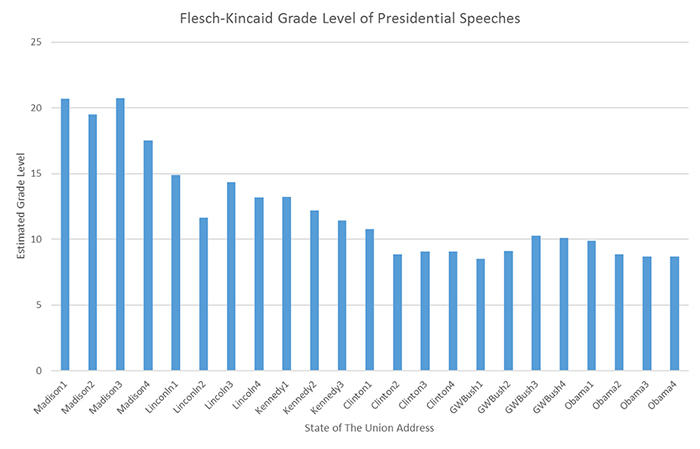
We repeat this analysis by considering presidential acceptance speeches from 2004-present. Note: It would be incorrect to associate grade level with intelligence. As we pointed out in our 2004 article, the following two sentences have the same Flesch-Kincaid score, but they have vastly different intellectual levels:
“It is a far, far, better thing that I do than I have ever done; it is a far, far better rest that I go to than I have ever known.”
“I went to the grocery store, bought some rye bread and ate it all up.”
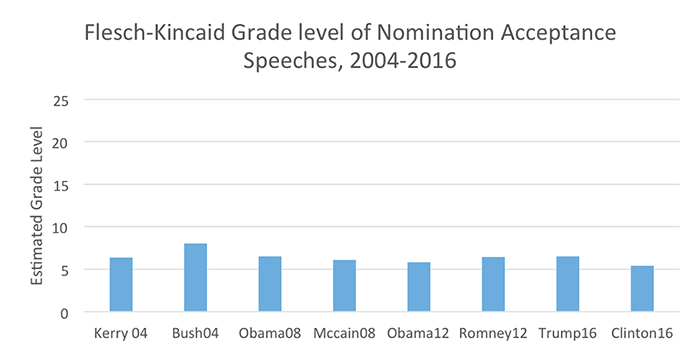
The results of the comparison do suggest that acceptance speeches serve a different purpose than State of the Union addresses and therefore have a different underlying structure.
Based on the Flesch-Kincaid grade level, Donald Trump was slightly above 6th grade, while Hillary Clinton was slightly below. Trump used 1,123 unique words, while Clinton used 1,205.
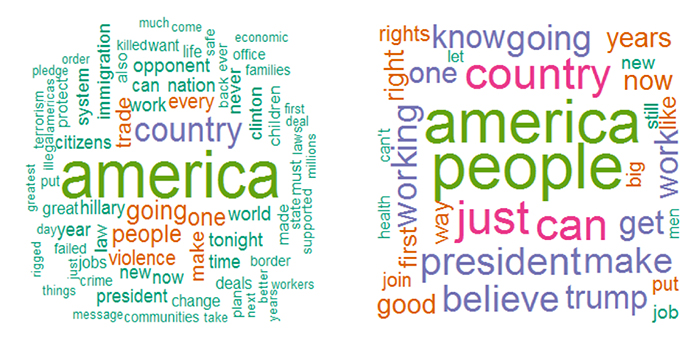
In addition to grade level, we can also think about the words themselves. First, a word cloud of all acceptance speeches from 2004-2016 (Figure 3), followed by word clouds of Trump and Clinton’s acceptance speeches (Figure 4), as well as the 10 most common words in acceptance speeches (Figure 5).
Finally, we can think about the mention of other politicians. Over all the speeches analyzed, Barack Obama is the runaway leader with 31 mentions. The Clintons are mentioned 13 times. The Bushes are only mentioned five times; they share that number with Presidents Lincoln and Reagan.
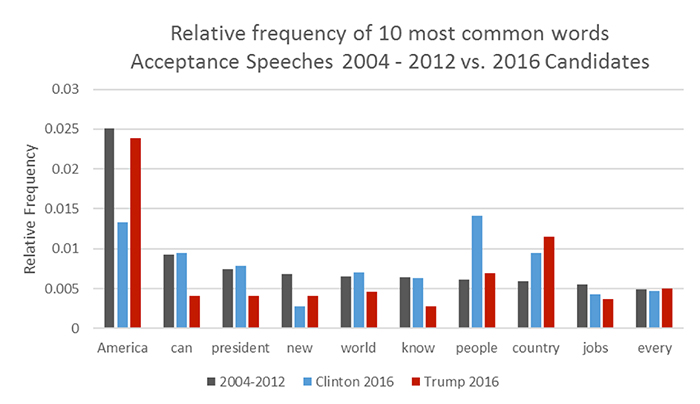
Note: The words “America,” “American” and “Americans” are all counted as “America,” – by far the most common word in historical speeches.
A comment on methodology: We have tried to be as unbiased as possible in our approach. For determining grade level, we use the wrapper function ‘flesch.kincaid()’ and the default ‘tokenize()’ from the koRpus package. We chose to use these default methods instead of more advanced options, such as treetagger(). For word cloud and frequency analysis, we truncated the default English “Stopwords” [1]. We added “ve,” “re,” “ll,” “will,” “applause,” and “cheers” to this list. We also mapped the words “American” and “Americans” onto “America.”
We have published the R scripts that we used to create this analysis here. You can do this at home.
Reference
1. The default list can be found here: http://jmlr.csail.mit.edu/papers/volume5/lewis04a/a11-smart-stop-list/english.stop.
Harrison Schramm, CAP, PStat, is a senior lecturer at Naval Postgraduate School, splitting his time between Defense Management and Operations Research where, in addition to teaching, he runs the Contested At-Sea Logistics Lab (CASLL). He served as the inaugural chair of the INFORMS Security Conference and is a past president of the INFORMS Analytics Society.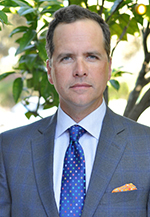
([email protected])